


Perplexity accompanies the US election, ChatGPT and Co. refused a statement
Perplexity provided the latest information on the US election. This is likely to further fuel the dispute with publishers.
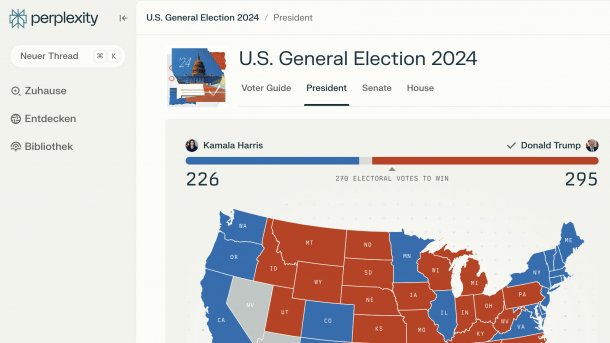
The Election Hub from Perplexity.
(Image: Screenshot Perplexity)
ChatGPT Search, Gemini, Google's AI search and co. only allowed one answer to questions about the US election, at least shortly beforehand: "I can't answer this question at the moment." Only when the result was known did most AI chatbots answer, for example, who won the election. It was a different story with Perplexity. The AI search accompanied the entire election, including the counting, and offered an Election Hub. It also made use of information from other publishers. Once again, this is unlikely to please them.
Videos by heise
Perplexity has prepared an overview of all relevant information, figures and assessments for the US election. Election districts, counting results and winners were displayed on maps. There were also links to the sources and to pages providing historical context or other additional information, for example. While Elon Musk's Grok also provided answers about the election, which according to TechCrunch were very often wrong, Perplexity provided an accurate all-round view of the election –. A large part of the content was not based on generative AI, but simply overviews and information.
Lawsuits by publishers against Perplexity
For voters and observers, however, this means that they no longer have to consume the usual media – although much of the information comes precisely from these. Perplexity brings all of this together seamlessly and offers an overview directly in the app. Some of the information also comes from partnerships for which Perplexity pays money. Specific data for the count apparently came from Democracy Works, an organization that compiles precisely these figures. Google also uses them for its own overview. Perplexity also has contracts with the Associated Press and other media companies, for example. However, not all of the information that could be found in the service came from these partners.
The content producers, i.e. usually the publishers, may have missed out on clicks to their pages because the content was already being consumed elsewhere. With the clicks, there is no opportunity to earn money with advertising. Several publishers are therefore already suing Perplexity –, including the New York Times, the Wall Street Journal and others.
In addition to the dispute over the payment and use of content, there is of course also the risk of hallucinations. Incorrect information before or during the vote count has been too high a risk for most AI providers, which is why they have prevented their AI models from responding. Not so Perplexity.


(emw)


