


Microsoft adds new functions to x86 emulator
In future, more apps can be emulated on notebooks with Windows on ARM. Microsoft is building in AVX, for example; a PC specification is coming from ARM.
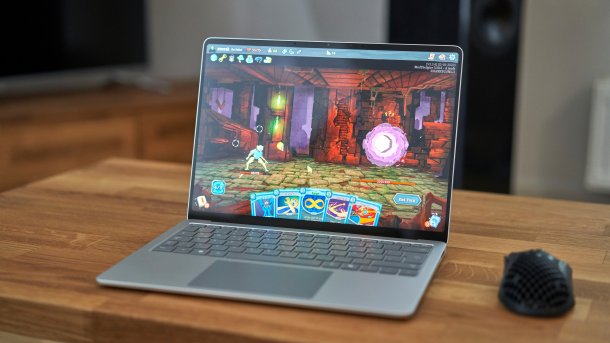
(Image: heise online / mma)
Microsoft's x86 emulator Prism learns new instruction set extensions: In the Canary insider channel, it can now translate the Advanced Vector Extensions AVX and AVX2, among others. Microsoft mentions three more, although this is not intended to be a complete list:
- Bit Manipulation Instruction Sets (BMI) for rudimentary operations
- Fused Multiply-Add (FMA), for example for matrices
- F16C for converting floating point numbers with different bit values
- RDRAND and RDSEED communicate with the random number generator in processors, which some games also use for random numbers
With the additional extensions, more games and creative apps should work. In many cases, Windows on ARM relies on the emulation of x86 software because there are no native ARM versions. The Prism emulator is a stopgap to improve the offering – with possibly worse efficiency than native apps.
Some of the instruction set extensions now supported are over a decade old. AVX for calculations with 256-bit vectors, for example, debuted with Intel's Core i-2000 aka Sandy Bridge in 2011. AMD has supported the format since the Bulldozer generation, i.e. the FX-8000, FX-6000 and FX-4000. Previously, Prism only supported some newer AVX-512 variants, which are rarely found in games.
Not all Canary updates make it into the final Windows versions. In the case of the Prism improvements, however, this seems likely: Microsoft is already using a variation of the Prism update in Windows 11 24H2 for Adobe Premiere Pro 25. The Insider Channel is likely to be used primarily for compatibility testing.
ARM adopts first final PC specification
Meanwhile, PC development is also continuing at ARM. The company of the same name behind the CPU instruction set has published a new specification for client computers with ARM processors, including for Windows-on-ARM notebooks and upcoming desktop PCs.
Videos by heise
The"Personal Computing Base System Architecture 1.0" (PC-BSA) describes a series of standard functions that ARM systems should be able to handle for this purpose. This involves ARM systems-on-chip (SoCs) whose CPU cores (processing elements, PEs) are compatible with the ARMv8 or ARMv9 architecture generations. The PC-BSA defines minimum requirements for interrupt controllers and memory management units, for example, so that various operating systems can run on such systems in a standardized manner.
The PC-BSA is based on existing ARM specifications such as ARM Base System Architecture (BSA) and the ARM Base Boot Requirements (BBR), which standardize the system boot with a UEFI BIOS and ACPI configuration tables and optionally also with a devicetree.
Empfohlener redaktioneller Inhalt
Mit Ihrer Zustimmung wird hier ein externer Preisvergleich (heise Preisvergleich) geladen.
Ich bin damit einverstanden, dass mir externe Inhalte angezeigt werden. Damit können personenbezogene Daten an Drittplattformen (heise Preisvergleich) übermittelt werden. Mehr dazu in unserer Datenschutzerklärung.


(mki)


