


Biodegradable foam to remove microplastics from the oceans
Chinese researchers have developed a new method of extracting plastic particles from liquids. The success rate in the experiment was astonishingly high.
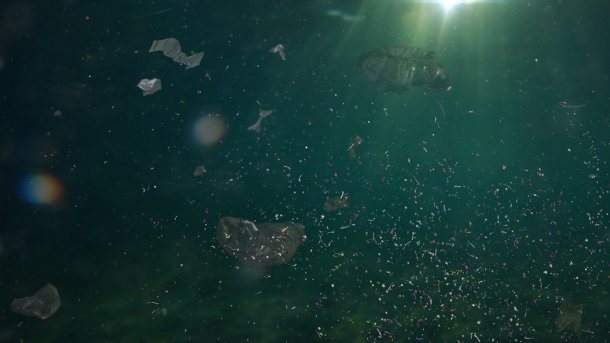
Microplastics in the sea: a major problem.
(Image: Shutterstock / Dotted Yeti)
It is common knowledge that we have a major problem with plastic waste in our oceans, rivers and drinking water, which is increasingly being broken down and then reabsorbed by humans, plants and animals in the form of microplastics or nanoplastics. But how can the material be removed from liquids so that it can be disposed of? Numerous attempts have been made over the years. A new method from China, developed at the universities of Wuhan and Huazhong, now promises a particularly high cleaning effect.
Porous network attracts plastic
The study, published last week in Science Advanced, relies on a fibrous framework of biomass that can be spread in the form of a foam. The absorption performance in four different types of water was 98 to 99.9 percent for polystyrene, polypropylene, acrylic glass and PET. The absorption material consists of cotton cellulose and the chitin of squid bones. The highly porous yet interconnected structure with a positive charge draws the plastics out of the water. The efficiency increased further with several absorption cycles.
Videos by heise
The material called Ct-Cel now needs to be developed further. It is also still unclear what happens to the foam after the plastic has been absorbed. "A recycling process could prevent microplastics from re-entering the environment during the natural degradation of the biomass foam. Although other contaminants could also be collected at the same time, the relatively simple cleaning in a solution system increases the possibility of reusing the microplastic," the researchers write. It is of great importance that the process also works with complex water surfaces. Tests were carried out with agricultural water, seawater, coastal water and still water. "Our design principles would facilitate the future development of practical and sustainable strategies based on biomass foams to combat microplastic pollution," conclude the researchers from Wuhan and Huazhong.
A cooking method – and the question of the plastic bottle
Another idea for solving the microplastic problem – but here in tap water – also comes from researchers in China, where there are still major problems with drinking water quality: They have developed a process in which a special boiling process facilitates the filtering of particles. The group of scientists from Guangzhou Medical University and Jinan University have found evidence that this works for 80 to 90 percent of hard water. This makes it possible to decontaminate the so-called NMPs (nano- and microplastic fragments). The lime contained in the water binds the particles. However, it is unlikely that oceans can be freed from microplastics in this way, as no one can boil the seas. Instead, the plastic breaks down mechanically and through the sun, penetrates into deeper layers and is absorbed by the plant and animal world.
Another problem is the water in plastic bottles, which is still widely used: Micro- and nanoplastics can be released from these – as well as reverse osmosis filters –, as researchers from Rutgers University announced in January. As it turned out, the bottles – bought in the USA in a normal supermarket – contain significantly more particles than previously assumed. It is still completely unclear what these particles can do to the body. In particular, nanoplastic particles are also likely to enter the cells. "We don't know if and how dangerous it is," said the co-author of the study, Phoebe Stapleton, a toxicologist at Rutgers University. The water industry sees no danger: "Currently, there are neither standardized [measurement] methods nor a scientific consensus on the potential health effects of nano- and microplastic particles," according to the International Bottled Water Association. Media reports about these particles in drinking water therefore "unnecessarily" unsettle consumers.


(emw)


