


Project Omicron: drones and robots to repair Europe's roads faster
European roads are often in a poor condition. A modular robot platform is intended to speed up repair work with the help of drones.
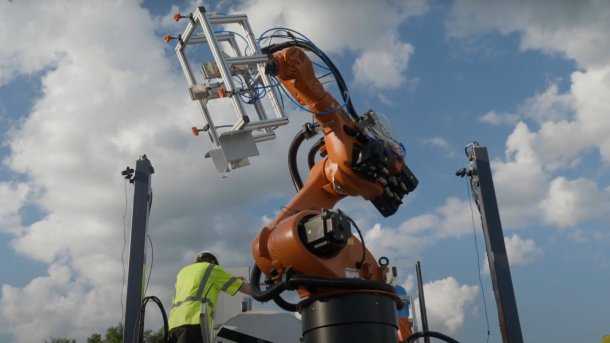
The modular robot platform can be equipped with various attachments for road maintenance.
(Image: European Science Communication Institute)
The road network in Europe is not in the best condition. Permanent roadworks are the result in many places in order to repair roads. However, this takes a long time, obstructs traffic and poses risks to road workers. Drones and robots should make road repairs faster, safer and more cost-efficient. In the EU-funded Omicron project, researchers at the European Science Communication Institute (ESCI) have developed initial approaches for a modular robot platform that can already take on various road maintenance tasks.
Specifically, it is a one-armed robot that is mounted on a road construction vehicle. It is designed in such a way that it can perform various tasks, including setting up and collecting roadworks barriers, barrier beacons and marking cones. The platform is also able to use other attachments to repair small cracks in the roads and remove redundant road markings with a laser. Road construction workers will be able to operate the robot from a safe distance from a control center. Augmented and virtual reality applications are combined in the process.
But the Omicron project is not just about roads. They are also looking at other infrastructure such as bridges and tunnels. They can be inspected for damage by autonomous drones. This already works and only takes a few minutes, as a test on a bridge in Italy has shown. Previously, human inspectors had to spend several hours or even days to detect cracks or corrosion in the road infrastructure, for example. Inspection work with autonomous drones makes this quicker, meaning that bridges and tunnels can be closed for shorter periods of time. It is also no longer necessary to send people to lofty heights to inspect bridges, for example. This increases safety.
Videos by heise
Monitoring the condition of roads
The researchers have also developed a system that enables continuous monitoring of road conditions. To accomplish this, they have attached 3D cameras and other sensors to a vehicle that drives along the roads, taking images of the road surface and combining them with depth scans. This data is then used to determine the condition of the road. Any necessary repair work can then be prioritized and forwarded to the road construction department accordingly.
Empfohlener redaktioneller Inhalt
Mit Ihrer Zustimmung wird hier ein externes YouTube-Video (Google Ireland Limited) geladen.
Ich bin damit einverstanden, dass mir externe Inhalte angezeigt werden. Damit können personenbezogene Daten an Drittplattformen (Google Ireland Limited) übermittelt werden. Mehr dazu in unserer Datenschutzerklärung.
Only a few tests of the technology have been carried out so far. The scientists are now working on expanding these tests and bringing the technology into regular use.



(olb)

