


SmartHome at CES 2025: tricky cameras, more Matter, playful light
Shelly, TP-Link, Aqara, Govee, Reolink and SwitchBot showcased new smart gadgets in Las Vegas, while Nanoleaf also presented a “dumb” one.
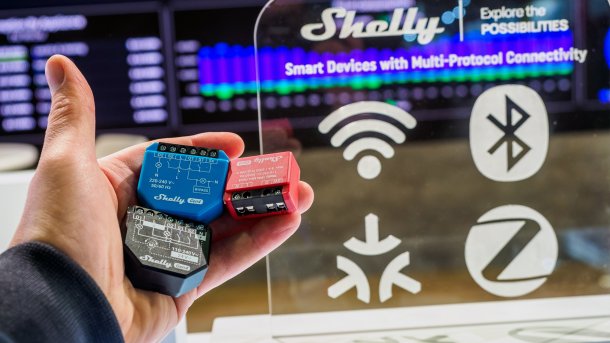
Shelly presented new relays at CES 2025, each of which can handle the four protocols ZigBee, WiFi, Bluetooth and Matter.
(Image: Berti Kolbow-Lehradt)
There is no shortage of flashing lights, lilting music and inviting buttons and levers in the casinos of Las Vegas. Just like in the smart home: networked components with all kinds of dazzling talents took up a lot of space at the CES 2025 technology trade fair in the US entertainment capital. New cameras from Reolink film for longer in continuous operation, models from TP-Link become more alert thanks to radar and tracking and video doorbells from Aqara and SwitchBot give the doorbell eyes.
Govee's new lights have a soft spot for music and gaming. Nanoleaf has a glowing special effect for the face in store and will be charging a subscription for certain light tricks in the future. Shelly poured out a cornucopia of components with the Matter protocol. A certificate turbo announced at CES 2025 by the responsible testing authority CSA gives hope that other manufacturers and their products will learn this smart home world language more quickly in the future.
Shelly starts with ZigBee for the first time and really gets going with Matter
At IFA 2024, Shelly presented the first adapter plug that understands the Matter communication protocol. At CES, the manufacturer followed this up with several Matter-capable series of relays, switches, sensors, and sockets. The manufacturer is also equipping devices with a ZigBee chip for the first time. The fourth generation of relay models 1, 1PM and 2PM and their smaller variants with the suffix “Mini” now use this protocol. Wi-Fi, Bluetooth and Matter-over-WiFi are also on board, so there are many connection paths to choose from.

The flush-mounted switches 1L and 2L, the fourth-generation water leakage sensor and the first IP44-protected outdoor plug, which is based on the third generation of the indoor plug, offer a choice between WiFi and Matter-over-WiFi. The devices are already in production and should be on the shelves by March.
CSA tests Matter devices faster, won't see Matter cameras in spring
Many smart home brands are slow to convert their product ranges to Matter because it takes a long time and is expensive to certify devices for the standard. The responsible organization, the Connectivity Standards Alliance (CSA), announced at CES that it would simplify the process.
Unlike before, manufacturers do not have to reapply for a certificate for a fee if they merely correct errors with updated firmware, CSA Head of Technology Chris LaPré explained to heise online. In addition, the CSA will in future inspect model series as a “portfolio” test in one go, instead of inspecting each device variant separately for an additional charge. LaPré cited adapter plugs with contacts for different national networks as an example. In addition, a new test procedure takes the opportunity to check whether the Matter-enabled devices are compatible enough to earn the “Works with…” seal from Apple and soon also those from Google and Samsung.
Videos by heise
This should help existing customers receive updates for Matter devices more quickly, and prospective buyers can expect Matter versions of smart home components sooner.
Matter is generally not yet available for the important device category of security cameras. They will probably not be included when the CSA updates the standard with Matter 1.5 in early summer. Chris LaPré assessed this as “not likely”. “Hard work” is going into this topic. However, the manufacturers have not yet been able to agree on common specifications.
Cameras from TP-Link with radar, tracking, and baby alarm
Even without the Matter logo, new cameras took up a lot of space at CES 2025. TP-Link presented models with varying special talents. The 4K model Tapo C668B detects objects with radar. This is designed to prevent false alarms and set exclusion zones more accurately than a PIR sensor. Radar is unusual for a battery-powered model. The set includes a solar panel to eliminate the need for frequent charging breaks.
The Tapo C545D outdoor camera has two 2K lenses. One always looks in the same direction, the other can be swiveled and tilted. The latter automatically tracks movements under motor control. Even if the tracking camera is distracted, the static camera does not lose sight of the main subject.

(Image: Berti Kolbow-Lehradt)
The Tapo C840 camera is specially designed for babies. Its AI-supported software is designed to recognize whether the baby has rolled its face onto the bedsheet or whether its face is covered by fabric, thus preventing it from breathing.
Another innovation without a camera: TP-Link announced an access panel for the Smart Lock Tapo DL110, which is available in the USA, that reacts to vein patterns in the palm. This approach is said to be more hygienic and forgery-proof than a fingerprint. You hold your hand ten to 20 centimeters in front of the infrared sensor to lock or unlock the door. We succeeded at the trade fair stand. But the speed was slow. It was also difficult to maintain the correct distance. There is no launch date or price tag for any of the devices mentioned.

(Image: Berti Kolbow-Lehradt)

