


Meta's head of AI: Yann LeCun does not believe in the future of generative AI
Yann LeCun makes bold statements. The head of AI at Meta does not like the Silicon Valley mindset and does not believe in generative AI.
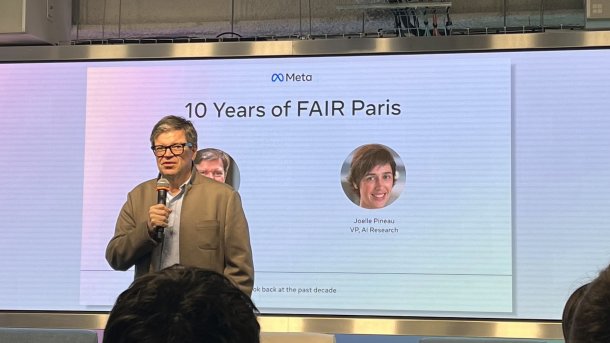
Yann LeCun in Paris
(Image: emw)
Yann LeCun doesn't like the term AGI, Artificial General Intelligence, at all. Anyone who claims that we will soon reach AGI is not directly lying, but is wrong or has a very personal understanding of what is considered AGI, says Meta's AI boss at the FAIR team's anniversary celebration. This understanding is more than just a dig at competitor OpenAI, which recently defined AGI as a threshold to be reached that is dependent on profit – not intelligence.
FAIR stands for Fundamental AI Research, Meta's AI department has been based in Paris for ten years. LeCun speaks to invited guests there. Shortly before that, the AI expert, who has taught at numerous well-known faculties around the world and is a Turing Award winner, spoke at the World Economic Forum in Davos. Last week, he also received the Queen Elizabeth Prize for his achievements in the field of machine learning. At the AI Summit in Paris, LeCun said that "governments should support open source AI". Meta offers most of its AI models as open source, with the exception of Llama's weights, for example.
AMI instead of arrogance and AGI
Someone from Meta is warning against the Silicon Valley mindset. "A common disease in some Silicon Valley circles: an inappropriate superiority complex." This includes the assumption that you have a monopoly on good ideas. If someone else has a good idea, the "symptom in the final stage" is the assumption that this idea was obtained by fraud.
Videos by heise
At LeCun, the ultimate goal is not AGI, but AMI – Advancements in human-robotic intelligence. It is a long-term project and there are many small steps to be taken to achieve it. The first step is to find out what architecture is actually needed to develop an AI that is intelligent. At LeCun, this means zero-shot learning, for example. AI models manage to complete a task at the first attempt and without having been trained to do so beforehand. The AI expert considers this to be a kind of human intelligence. Cats also have a similar intelligence. However, this requires knowledge of the physical world.
World knowledge as the basis for intelligence
Generative AI is based on predictions. This means you can't build up world knowledge, says LeCun. He has long considered scaling to be the wrong approach and explains as an example: "You can't predict what a room looks like, you can't know what's in a room." You might be able to recognize the position of the windows based on the light, but you can't predict how a second half of a room will look. He also believes that Sora and image generators are the wrong way to depict the world. In Paris, LeCun says very specifically: "The future of AI will not be generative AI."
People learn visually, not through language. Thoughts are there before language is, they are converted into language, but those who don't have language still have thoughts. For LeCun, this means that we need "natural data" – but this is only available in a disorganized form. So we need a new architecture. If anyone believes that the current models can already solve tasks, they are being deceived. "Models are trained for the tasks."

A 17-year-old can drive a car after just a few hours. "And we still don't have any level 5 cars," LeCun sums up. These are cars without drivers, only with passengers. Waymo, for example, is level 4 – The routes are limited, and there are also cameras whose images are shown to people in case of doubt, who then intervene from a distance. And LeCun repeatedly emphasizes that it is not even possible to develop a robot that is as smart as a cat.
However, his AI team in Paris is working on this. Initially in the form of a dog. Spot runs around the office as a household robot. LeCun also believes in smart glasses and that AI will make our lives easier. Currently generative AI, but something completely different in the future.
Transparency notice: The author was invited by Meta to the Meta FAIR anniversary celebration in Paris. Meta covered the travel costs. There were no specifications regarding the nature and scope of our reporting.


(emw)

