


The Gulf Stream will probably not collapse
There are studies that predict the end of the Gulf Stream. A recent study from England comes to a less dramatic conclusion.
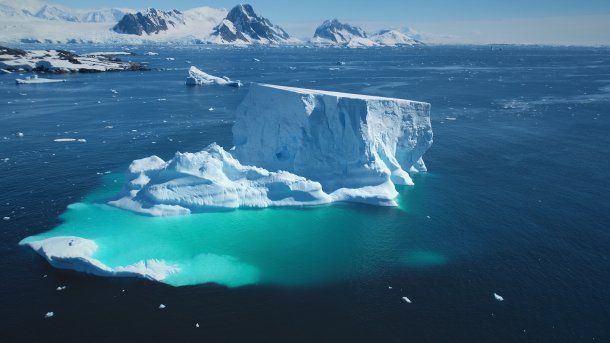
Icebergs in the sea: strong weakening or collapse?
(Image: Mozgova/Shutterstock)
The Gulf Stream is weakening, but it is not collapsing. Climate change is putting pressure on the North Atlantic Current. However, fears that it will dry up completely may be unjustified. A new study by the University of Exeter has come to the conclusion that the current system is more stable than some researchers assume.
The Gulf Stream is part of the Atlantic Meridional Overturning Circulation (AMOC), which brings warm surface water from the Gulf of Mexico into the North Atlantic and thus ensures the mild climate in Western and Central Europe. Some studies suggest that the AMOC could dry up. The end of this so-called thermohaline circulation, which is additionally driven by winds, would have an immense impact on various regions, especially Europe.
The researchers simulated extreme conditions
For the new study, which has been published in the journal Nature, Jonathan Baker's team simulated the development of the AMOC up to the year 2100 under extreme conditions. These included a quadrupling of the carbon dioxide content in the atmosphere and a massive influx of meltwater. The team used 34 CMIP6 climate simulation models, which can be used to simulate interactions between the atmosphere, cryosphere and oceans.
The AMOC proved to be quite stable. Although it weakened significantly in all simulations, it did not collapse completely. The reason for this is therefore the wind-driven rise of deep water from the North Atlantic in the Southern Ocean. The team observed this process in all simulation runs.
The reason for this could be mass conservation: If water rises in one place, it must sink elsewhere. The authors therefore conclude that the AMOC will not collapse completely by the end of the century, even under extreme conditions.
How does the AMOC work?
The AMOC is part of the global oceanic circulation, in which energy is exchanged between the world's oceans through currents. Warm water moves from the Gulf of Mexico along the east coast of North America to the North Atlantic. Along the way, it cools down and the relative salt content increases due to evaporation. The colder and salt-rich seawater sinks at various points around Greenland and flows back southwards at depth.

Global warming is disrupting this mechanism. The melting of the Greenland ice sheet and increased precipitation are reducing the salt content in the North Atlantic and thus the density of the water. This could inhibit the sinking and thus weaken the AMOC.
Videos by heise
"It is interesting and new to see how the models react to extreme parameters, such as a very high atmospheric CO₂ content and strong freshwater input," said Jens Terhaar from the Arctic Ocean Biogeochemistry and Ecosystem Modeling research group at the University of Bern, who was not involved in the study. The study shows that the AMOC will not disappear completely, but could weaken considerably. "Whether it ends up being a collapse or a very strong weakening makes little difference to the effects of this change in the end. Both would have extreme consequences and everything should be done to avoid this."


(wpl)

