


High operating costs: Floating LNG terminals are little used
The floating LNG terminal in Le Havre is intended to secure the energy supply in France. However, it is rarely used due to high operating costs.
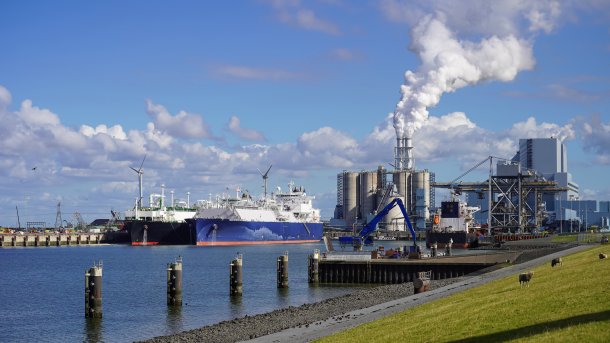
Floating LNG terminal
(Image: Sander van der Werf/Shutterstock)
The LNG terminal in Le Havre, which is intended to secure the energy supply for France and the European Union, is used very little. The situation is similar at German LNG terminals.
Last year, only around 2 percent of French liquefied natural gas (LNG) imports were handled via the floating terminal in the port on the English Channel, reports the US business news agency Bloomberg. This can be reconstructed based on ship data and data from the port.
According to the data, French LNG imports fell by 14 percent last year. The last delivery arrived in Le Havre in June 2024. It was only in the first two months of this year that more imports were recorded again, as demand in Europe increased.
Operating the floating terminals is expensive
The terminal was therefore unable to benefit from the high fuel costs this winter. According to Bloomberg, the reason for the low capacity utilization is the very high operating expenses for the terminal. Operating them is particularly expensive in winter.
The terminal in Le Havre was put into operation in 2023. It consists of a floating LNG storage facility and a plant in which the liquefied gas, which has been cooled to minus 162 degrees Celsius, is converted back into a gaseous state.

Up to 5 billion cubic meters of gas can be imported via this facility, which corresponds to around 10 percent of French consumption. The plant was also intended to supply neighboring countries, but obviously the capacities are not needed to the same extent.
The situation in Germany is therefore similar: here, too, less gas arrives at the floating LNG terminals than at onshore terminals in neighboring countries.
Videos by heise
The operator of the terminal in Le Havre is already looking for alternative uses. The same applies in Germany: one of the LNG terminals on the Baltic Sea is to be leased to Egypt. According to Bloomberg, negotiations are already underway.


(wpl)

