


Qudits instead of qubits: Novel quantum computer simulates elementary particles
With five states instead of two, qubits could improve the performance of quantum computers. Initial simulations provide insights into particle physics.
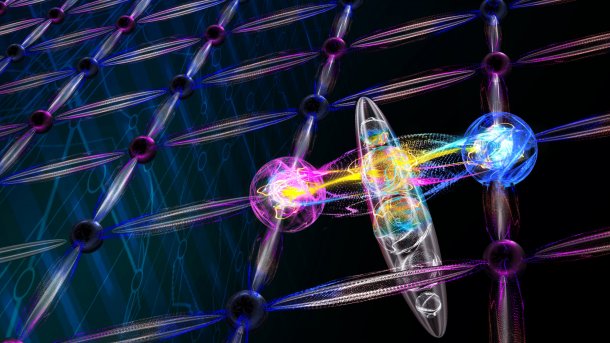
(Image: Harald Ritsch)
Quantum computers are often based on the idea of classical bits and extend it: quantum bits can not only assume the states 0 and 1, but also any superposition of these values. A research team led by Martin Ringbauer from the University of Innsbruck and Christine Muschik from the University of Waterloo, Canada, has now demonstrated that there is another way. Together, they have developed an alternative form of quantum computer based on so-called quudits and used it to simulate a problem from elementary particle physics. They have published their results in the journal Nature Physics.
From qubits to quudits
Qudits are quantum systems that can assume more than just two different states. In fact, this is true for most quantum systems, and selecting two sufficiently isolated states to encode the qubit states 0 and 1 requires considerable effort. Qudits use these additional states to store more information with fewer components, allowing more complex problems to be solved with more compact devices. At the same time, however, quudits are less mature than qubits and are more challenging to work with.
The research team from Innsbruck and Waterloo uses trapped ions – in their experiments, the same technique that is used to build qubit-based quantum computers. Instead of qubits, the Austrian-Canadian team works with quutrits and quints, i.e. systems with three and five states respectively.
Videos by heise
Complex particle physics
The additional states enable a more efficient simulation of complex fields that occur in particle physics. Research into elementary particles and their interactions is crucial to deciphering the fundamental mechanisms of the universe. The standard model of particle physics describes these particles and forces by representing them as excitations of fields. Probably the most relevant quantum field theory for everyday life is quantum electrodynamics, which describes the phenomena of electromagnetism: from electricity and light to the forces that hold matter together.
Empfohlener redaktioneller Inhalt
Mit Ihrer Zustimmung wird hier ein externes YouTube-Video (Google Ireland Limited) geladen.
Ich bin damit einverstanden, dass mir externe Inhalte angezeigt werden. Damit können personenbezogene Daten an Drittplattformen (Google Ireland Limited) übermittelt werden. Mehr dazu in unserer Datenschutzerklärung.
In order to research the field theory, scientists use experiments on particle accelerators and, above all, complex computer simulations. However, these often exceed the capacities of classic supercomputers. This is mainly due to the fact that the fields under consideration can assume different strengths and directions in multidimensional space. Quantum computers could provide a decisive advantage here. "Our approach enables a natural representation of fields as they occur in nature," says Michael Meth, first author of the study. "This simplifies the problem considerably."

(Image: Universität Innsbruck)
2016 scientists from Innsbruck showed the formation of particle-antiparticle pairs. "At that time, we were working in a one-dimensional space where the fields did not have to be explicitly simulated," explains Christine Muschik, head of the study from Waterloo. Now the team is presenting the first simulation in two spatial dimensions. "In addition to pair formation, we also see a magnetic field building up, and there is no such thing in one dimension."
A window into particle physics
The work should open up new possibilities for investigating other phenomena involving the smallest particles. These include, for example, the strong interaction that occurs within the atomic nucleus. It causes quarks to combine to form heavy particles such as protons and neutrons. "Quantum computers give us a new window into the world of elementary particles," says Martin Ringbauer, head of the study from Innsbruck. "With the Qudit approach, these systems are tailor-made to investigate fascinating open questions in particle physics."


(spa)


