


Genetics: Colossal Biosciences claims to have revived the direwolf
The US company Colossal Biosciences claims to have revived the direwolf, which died out thousands of years ago. Scientists consider this to be misleading.
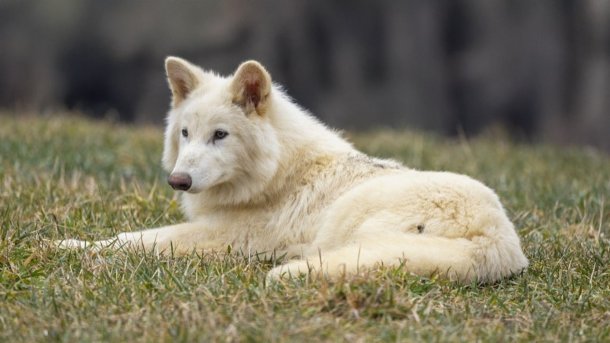
Direwolf or gray wolf with direwolf traits?
(Image: Colossal Biosciences)
The direwolf: In the fantasy world of Westeros, where the well-known series Game of Thrones is set, it is the heraldic animal of House Winterfell, one of the great noble houses. In the real world, however, the animal has been extinct for around 13,000 years. Or it was – until now. The US company Colossal Biosciences claims to have revived the animal.
The company from Austin in the US state of Texas calls itself “the world's only de-extinction company”. It aims to bring back extinct animals.
Empfohlener redaktioneller Inhalt
Mit Ihrer Zustimmung wird hier ein externes YouTube-Video (Google Ireland Limited) geladen.
Ich bin damit einverstanden, dass mir externe Inhalte angezeigt werden. Damit können personenbezogene Daten an Drittplattformen (Google Ireland Limited) übermittelt werden. Mehr dazu in unserer Datenschutzerklärung.
The company has created three direwolves: two males named Romulus and Remus, who were born at the beginning of October 2024, and the female Khaleesi, who was born at the end of January 2025. According to Colossal Biosciences, the three “healthy direwolf pups” live in a fenced-off area of over 800 hectares, where they are looked after by a team of ten caretakers. The site is located in the north of the USA. The company is keeping the exact location secret.
Comparison of genomes
To resurrect the animals, the company says it has extracted genetic material from dire wolf bones, a 13,000-year-old tooth and a 72,000-year-old skull. The genome residues were sequenced and then compared with the genome of canids living today, including wolves, jackals, foxes and red dogs. In this way, the researchers identified the genetic variants that are specific to the dire wolf.
Empfohlener redaktioneller Inhalt
Mit Ihrer Zustimmung wird hier ein externes YouTube-Video (Google Ireland Limited) geladen.
Ich bin damit einverstanden, dass mir externe Inhalte angezeigt werden. Damit können personenbezogene Daten an Drittplattformen (Google Ireland Limited) übermittelt werden. Mehr dazu in unserer Datenschutzerklärung.
They then matched the genetic material of the – according to Colossal Biosciences – “closest living relative”, the gray wolf. There is no direct relationship between the dire wolf, Aenocyon dirus, and the modern wolf, Canis lupus. The former is not the ancestor of the latter. The Aenocyon and Canis species diverged around 5.7 million years ago.
In 20 places, 14 genes were modified to produce a dire wolf. To put this into context: the wolf genome comprises around 19,000 genes. The modified cell nuclei were then inserted into enucleated egg cells, from which a total of 45 embryos developed. These were to be carried to term by females, which was successful in at least three cases.
Dire wolf or gray wolf with direwolf traits?
Colossal Biosciences celebrates this as the return of an animal that has been extinct for thousands of years. Scientists are putting the brakes on the euphoria: Romulus, Remus and Khaleesi are not direwolves, but “gray wolves with direwolf-like characteristics”, says paleogeneticist Nic Rawlence from the University of Otago in Dunedin on the South Island of New Zealand, i.e., hybrids with characteristics that Colossal Biosciences “consider to be the important direwolf-like characteristics”.
His colleague, zoologist Philip Seddon, agrees: “They call it the world's first revival. While this undoubtedly required some amazing technical breakthroughs, the cute pups Romulus, Remus and Khaleesi are not direwolves – they are genetically modified gray wolves.”

Both Otago researchers, who were not involved in the project, point out that the direwolf and gray wolf lineages split a long time ago. They are different genera that differ from each other by more than 20 changes in 14 genes. According to Seddon, even the African jackal could be more closely related to the dire wolf than the gray wolf.
Videos by heise
Colossal Biosciences wants to revive the mammoth
However, the direwolves are not Colossal Biosciences' only revival project. It wants to bring back the dodo and the woolly mammoth, the mighty, shaggy relative of the elephant. The company recently presented mice with particularly dense fur, which is said to have been caused by implanted mammoth genes. Colossal Biosciences was founded by entrepreneur Ben Lamm and geneticist George Church, who initiated the Personal Genome Project in 2006.
Rawlence considers resuscitation to be difficult: “To really resurrect something, you have to clone it,” he says. “The problem is that we can't clone extinct animals because the DNA is not preserved well enough. Even if you sequence the genome, you can't extract the DNA from extinct animals in long enough strands like you can from a living animal.”
In this respect, the other great houses in Westeros can rest easy: The direwolf is unlikely to return at this time.


(wpl)

