


EUGH confirms: Mobile phone contracts for a maximum of 24 months
Vodafone Germany may never bind consumers for longer than 2 years. This also applies to existing customers, says the ECJ.
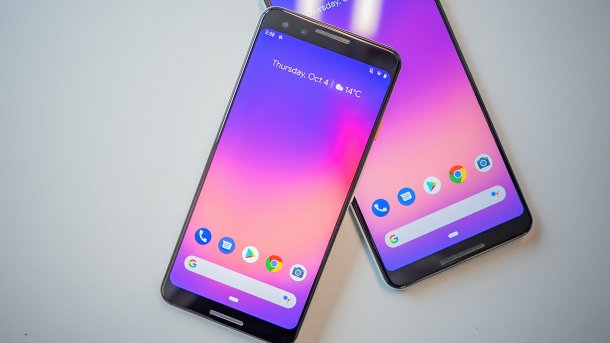
Google launched the Pixel 3 and Pixel 3 XL Android phones on the market in 2018.
The maximum term of mobile phone contracts with consumers is 24 months, even if it is an early contract renewal. This decision by the European Court of Justice (ECJ) is a defeat for Vodafone Germany and a victory for consumer protection organizations. The legal dispute, which has been pending for years, has already gone all the way to the Federal Court of Justice and back to the Düsseldorf Regional Court.
The reason for the proceedings are Vodafone's attempts to bind German consumers for longer than 24 months. In one case, an existing customer wanted a new, subsidized cell phone before the original 24 months expired and agreed to a “new contract” at a higher cost in 2018. The consumer also signed a clause stating that a new minimum contract term of 24 months would begin “on the first day after the minimum contract term of the initial contract expires”. However, calculated from the time of signing, this meant more than 24 months.
In a second, similar case from 2018, a German consumer signed a document entitled 'contract extension' two months before the 24 months of the original contract expired, which stipulated a contract term of 26 months. Again, he accepted higher running costs and received a new cell phone in return. This practice earned Vodafone a lawsuit from the consumer advice center in Berlin. Incidentally, 2018 was the year in which Google launched the Pixel 3 and Pixel 3 XL.
“Initial minimum contract term”
The version of the Universal Service Directive in force at the time stipulated an “initial minimum contract term” of a maximum of 24 months. The Bundestag incorporated this into the German Telecommunications Act. Vodafone argued that consensual contract renewals with existing customers were not covered by the term “initial”; the provision only referred to the very first contract, i.e., the “initial” contract concluded with a consumer, not to subsequent contracts. Perhaps Vodafone had entrusted an Italian lawyer with drafting the contracts.
Videos by heise
Although Vodafone's argument was heard by the Düsseldorf Regional Court (LG), the court ruled against the network operator for other reasons. Both sides appealed, and the Higher Regional Court rejected Vodafone's interpretation. The Federal Court of Justice then sent the case back to the court of first instance to ascertain missing factual details. Finally, the case came before the Higher Regional Court (OLG) for the second time, which saw two possible interpretations of the phrase “initial minimum contract term”: either it referred only to initial contracts between customers and providers, or also to any further minimum contract term.
The OLG submitted a request for a preliminary ruling to the ECJ, which has now ruled in favor of competition and consumer protection (case no. C-612/23). The court clarified that “the term 'initial minimum contract term' in (the Universal Service Directive) refers both to the term of the initial contract between a consumer and a provider of electronic communications services and to the term of a subsequent contract between the same parties, so that this subsequent contract may not contain a minimum contract term of more than 24 months, even if it was signed and put into effect before the initial contract expired.”
Italian is different
First, the ECJ consulted various language versions of the directive. The judges found that the wording of the provision in the Spanish, German, Greek, English, and French language versions makes it clear “that the adjective 'initial' used in the feminine form is not intended to refer to the 'contracts' or the 'contract', but to the 'minimum term of the contract'.” The limitation to a maximum of 24 months would therefore apply to both the initial contract and any subsequent contracts. However, other language versions, such as the Italian and Portuguese versions, could be interpreted as meaning that only the initial contract is covered. However, the recitals of the directive and its objective clarified that it was intended to make it easier for consumers to switch providers “to enjoy the full benefits” of competition.

Incidentally, the current version of the Universal Service Directive (Directive 2002/22/EC) no longer deals with the issue of contract duration, it has moved to the Electronic Communications Code (Directive (EU) 2018/1972). There is clearer wording there, according to which telecom contracts with consumers “shall not contain a minimum contract duration exceeding 24 months.” Machine-to-machine communication (M2M) is excluded from this.
Even back then, Section 43b of the German Telecommunications Act referred to the “initial minimum term of a contract”, not the minimum term of an initial contract. Today, Section 56 TKG refers to “the initial term of a contract”. The case will now go back to the Düsseldorf Higher Regional Court, which will most likely rule in favor of the consumer advocates from the Berlin Consumer Advice Center and against Vodafone. The cell phones subsidized in 2018 have hopefully long since been recycled.


(ds)

