


U.S. Army tests low-cost reconnaissance drones from the 3D printer
Reconnaissance drones are quickly "lost". That is expensive. US soldiers have developed drones that can be printed by themselves and cost little.
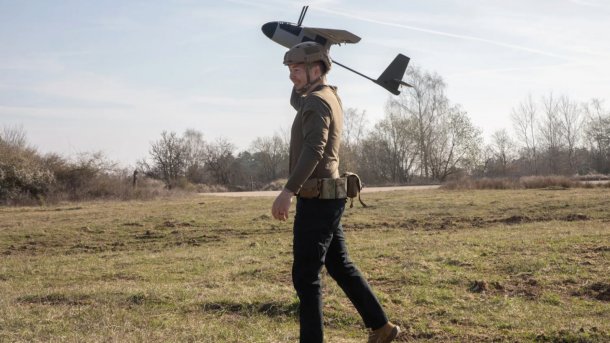
The military reconnaissance drone from the 3D printer is launched by hand.
(Image: U.S. Army / Pfc. Brent Lee)
The U.S. Army plans to use 3D-printed reconnaissance drones to detect enemy electromagnetic signatures for the first time during an exercise in Poland in May. This was reported by Task & Purpose on Monday. The drones should be able to be manufactured by the units in the field themselves if required, and only cost a fraction of drones offered by the military industry.
Reconnaissance drones don't have it easy: if they are detected by the enemy during a mission, they are usually fought and then lost. Such small reconnaissance drones manufactured by defense companies can quickly cost up to 28,000 US dollars. In a conflict, this can add up to a considerable sum.
Soldiers from the 2nd Multi-Domain Effects Battalion stationed in Mainz-Kastel have now found a way to significantly reduce the cost of building a reconnaissance drone that can provide visual images and electromagnetic signatures of the enemy. The drones they have developed can be produced for between 2,000 and 3,000 US dollars, they promise.
Self-study drone construction
The U.S. Army unit had a lot to learn before it got that far. The structural components came from the 3D printer. Accordingly, the soldiers involved had to familiarize themselves with 3D printing to find the right print quality to achieve the necessary stability while keeping the weight of the drone as low as possible.
They also had to gain experience with the necessary control and reconnaissance electronics. Sergeant 1st Class Tyler Baumgartner, head of the drone laboratory, explained to Task & Purpose that this required “many hours of self-study”. If the soldiers got stuck, they got tips from friends and partners.
However, this was not the most difficult part of the project. The approval process to obtain permission and funding from the US Department of Defense was much more complicated. The lengthy process also increased the cost per drone. Out of eight months, around 90 to 120 days were spent “on paperwork” and waiting for approvals. As a result, only seven drones could be built and taken into the air during this time.
In addition, the soldiers had to struggle with the procurement of the necessary components, such as the electronics. These cannot be sourced from certain countries, such as China. The alternatives are correspondingly expensive and increase the price of the reconnaissance drones.
Videos by heise
However, the first tests of the drones were not successful. However, the team has learned from its mistakes and has been able to make constant improvements. The drones are now operational. Up to two drones are to be tested in a realistic scenario during a military exercise in Poland in May. The aim is to determine whether they are actually suitable for long-range reconnaissance.



(olb)

