


Payment by QR code: How a Softbank subsidiary wants to assert itself in Japan
In China, most people pay via AliPay and WeChat Pay – using Japanese QR code technology. There, provider PayPay is racing to catch up.
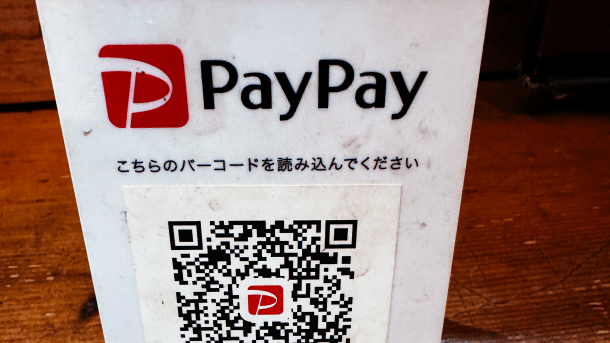
PayPay QR code in a Japanese restaurant.
(Image: Ben Schwan / heise online)
The quick response code, or QR code for short, has a long and exciting history. Masahiro Hara and Takayuki Nagaya invented the two-dimensional matrix barcode, which can be read effortlessly and, above all, quickly and error-free by camera – and can still transmit sufficient data for many applications (on average a good 3 KByte) –, back in 1994. At the time, the two were working for the Japanese automotive supplier Denso, which wanted to use more accurate labels than simple barcodes to speed up component logistics.
Japanese invention conquers Chinese payment system
The rest is history: the system was increasingly optimized, standardized and finally widely used by a diverse audience – at the latest with the advent of smartphones that came with a camera. In Germany today, QR codes are used for various purposes: from transmitting a URL for a restaurant menu to forwarding billing data to a banking app to checking tickets on public transport or at concerts. Private individuals and marketers also use the technology to transfer content more quickly or to attract people to the web. True to the motto: Why enter a web address when you can scan a QR code? Instead of typing in content, you just scan it.
What is virtually unheard of in this country, however, is payment by QR code. While QR-based payment systems such as those from WeChat (Weixin) or AliPay are completely commonplace in China and have replaced credit cards (including their offshoots on mobile devices), payment applications in Germany are sporadic at best, for example for QR payments from PayPal to PayPal accounts. Ironically, the non-implementation of QR payments also applied to the home of QR codes themselves, namely Japan. Regular credit cards were used there for a long time, which later ended up on i-Mode cell phones, which, from today's perspective, are Internet-enabled feature phones that dominated the local market for many years. Later, e-money cards such as Suica, which could also be used on iPhones quite early on. Plus stored credit cards in services such as Apple Pay and Google Pay on smartphones and smartwatches, as we know it from Europe, became established. In other words, the market for payment methods in Nippon is complicated and diverse. It is only with the coronavirus pandemic, including the trend towards contactless payments and Japanese government programmes to digitize more services, that real champions are emerging.
Videos by heise
Softbank enters the scene – with help from South Korea
In the Middle Kingdom and other Asian countries (plus the Global South), on the other hand, QR payment has been consolidated, which is now being felt by Chinese tourists in the West. The logos of AliPay and WeChat Pay can now be seen more frequently in large chain stores. In the People's Republic, almost everything can be processed with QR payment. Whether in the supermarket, luxury department store, cab, butcher or even the beggar on the street: everywhere you go, you can pay with WeChat Pay or AliPay using a QR code. The app is started, a – often simply printed – code is scanned, the payment is confirmed and that's it. Except for a smartphone – such as a card reader – neither the customer nor the retailer need any additional hardware. No wonder the Japanese were envious of what was happening with their basic technology. Softbank Group, probably the country's largest digital company, did not want to wait any longer – and launched a service called PayPay in 2018, which is based on what was available in China. The company was founded under the umbrella of LY Corporation, which combines various well-known internet brands such as Yahoo Japan (no longer connected to the US parent company) and Line, and in which the South Korean internet giant Naver also has a stake.

(Image: Ben Schwan / heise online)
The idea behind PayPay was simple: to try to replicate the QR payment success in China and other Asian countries in the fragmented Japanese payment market. It also aimed to build its own app with a loyalty program around it and to add profitable financial services through its own bank. Almost seven years later, it has to be said that it has succeeded: according to LY, PayPay had 66 million registered users at the end of last year. Considering that Japan currently still has a population of around 123 million people, this is a huge success. This penetration of the population has been achieved firstly through the market power that LY has through its widely used online services in the country. Secondly, by ensnaring many merchants and restaurant operators, especially smaller ones, with low prices and customer discounts, who would never have thought of offering cashless payments before, as cash was (almost) the only king in Nippon for a long time.
Direct debit from the account
PayPay's approach boils down to a debit payment function that is linked to the customer's account. For PayPay and its financial technology division, this offers the key advantage that the company does not have to – pay in advance as it would with a traditional credit card with monthly billing or partial payment. Customers connect their (Japanese) bank account to PayPay and identify themselves beyond doubt using their citizen number. Payment is then made directly via app and QR code.
To keep people on board, there is a loyalty program for collecting points and discount battles, especially in the initial phase of PayPay and on important annual occasions. Here, you can save one to low double-digit percentages when paying with PayPay. Those who want to budget their money carefully and don't want to fall into the credit trap will be pleased that direct debits are made. People with more money and/or control, on the other hand, will be annoyed that they do not get an interest-free loan (if they pay in full each month) as with credit cards. Ultimately, PayPay makes you dependent on the bank to which the account belongs and you have to use the Japanese equivalent of an overdraft facility if you are short of cash. WeChat Pay and AliPay work in the same way: via a standard instant debit from the account or credit balance.

(Image: Ben Schwan / heise online)
As nice and practical as PayPay is with its many acceptance points in Japan, there are some problems with the service if you don't live in Nippon. This is because PayPay only allows registration with a Japanese bank account and citizen number. Due to the debit function, the company does not provide any other way of using –, for example via a deposited credit card –. If you enter the country as a tourist, you are excluded and should stick to other payment options. Be it a physical credit card or in Apple Pay and Google Pay – or Suica and its variants such as Pasmo or Icoca as a physical card or on a smartphone or smartwatch. Suica and the like are also "real" e-money that is debited immediately when spent. However, by topping up by credit card on an iPhone, for example, you also have the advantage of paying later with the credit card statement. If a retailer in Japan has decided to rely solely on PayPay for digital payments (which is relatively rare), cash is the only option.
Compatibility with other QR payments
Nevertheless, PayPay is aware of the problem with tourism, especially as it is looking for markets to expand into. According to the company, the LY subsidiary currently has no plans to implement its offer for people not living in Japan. However, QR payment providers are now trying to become compatible with each other. As many as 19 other cashless services from 11 countries and regions around the world are currently connected to PayPay. These include AliPay from China and the HIVEX network, which is itself trying to create more interoperability. However, the PayPay compatibility list is quite disappointing with a European and North American perspective: Asia is clearly the most strongly supported, be it South Korea, Singapore, Thailand, Taiwan, Mongolia, Malaysia, the Philippines or even China (mainland with Hong Kong and Macau).
"Since the launch of our service in October 2018, we have been working to create an environment that helps merchants capitalize on tourism-driven demand while increasing the convenience of such travelers," the company emphasizes. They are interested in an implementation that is as seamless as possible. "When visitors pay for goods and services using compatible cashless payment services via PayPay QR codes, the amounts can be automatically converted into local currencies after entering the price in yen." This should ensure a stress-free shopping experience. "And retailers also benefit from smooth interaction with tourist guests."

(Image: Ben Schwan / heise online)
The problem: as mentioned, the West is left out. There is not a single provider from the USA or Canada that is compatible with PayPay, – partly because QR payments are hardly known there –. At least Italy is included in the EU: Tinaba from the eponymous neobank Tinaba S.p.A and its parent company Banco Profilo. But even here, Germans are not really wanted. Although Tinaba offers an English information website, it only sells its app in the Italian App Store and apparently expects customers who are also resident in Italy.
This shows once again that the EU single market for financial services is not yet fully established: banks and credit card issuers are still allowed to decide for themselves which customers from which member states they want to serve, instead of EU citizens being allowed to choose the best offer in all countries. PayPay would like to cooperate with other partners, but of course they have to exist first. However, as there is still a large ecosystem of alternative payment methods without QR codes in Japan, this need not bother visitors for now. It would be a different story if PayPay were to gain market power similar to that of AliPay and WeChat Pay in China.


(nie)


