


Customs duties, App Store, AI and more: Apple's five biggest current problems
Tim Cook will have been Apple boss for 15 years in 2026. He has some big tasks ahead of him before the anniversary. An overview.
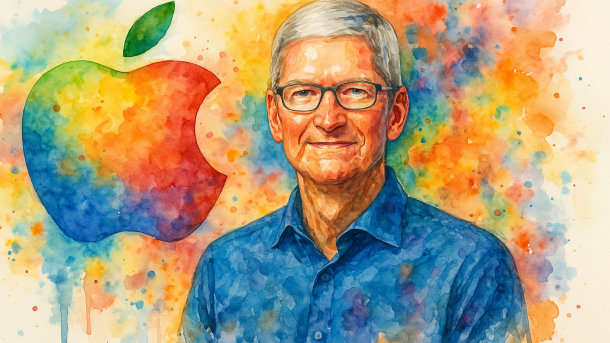
Less picturesque for Tim Cook: Apple is currently on fire in many places.
(Image: Erstellt von Mac & i mit ChatGPT 4o)
This time has passed rather quickly: Timothy Donald Cook, born on November 1, 1960 in Mobile, Alabama in the south of the USA, will have been CEO of Apple for a total of 15 years in August next year. He took over the position in August 2011 when Steve Jobs retired due to his long illness, who died on October 5, 2011. Cook never had an easy job, but managed to achieve enormous growth for Apple and make it the most valuable company on the US markets. Stock market legend Warren Buffett recently said that Cook had made his investment company more money than himself. Nevertheless, complex problems await Cook until his anniversary next year. Apple seems to be facing attacks on its most important business models from all sides – and the changing political landscape, as well as technological progress, are primarily to blame. An overview of the five central problems that the Apple CEO must now tackle.
1. the big app store problem
Apple has been under legal pressure for years in its rapidly growing service business. Whether in the EU, the USA or numerous other countries: Antitrust watchdogs and competition regulators find that Apple has overreached in its regulations for developers. For example, the company has to allow alternative app stores and open up its platforms, sometimes down to the smallest detail. In the USA, it has now been added that sales via web links may no longer be hindered or subject to commissions. This is a feast for corporations such as Epic Games or Spotify, which have long complained about having to pay Apple too much money.
2. the matter of punitive tariffs
For many years, Apple manufactured almost all of its important products in China. The company began to diversify here after the first Trump administration. However, the US punitive tariffs that have been introduced are hitting Apple hard. As soon as either components are subject to them or the planned 145% are reactivated (there is currently a "tariff pause"), Apple could have to start a major round of price increases for its US customers.
Videos by heise
3. delays with good AI
Apple's voice assistant Siri has been criticized and ridiculed for years. A lot should improve here as part of Apple Intelligence. The voice assistant should be able to understand the user context, read the screen and carry out actions in apps. All of this has been postponed until next year – with luck next fall –. However, this still does not clarify how Apple intends to compete with chatbots: Siri will still be worse than chat assistants such as Google Gemini or ChatGPT.
4th Google deal before the end
Apple has been making (a lot of) good money for years with a search deal it struck with Google. The company shares in the revenue from search advertising and receives around 20 billion US dollars a year. The problem is that the contract (and similar ones of its kind) could be banned in a major lawsuit brought by the US Department of Justice. This would not only affect Apple: Firefox parent company Mozilla would also be threatened with bankruptcy.
5 China remains difficult
In connection with the relocation of production and the increasingly aggressive trade war between the USA and China, business in the People's Republic, once Apple's second-largest market after its home country, will continue to deteriorate, observers believe. Sales recently shrank more significantly than Wall Street had estimated.
Conclusion: Tim Cook has a lot to do
As can be seen, Apple is struggling with a whole range of problems. Some of them are home-made (AI, overly aggressive app store regulations), others come from outside (Google lawsuit, China). However, CEO Cook has regularly shown in the past how he manages to deal with difficulties. The iPhone, for example, faces completely new, exciting developments in the coming years – despite the fact that the technology will soon be 20 years on the market.
Empfohlener redaktioneller Inhalt
Mit Ihrer Zustimmung wird hier ein externer Preisvergleich (heise Preisvergleich) geladen.
Ich bin damit einverstanden, dass mir externe Inhalte angezeigt werden. Damit können personenbezogene Daten an Drittplattformen (heise Preisvergleich) übermittelt werden. Mehr dazu in unserer Datenschutzerklärung.


(bsc)


