


Defective Ryzen processors: Asrock tweaks the BIOS again
A BIOS update for Asrock boards limits the current in Precision Boost Overdrive overclocking mode so that Ryzen 9000 CPUs are no longer damaged.
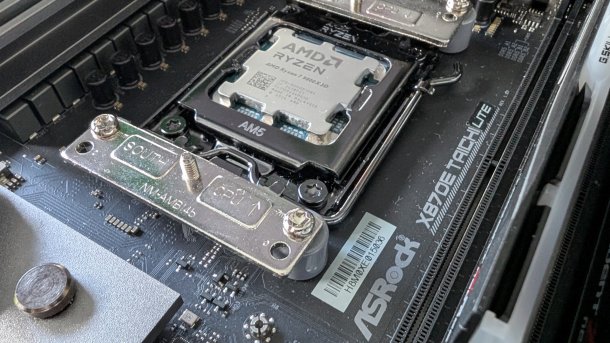
(Image: chh / c't)
The Taiwanese motherboard manufacturer Asrock has released BIOS version 3.25 for AM5 motherboards, which reduces the maximum current in the automatic overclocking mode Precision Boost Overdrive (PBO). This is Asrock's response to numerous cases in which systems with Ryzen 9000 processors no longer boot. In an interview with Youtuber Steve Burke from Gamers Nexus, Vice President of Motherboard & Gaming Monitor Business Unit Chris Lee confirmed that he had identified another cause of the problems in collaboration with AMD.
According to this, the manufacturer has set the current levels for the Thermal Design Current (TDC) and Electrical Design Current (EDC) and the power limit (Processor Power Tracking, PPT) to excessively high values when PBO is activated, which not every processor can cope with. Precision Boost Overdrive is an AMD overclocking function that automatically increases the CPU clock frequencies as far as the voltage converters on the board allow. Users have to activate it manually in the BIOS setup or the Ryzen Master tool under Windows.
Peak current too high
In the c't lab, we were able to reproduce the change with BIOS 3.25 on an Asrock X870E Taichi Lite. With version 3.16, the board sets the current at continuous load (TDC) to 235 amps. This value reflects the performance of the voltage converters on the board and differs depending on the model. Up to 1000 amps (EDC) and 1000 watts (PPT) are possible for short-term load peaks, although these values are not achieved in practice. We also asked Asrock for comment, but have not yet received a response.

(Image: chh / c't)
With firmware 3.25, Asrock reduces the PBO peak values for current (EDC) and power consumption (PPT) to 325 amps and 325 watts. The TDC remains unchanged at 235 amps. For comparison: Without overclocking, the Asrock X870E Taichi Lite adheres to the AMD specifications for the Ryzen 7 9800X3D we used with 162 watts PPT, 120 amps TDC and 180 amps EDC.
Replacement CPU from AMD
The Asrock employee also explained that affected customers with a defective CPU should contact AMD for a replacement. The motherboards themselves are not defective. They will run again with a different processor. Asrock recommends that users install the latest BIOS version 3.25 or higher, which should also be included in all newly produced boards ex works.
However, there are other reasons for the problems with Ryzen 9000 systems no longer booting with Asrock boards. At the end of March, Asrock released a BIOS update that improves compatibility with some memory modules. In addition, some cases could be traced back to user errors, such as bent pins in the CPU socket when installing the processor. However, it remains to be seen whether the problems have now been completely solved, as not every affected user had activated PBO.
Overclocking always carries a residual risk
From our point of view, this case once again confirms our opinion at c't that you should know exactly what you are doing when overclocking. Users should urgently stay away from automatic overclocking functions, even if they come from AMD and the board manufacturers, as is the case with PBO. Every CPU behaves differently, so defects caused by excessive voltages, currents and temperatures can never be ruled out.
Videos by heise
For years, Intel had tolerated excessive power limits and currents in Core i processors from board manufacturers until last year, when numerous Raptor Lake processors no longer ran stably due to other bugs in the voltage control. With the successors to the Core Ultra 200S series, all boards adhere to the Intel specifications ex works, as has been the case with AMD since the first Ryzen generation.
Damaged Ryzen processors due to overclocking are not a new phenomenon. Two years ago, there were burnt-out Ryzen 7000 CPUs due to overclocking RAM. XMP and EXPO modules require a higher DRAM voltage of 1.25 to 1.45 volts for the high speeds, i.e. far more than the specified 1.1 volts of DDR5 RAM. Because the memory controller is located in the processor, the DRAM voltage is also applied to the sensitive conductor tracks of the I/O die, which is manufactured using 6-nanometer technology. Here, too, operation is outside the specification, which is always at your own risk and can damage hardware.


(chh)


