


visionOS 26: Better persona, more spatial content and widgets for the first time
From visionOS 2.5 directly to visionOS 26: Apple brings numerous innovations for its Vision Pro headset – more than many would have expected.
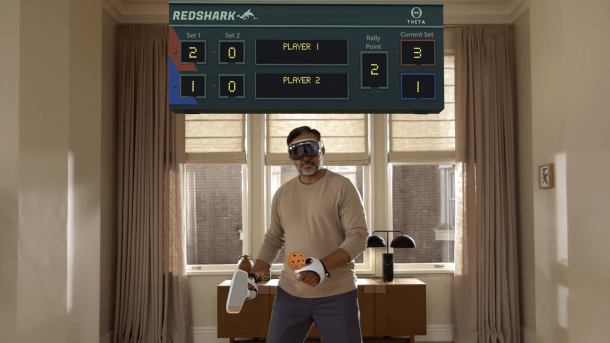
Vision Pro with Sony's Spatial Controller: Apple has no problems with external hardware.
(Image: Screenshot Apple.com)
- Ben Schwan
The rumors about the new Vision Pro operating system were rather thin on the ground: Not much more than a new feature for scrolling using eye tracking had been predicted. However, it now appears that Apple has been working much more intensively on visionOS. Like the other new operating systems, it now bears the version number 26, a leap from (currently) visionOS 2.5.
Widgets for vision, more spatial functions
Apple has actually implemented the previously speculated eye scrolling: it is called "Look to Scroll". However, Apple did not spend any time on this at the WWDC 2025 keynote, only mentioning it in an overview of the most important new functions. One of the more important innovations for the company is the first integrated support for widgets. The mini-programs are available specifically for the Vision Pro, but "compatible widgets" from iPadOS programs can also be used. The visionOS variants use 3D effects, for example with a new clock or spatial photos. Widgets are managed via a new management app and can be placed anywhere in the room. They do not forget their position, as is already known from regular windows: even if Vision Pro is switched off, the locations remain saved. A new WidgetKit enables the creation of mini programs directly for visionOS.
Apple has implemented improved spatial functions for the Spatial Photos function, among others. This means that more realistic 3D variants can now be created from existing 2D images. They are presented in the (already available) Spatial Gallery app, including curated materials from Apple itself. Spatial functions for the Safari browser are also new: Apple is hoping to take the first step into the "Spatial Web". There is a new view that puts existing websites into a 3D reading mode in which photos become spatial. Developers can also incorporate 3D elements into their pages, which can then be easily pulled out of the browser and distributed in space –, for example fashion or furniture.
Videos by heise
Personas should look less like ghosts
Apple claims to have significantly improved the not uncontroversial persona function, with which users can send their own images into the 3D world as avatars. They have become "dramatically" better, they say. Hair, eyelashes and complexion should be depicted more realistically. "This makes the persona more natural and familiar," says Apple. The demo shown at the WWDC keynote did indeed look much less ghostly. The setup is done as usual via the Vision Pro itself, but you can also choose from over 1000 virtual glasses if you want to "put one on".
In future, users will also be able to share spatial experiences if they are rich enough to own several Vision Pro devices. In future, it will be possible to play games or watch movies together. Switching between users in a corporate context will also be simplified. Content that should only be shared with certain people in the company can be protected automatically. New APIs and tools for companies allow, among other things, eye, hand and vision data as well as the regular settings for operating aids to be saved on iPhones with iOS 26 and quickly transferred to a new Vision Pro.
Accessories: Sony support and 360-degree video
Apple supports spatial controllers for visionOS for the first time. The first model are the devices from Sony, called VR2 Sense by the manufacturer and costing 50 euros. There are also new APIs so that games and other applications can also support them. One of the first games will be Pickle Pro, a pickleball title. Furthermore, visionOS 26 supports the Logitech Muse 3D pen, which was specially developed for the headset. This "enables precise input and new ways to interact with collaboration apps like Spatial Analogue", Apple writes.

(Image: Screenshot Apple.com)
Apple also announced a "brand new Adobe app" based on Premiere – that enables video editing for spatial content on the headset. Also announced: visionOS 26 provides integrated support for images from 360-degree cameras such as those from Insta360, Go Pro or Canon. These can then be played back directly on the Vision Pro, including a spatial experience – significantly nicer than would be possible on 2D displays. According to Apple, "content with 180-degree, 360-degree and wide-angle fields of view" is supported. Finally, the Home view now allows you to create folders directly, you can unlock the iPhone with the Vision Pro (otherwise very annoying when wearing the headset) and there is a new environment from the planet Jupiter. Hand tracking is still possible with up to 90 Hertz.
Empfohlener redaktioneller Inhalt
Mit Ihrer Zustimmung wird hier ein externer Preisvergleich (heise Preisvergleich) geladen.
Ich bin damit einverstanden, dass mir externe Inhalte angezeigt werden. Damit können personenbezogene Daten an Drittplattformen (heise Preisvergleich) übermittelt werden. Mehr dazu in unserer Datenschutzerklärung.


(bsc)


