


Twenty: The open source alternative to Salesforce is here
After two years of development, Twenty is ready for productive use. The open source CRM has already won many advance praises.
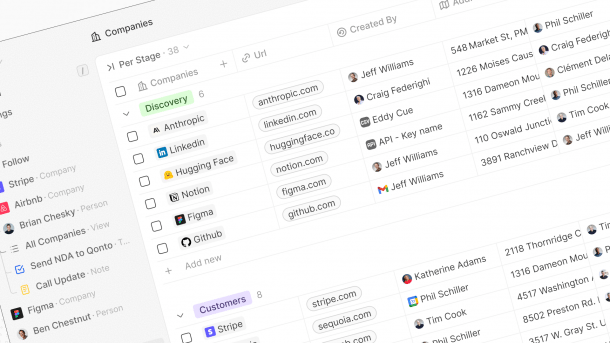
(Image: Twenty PBC)
Twenty is ready for productive use: Version 1.0.0 of the open source CRM has been released. The developers describe their customer relationship management software as a free Salesforce alternative that companies can operate themselves or obtain from the Twenty cloud.
The central functions of Twenty are not surprising: contacts can be managed in standard objects, where the CRM provides for people, companies and opportunities. The latter are data on potential deals, and their progress can be recorded and monitored.
Users can also create custom objects. The name, icon and description can be freely assigned here, after which users can add the desired fields. Fields are also divided into standard and custom types: the former includes information that every company needs, such as a customer's first and last name.
Fields with different data types such as text, number, date, selected value can also be created. New fields can be added with just a few clicks – and also deactivated again. However, the data and connections between fields are not deleted; they no longer work in the app, but the call via the API is retained so that applications that access Twenty via the API continue to work.
Tables or Kanban
The data in the CRM can be called up via configurable views. The standard views of each object, which are unfiltered and unsorted, are included by default –, for example all persons or all companies. You can also store your own views, which can specify filters and sorting. The software can output such views as a table or Kanban. If the user changes a view, they can change its settings or save it as a new view with a single click.
Tables can be created indefinitely, and users can add and delete entries with a single click. It is just as easy to add your own fields. The Kanban view is designed for tracking processes. Each column is a step in the process, the movable cards consist of fields. The menu can be used to set which card is displayed; users can also quickly add or delete columns. In addition to the detailed view, a compact view is also on board.
New data can be imported from .csv, .xlsx or .xls files; users can assign the columns to be transferred directly to the fields they have set up. For example, if a company wants to store its contact data for a social network as a field in addition to the customer name, the latter appears here and the person responsible can check in advance whether the import is working correctly. Twenty can export the data in .csv format.
Twenty offers an email function: one or more addresses can be linked to people, whereby the software can differentiate between internal employees and external customers. Twenty does not synchronize internal emails with the CRM; the synchronized messages can be viewed in the overview for an external person or company. Which data the CRM synchronizes can be set – In addition to the complete email, only the subject and metadata or only the metadata can be shared with other CRM users. If desired, Twenty can automatically create new contacts based on the emails. In the future, the developers are also promising the sending of messages directly from the CRM.
Users can create any number of notes, which can be formatted with headings, tables and lists. Other users can comment on notes. Tasks can also be stored, to which content such as text and images, people and appointments can be added. An overview of open tasks is also included.
Videos by heise
Integration and automation
Twenty offers an API to access the data stored in the CRM and to synchronize information between systems. For example, Twenty can automatically retrieve details of newly created people or companies. Webhooks can also be used, for example, to notify you of newly created persons or updated notes. It is also possible to automate the creation of tasks in this way. For automation, users can set up trigger-based workflows that work both internally in Twenty and with external software.
Twenty also includes practical features such as customizable branding, user management, user profiles, dark mode, configurable authentication providers, quick search and favorites for CRM entries.
As open source software, Twenty is licensed under AGPL v3, and instructions on how to use it yourself can be found on the project's website. Alternatively, the CRM can be obtained as SaaS including support from the developers, details can be found here. The roadmap can also be viewed on Twenty's GitHub page. The CRM has already collected over 28,000 stars here.


(fo)


