


Lenses in VR glasses: Between sharpness, weight and optical side effects
Fresnel, pancake or aspherical: VR glasses contain a lot of optical know-how, but choosing the right lens remains a compromise.
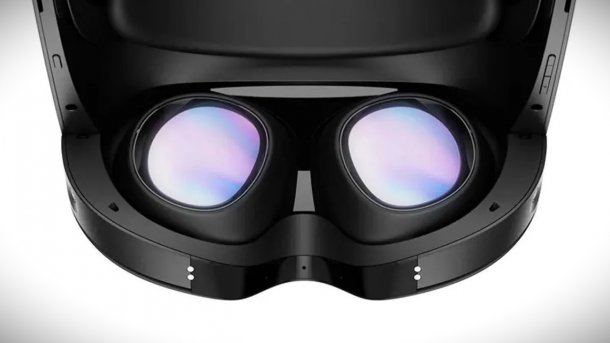
The lenses in VR glasses play a decisive role in the image quality and immersion of the VR experience.
(Image: Meta)
Choosing the right lens is crucial for image quality, comfort and ultimately the user experience in virtual reality. Today, the market offers three established lens types – Fresnel, pancake and aspherical –, each of which has specific advantages and disadvantages. However, there is still no ideal solution. The attempt to build the perfect headset is and remains a balancing act between physical limits and economic constraints. But what are the differences between the most common lens types and what should buyers look out for?
The view through VR lenses is very subjective
Arne Engler is a graduate engineer (FH) in ophthalmic optics and Managing Director of vroptiker.de. He and his team work with numerous VR manufacturers and offer interchangeable prescription lenses for all common VR glasses. Engler warns against looking at technical specifications in isolation: "The eye is not a lens, but an organism." The brain compensates for many shortcomings, such as the blind spot where the optic nerve exits.
"If you close one eye, you don't perceive a spot where you can't see anything. Almost all optical illusions are based on such effects. What the eye sees is not the same as what we perceive visually." This ability to interpolate explains why lens effects such as glare (diffuse light overshadowing), halo effects (luminous edges), chromatic aberration (color fringing) or a narrow sweet spot are perceived differently from person to person.
Lenses have a major influence on visual comfort
Even if they are not immediately noticeable, poor optical properties of VR glasses can lead to fatigue, discomfort or even visual impairment, especially after prolonged use. The risk of myopia plays an important role in this context. VR glasses project the image in such a way that the eye is focused on a virtual distance of around 1.5 to 2 meters, although the object displayed often appears much closer.
This permanent close work, similar to the intensive use of smartphones and monitors, can promote the development of myopia, especially in children and adolescents, or exacerbate existing myopia in adults. Some types of VR lenses, such as aspherical lenses, are also suspected of increasing myopia due to their design. Anyone who is short-sighted should therefore always wear corrective lenses under their VR glasses or purchase appropriate VR prescription inserts.
It is also important that when buying VR goggles, attention is always paid to a stepless IPD setting so that the distance between the lenses can be adjusted exactly to the distance of your own pupils. If the deviation is too great, the image will be blurred, causing additional strain on the eyes.
VR-Linsen - Fresnel, Pancake, asphärisch (3 Bilder)

Josef Erl
)Fresnel lenses: tried and tested, inexpensive and outdated
Fresnel lenses were the standard in many VR headsets for years, but are now considered technically obsolete. They can be found in the Meta Quest 2, the Playstation VR2 or Meta's current entry-level VR headset Quest 3S. Their advantage lies in their simple and flat design. The concentric grooves reduce the weight and enable a comparatively wide field of vision. However, this groove structure is also their greatest weakness.
A frequently criticized phenomenon are "God Rays" – ray-like light artefacts, which mainly occur in high-contrast scenes. They are caused by light scattering on the grooves and can hardly be avoided physically. In addition, the "sweet spot" of many Fresnel systems, i.e. the area with maximum image sharpness, is comparatively small. This means that even slight eye movements or sub-optimal positioning can lead to blurring, distortion or color fringing in the image.
Pancake lenses: compact and clear – but light-absorbing
Pancake lenses are a more recent type of lens that has established itself in compact standalone headsets in particular. It uses several mirrors and polarization filters to fold the light path and thus enable a flatter design. The Meta Quest 3 and the Pico 4 Ultra rely on this principle. Pancake lenses enable high image sharpness right to the edges and minimize distortion and colour fringing (also known as "chromatic aberration"). The result is a generous sweet spot and good spontaneous compatibility, as Engler emphasizes.
However, the price for the flat design is high: "Every additional optical surface absorbs light," explains Jaap Grolleman, Head of Communications at VR manufacturer Pimax. While aspherical glass lenses allow up to 99 percent of the display light to pass through, pancake systems often only achieve around 15 percent. This results in lower brightness, reduced contrast and less vivid colors, especially at the edge of the field of view.
The maximum displayable field of view (FOV) is also generally smaller than with Fresnel systems, even if marketing claims occasionally suggest otherwise. "As the lenses become steeper towards the edge, the FOV can only be increased at the expense of a higher construction depth, higher weight and increasing chromatic aberrations," explains Engler.
Aspherical lenses: clarity for demanding – but large and heavy
Aspherical lenses are considered to be the highest optical quality variant. They do not require a groove structure, offer a consistently sharp image and do not cause God Rays. Instead, the targeted curvature of the lens ensures minimal distortion and high image clarity over a large field of view. High-end models such as the Crystal series from Pimax consistently rely on glass lenses with an aspherical shape.
Videos by heise
However, this quality comes at a price: the lenses are heavy, require more space between the display and the eye and are therefore hardly suitable for compact designs. In addition, eye movements can lead to a so-called "wobble effect", i.e. a slight image distortion caused by the flatter pixel sphere.
Engler points out that this lens shape may even encourage myopia, i.e. an increase in short-sightedness. Pancake lenses perform significantly better here: "According to the current scientific situation, pancake lenses should prevent myopia even with continuous use," says Engler.
What do the perfect VR glasses look like?
"A headset is always a compromise of different aspects. If you improve one, you worsen another. That's why you first have to look at what the objective is," says Engler. For him, the Meta Quest 3 is currently the almost perfect standalone headset: "Very good spontaneous compatibility, high sweet spot, low chromatic aberration." He only considers the Pico 4 Ultra to be ahead in terms of comfort and weight.
"A combination of both would be the perfect standalone VR glasses for me." Engler currently sees no comparable product on the PC VR market. Many headsets are too heavy and have too many disadvantages in favor of a high FOV. "Basically, I would simply install the Meta Pancake lens and a better display in my old Valve Index. Comfort, connectivity and tracking are still first class." It is quite possible that Valve will soon follow up on this. According to rumors, hybrid VR glasses codenamed "Deckard" could be released this year.
"There is no such thing as a perfect headset," says Grolleman. "Compromises always have to be found in terms of price, size, weight, field of vision, stereo overlay, clarity, resolution, heat distribution and functions such as eye tracking." With the Crystal series, the focus is consistently on optical quality, even if the weight increases in return. "This is ideal for simulations," he explains. "For mobile applications such as social VR or films, on the other hand, you need lighter devices." Pimax has now announced the compact Dream Air series with pancake lenses for these applications. The upcoming slim XR glasses for media consumption from ByteDance and Meta are also likely to rely on this type of lens again.
Conclusion: every VR headset is a compromise
Anyone buying VR glasses today should be aware that no lens can meet all requirements at the same time. It always depends on the intended use: If you are looking for a lightweight, compact device for movies or social applications, pancake lenses are a good choice. Aspherical systems deliver the highest image quality, but are larger and heavier. If you are primarily looking for an affordable entry-level lens, Fresnel lenses are a compromise solution, but you will have to live with optical limitations.
In the long term, modular lens systems could be a solution. A concept with a weaker main lens in the headset, which is supplemented by interchangeable additional lenses with visual acuity, would be conceivable – similar to microscopes. Arne Engler considers such a system to be quite realistic for high-end PC VR, but not for mobile headsets for the mass market. Until then, VR remains an optical balancing act between clarity, light intensity, field of vision and comfort. And every user must decide for themselves what compromises they are willing to make.


(joe)


