


High-speed trains: Porous buffer reduces tunnel noise
High-speed rail travel can lead to tunnel bangs at tunnel exits. Chinese researchers have got to grips with the problem.
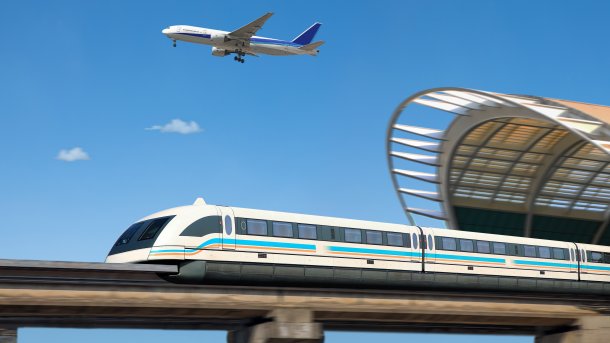
(Image: cyo bo / Shutterstock.com)
Chinese researchers have found a way to reduce the low-frequency shock waves that occur when a magnetic levitation train leaves a tunnel at a speed of 600 km/h to make high-speed train journeys more comfortable and reduce the acoustic impact on the environment. This was reported in the Guardian on Thursday. According to the report, a porous buffer around 100 m long at the tunnel entrance could significantly reduce the tunnel bang.
When a high-speed train enters a narrow space, such as a tunnel, the air is compressed by it like in a piston. The air pushed in front of the train expands at the tunnel exit, resulting in a tunnel bang that sounds like a small thunderclap. The higher the speed of the train, the more likely it is that a shock wave will occur.
At particularly high speeds of 600 km/h, even short tunnels of around 2 km in length are sufficient to provoke a tunnel bang. Average high-speed trains with a speed of around 350 km/h already need a longer tunnel to produce a bang when exiting the tunnel.
The Chinese engineers tackled this problem by installing a lightweight, porous buffer at the tunnel entrance and applying an additional layer of the material to the tunnel walls of the first section over a length of 100 meters. This allows the air pushed in front of the train to escape before the train reaches the tunnel exit. The principle is similar to that of firearm silencers. The muzzle blast is reduced by separate chambers that slow down the gases of the projectile's propellant charge.
Significant reduction in the tunnel bang
The scientists found that the tunnel buffer can have a major effect. Pressure fluctuations can be reduced by up to 96 percent, so that tunnel exits are quieter and lead to less acoustic pollution of the environment. The costs are said to be low, and the installation and application of the porous material involves little additional work.
This technology is to be applied to the prototype of the Chinese maglev train of the China Railway Rolling Stock Corporation. The train could travel at a speed of 600 km/h in continuous operation and thus compete with domestic flights on short and long distances and contribute to reducing environmental impact. On an example route between Beijing and Shanghai, CO₂ emissions could be seven times lower. The train could cover the distance in 2.5 hours, the same time it takes to fly.
However, there is no such route yet. Official approval from the central government in Beijing for construction is still pending. However, the provincial governments are pushing for the construction of such a pilot route.
Videos by heise
However, the technology to reduce tunnel noise could also be applied to “slower” trains that can travel at around 350 km/h. It is conceivable that the technology will also be introduced in other countries with high-speed trains. This includes Japan, for example. On the route between Tokyo and Osaka, a maglev train is to travel at a speed of 505 km/h, reducing a journey that currently takes 2.5 hours to 67 minutes in domestic traffic. However, the line is not due to be built until 2027.



(olb)

