


Quantum internet: Classical network technology transmits quantum information
A quantum internet should transmit information securely and connect quantum computers. Parts of it could be compatible with conventional network technology.
(Image: Sylvia Zhang)
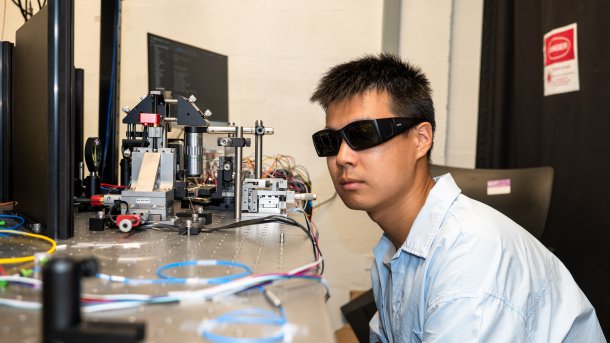
In an experiment, a research team from the University of Pennsylvania has transmitted quantum information via classic internet protocols, routers and fiber optic cables. The team thus demonstrated that future quantum internet could possibly be based in part on existing network technology. The study was published in the journal Science.
From the internet to the quantum internet
A quantum internet could solve key challenges in communication and data processing in the future. It promises tap-proof data transmission and the networking of quantum computers. This would enable them to exchange information or perform complex calculations together.
However, there are many technical hurdles involved in setting up a quantum network. Quantum objects are extremely sensitive to external influences such as vibrations or temperature changes. Even minimal disturbances can destroy the information they carry. In addition, conventional network technologies, such as signal amplifiers and routers, cannot easily process quantum signals.
Several studies have already proven that conventional fiber optic cables can transmit quantum information. For example, a team from England, Poland and the Netherlands recently established Quantenkommunikation over a 250-kilometer commercial fibre optic cable between Frankfurt am Main and Kehl near Strasbourg. Photons, i.e. individual particles of light, carried the information from the transmitter to the receiver.
Whether typical internet protocols and other network technology can be used to transport quantum information without destroying it has so far remained largely unexplored.
Hybrid data packets
To combine these two areas, the team led by Yichi Zhang from the University of Pennsylvania combined classical and quantum-based data to create a hybrid data packet. The well-known Internet Protocol (IP) splits information into data packets, adds header data to them and assigns them to destinations via an IP address. Using a similar idea, the team developed a chip that combines a classic header with the quantum information to be transmitted, the so-called quantum payload. They encoded the quantum information within entangled photon pairs.
Using the header, routers addressed the hybrid data packets correctly and forwarded them without accessing the sensitive quantum information. In addition, the researchers integrated an error detection system into the IP header that recognizes and mitigates external interference before it affects the quantum information. This system proved to be an important tool for preserving the quantum information during a five-hour test, as the team writes in its publication.
Videos by heise
Three routes in the test
To test their concept, the team developed three different test tracks over a distance of up to seven kilometers. They used fiber optic cables, routers and nodes to transmit quantum information to multiple addresses. In the largest setup, the team routed quantum information from two possible sender addresses via two routers to three possible destination addresses. According to the researchers, their results demonstrate that hybrid data packets can be transported stably over a classical network.

(Image: Sylvia Zhang)
"In many ways, a quantum internet protocol will also resemble our classic internet protocols", explains Hannes Bernien, quantum researcher at the University of Innsbruck, who was not involved in the study. With their study, the researchers have elegantly demonstrated how this could work, thus taking an important step towards a scalable quantum internet.
"In a conventional network, however, there are many other components that are fundamentally incompatible with quantum signals," Bernien points out. Signal amplifiers designed to overcome longer distances are not possible in the quantum world due to physical laws. "In this respect, I think that a quantum network will always need its own infrastructure."
Networked quantum computers for quantum cloud computing
Quantum networks that transmit information tap-proof are already commercially available and work over distances of up to around 100 kilometers. However, the networking of quantum computers or quantum sensors is particularly exciting. "For me, a quantum internet is only really interesting when it connects quantum processors", says Bernien. "It's actually just like today's internet, which would be pretty boring without computers."
Such a quantum network would enable cloud computing, for example. "It is now assumed that a modular approach must be used to build a quantum computer of the necessary size", says the researcher. So instead of building one large quantum computer, many small ones are linked together using a quantum network.
The team from Pennsylvania see their work as the basis for further developments. As technology advances, hybrid networks with higher data rates and greater scalability could be realized to meet the increasing demands of a quantum internet. The combination of classical network technology and quantum systems could help to make efficient use of the existing infrastructure while gradually adapting it to the needs of quantum applications.


(spa)


