


DirectX: 30 years of Windows gaming from DOOM95 to ray tracing
What is now the foundation of most PC games began almost 30 years ago as a desperate act of self-defence. A look at technology, triumphs and failures.
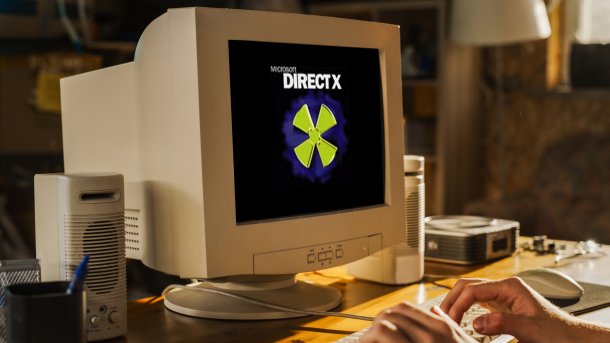
(Image: Gorodenkoff/Shutterstock.com/Bearbeitung heise medien)
What is now the foundation for most PC games began almost 30 years ago as a desperate act of self-defence. The history of DirectX is not only a chronicle of technical milestones but also a lesson in strategic moves, entrepreneurial daring, and the unstoppable evolution of game graphics. It is inextricably linked to the rise of Windows as the dominant gaming platform.
The beginnings: The “Manhattan Project” for Windows 95 (1994–1995)
At the end of 1994, Microsoft was facing a dilemma. The eagerly awaited Windows 95 was supposed to revolutionize the PC market, but one crucial group remained sceptical: the game developers. They stuck with the tried and tested but outdated MS-DOS. The reason was simple: DOS offered direct, unfiltered access to the hardware, which was a necessity for the performance-hungry games of the time. Windows, on the other hand, with its layers of abstraction and cooperative multitasking, was considered slow, unpredictable, and simply unsuitable for games.
When Microsoft evangelist Alex St. John asked developer studios whether they would develop their next big game for Windows, he received nothing but ridicule and rejection. The situation was critical. Without games, Windows 95 was in danger of losing a crucial part of the home PC market, which was increasingly dominated by Japanese gaming consoles.
Out of this need, the “Manhattan Project” was launched internally. The name, a deliberate allusion to the development of the first atomic bomb, reflected the ambition and urgency with which Microsoft wanted to conquer supremacy in the gaming sector. A small, powerful team consisting of three developers, Alex St. John, Craig Eisler, and Eric Engstrom, was given the task of developing a "Game SDK" (Software Development Kit) within just four months.
The result was published as DirectX 1.0 on 30 September 1995. The first version was a set of programming interfaces (APIs) designed to standardize direct hardware access: DirectDraw for hardware-accelerated 2D graphics, DirectSound for sound output, DirectPlay for network games and DirectInput for input devices. Curiously, the name “DirectX” was a spontaneous creation of a journalist who mockingly summarized the many “Direct” components. Microsoft recognized the potential of the name and adopted it without further ado.
The breakthrough: DOOM95 as a Trojan horse
An API alone does not make a success. To convince the developer world, Microsoft needed a figurehead—a game that unmistakably demonstrated the superiority of DirectX. The choice fell on the biggest game title in the world at the time: DOOM. In a move that was as daring as it was ingenious, Microsoft approached John Carmack from id Software. The offer: Microsoft would port DOOM to Windows completely free of charge, with no strings attached. The project was led by Gabe Newell, later founder of Valve.
Empfohlener redaktioneller Inhalt
Mit Ihrer Zustimmung wird hier ein externes YouTube-Video (Google Ireland Limited) geladen.
Ich bin damit einverstanden, dass mir externe Inhalte angezeigt werden. Damit können personenbezogene Daten an Drittplattformen (Google Ireland Limited) übermittelt werden. Mehr dazu in unserer Datenschutzerklärung.
The result, DOOM95, was a sensation. Not only did it run more stable and smoothly than the DOS version, it also offered a higher resolution of 640 × 480, 24 additional audio channels, and, above all, a drastically simplified multiplayer setup via DirectPlay. DOOM95, released on August 20, 1996, became the first DirectX game ever introduced and the ultimate testament to the power of the new API. The success was so great that Microsoft founder Bill Gates walked through the corridors of a virtual level with a shotgun and trenchcoat in a legendary promotional video. As DOOM was installed on more PCs at the time than Windows 95 itself, the game served as the perfect Trojan horse to establish DirectX on millions of computers.

The cornerstones of 3D graphics: DirectX 3.0 to 6.0 (1996 –1998)
After DirectX 2.0 was skipped for internal reasons, DirectX 3.0 brought a decisive innovation in 1996: Direct3D. This was the first time that hardware-accelerated 3D graphics found its way into the API. Optimizations for the new MMX instructions of the Pentium processors and extended multiplayer capabilities completed the package.
Two years later, in 1998, DirectX 6.0 set new standards. Revolutionary functions such as multitexturing (the overlaying of several textures on an object for more detail) and bumpmapping (a technique to make surfaces appear more vivid through light and shadow effects) were introduced. AMD's 3DNow! Instruction set was also supported. Graphics cards such as the then popular Riva 128 and Voodoo Graphics ran significantly faster than with DirectX 5.0. For the first time, DirectX seemed powerful enough to make proprietary, chip-specific APIs such as 3dfx' Glide superfluous, which already supported the aforementioned functions on the Voodoo graphics chips – but only on those.
DirectX 7 with Transform & Lighting (1999)
DirectX 7.0, released in 1999, introduced Hardware Transform & Lighting (T&L). For the first time, T&L shifted a large part of the geometric calculations and lighting effects completely from the CPU to the graphics card. Hardware T&L became the standard for modern 3D applications and enabled significantly more complex scenes without any loss of performance.
However, the implementation of DirectX 7 was not without its problems. Some hardware manufacturers struggled with the practical implementation, such as S3 with their Savage2000 chip. S3 admitted that their first drivers did not utilize the T&L hardware at all, as the company had initially focused on stability. Only later driver versions were to unlock the full DirectX 7 functionality—a issue that also plagued other manufacturers. With the Savage2000, however, the wait was to be in vain.
DirectX 7 established the basis for hardware-accelerated 3D graphics, which was to become the standard in the following years.
Videos by heise
The era of shaders: DirectX 8 and 9 (2000 –2004)
With DirectX 8.0, 3D graphics experienced perhaps its greatest revolution in 2000. Microsoft merged DirectDraw and Direct3D into “DirectX Graphics” and introduced shader technology. Instead of having to rely on fixed effects wired into the hardware, developers could now use pixel and vertex shaders (version 1.1) to write their small programs that were executed directly on the GPU. This made hardware-accelerated per-pixel lighting, complex material effects, and unprecedented artistic freedom possible for the first time. The first shader language was still a kind of assembler with 17 basic instructions and a maximum length of 128 instructions per program for the vertex shaders.
DirectX 9.0, released in December 2002, took this development to the extreme. With the High-Level Shader Language (HLSL), the cumbersome assembler programming was replaced by a much more accessible, C-like syntax. The complexity of the shader programs grew exponentially: pixel shaders could initially process 96 commands, vertex shaders even 256, including jumps and loops – later expansion stages of DirectX 9.0 significantly extended these capabilities with Shader-Model 3.0.
The high-precision floating-point data formats were a particular blessing, as they prevented color distortions (banding) in complex calculations. A controversial but innovative function was displacement mapping, which generated geometric details at runtime and thus gave flat surfaces real depth. Nvidia deliberately avoided optimized support for the GeForce FX series, fearing that developers would lose control over the final appearance of the game.
The Vista controversy: DirectX 10 (2007)
The release of DirectX 10 in 2007 was accompanied by one of the most controversial decisions in Microsoft's gaming history: the API was linked exclusively to the new Windows Vista operating system. Microsoft wanted to force the switch to the new OS, but the move backfired. Valve boss Gabe Newell called the decision a “terrible mistake” in an interview. According to the Steam statistics at the time, only a tiny two percent of gamers used a DirectX 10-capable graphics card in combination with Vista.
The result was a vicious circle: as consoles did not support DirectX 10 and the PC player base remained on Windows XP, the studios continued to develop for the lowest common denominator (DirectX 9) and ignored the new functions. Exclusivity became a boomerang and slowed down technical adaptation for years. The fear of such fragmentation was repeated years later when AMD employee Richard Huddy caused confusion in 2014 by declaring that DirectX 12 would not be released for Windows 7—a statement that Microsoft only corrected later.
Increased efficiency: DirectX 11 and 12 (2009 –2015)
In 2009, the new Windows 7 came with the DirectX 11 interface, which Microsoft later added to Vista. The most important innovation was DirectCompute, which also opened up DirectX to GPGPU applications for the first time, i.e., general calculations on the graphics chip. On the gaming graphics side, the hardware tessellation was the most talked about feature. This is a technology that more or less dynamically refines simple 3D models with additional polygons to achieve a higher level of detail without CPU load – in simplified terms, it could also be referred to as geometry compression.
With DirectX 12, announced in 2014, Microsoft made a radical change in strategy. Instead of new graphics effects, efficiency took center stage for the first time. “Over the past ten years, new Direct3D versions have added more and more effects that widened the gap to the hardware,” explained AMD manager David Oldcorn at the GDC at the time. DirectX 12 should drastically reduce this gap and enable developers to get closer to the hardware.
The demonstration at the GDC was impressive: a 3DMark test showed how DirectX 11 distributed the load unevenly across four CPU cores and pushed one core to its limits. DirectX 12, on the other hand, used all cores equally and achieved 50 percent higher performance. Microsoft's promise was clear: “Console efficiency on Windows PCs.”
Competition and continuous evolution: Mantle, Vulkan, and the future
The pressure to increase efficiency was no coincidence. AMD had introduced its own low-level API, Mantle, in 2013, which was designed as a direct response to the inefficiencies of DirectX 11. Mantle served as an important pioneer and source of ideas for DirectX 12 and the cross-platform API Vulkan. AMD discontinued the further development of Mantle 1.0 back in 2015 and recommended that developers switch to DirectX 12 or Vulkan—an admission that the battle against the established standards could not be won.
Today, the focus is on continuous further development. Instead of waiting for a “DirectX 13,” DirectX 12 Ultimate is constantly being expanded as an extendable platform. Functions such as DirectX Raytracing (DXR) for realistic real-time reflections and shadows, mesh shaders to increase efficiency when displaying complex geometries, and Variable Rate Shading (VRS) are being successively integrated. These updates are made directly via Windows updates and ensure that the platform uniformity between PC and Xbox Series X/S is maintained.
Empfohlener redaktioneller Inhalt
Mit Ihrer Zustimmung wird hier ein externes YouTube-Video (Google Ireland Limited) geladen.
Ich bin damit einverstanden, dass mir externe Inhalte angezeigt werden. Damit können personenbezogene Daten an Drittplattformen (Google Ireland Limited) übermittelt werden. Mehr dazu in unserer Datenschutzerklärung.
The latest development, DXR 1.2, promises massive performance improvements in path tracing through techniques such as Shader Execution Reordering (SER) and Opacity Micro-Maps. This brings us full circle: from the first, simple 2D acceleration to the simulation of physically correct light rays, DirectX has fundamentally shaped the gaming world over three decades.


(vza)

