

Hydrogen car Hyundai Nexo in driving report: Better – and still hopeless
The new Hyundai Nexo does everything better than its predecessor. The idea of a fuel cell car is apparently not to be killed off, despite the lack of prospects.

(Image: Hyundai)
- Wolfgang Hörner
“The new Hyundai Nexo is the fuel cell car with the longest range on the market,” says the manufacturer, not without pride. According to WLTP, it's 826 km, and refueling should take less than five minutes, with further reduced sensitivity to low temperatures. When the Hyundai comes to the German market in spring 2026, it will only have to compete with the Toyota Mirai (Test) with a range of 650 km—as much as the first generation of the Nexo already offered. In 2028, Toyota intends to launch a new model, developed in cooperation with BMW. It also gets more power; its 150 kW exceeds the predecessor's by around 30 kW. 350 Nm of torque should be enough to get the SUV moving quickly. The Nexo owes its improved performance data to a more efficient fuel cell element and more powerful electronics.
Two tons and front-wheel drive
The front-wheel-drive Nexo weighs around two tons and, at 4.75 m, is about as long as a BMW X3. It doesn't feel as snappy as some battery-electric vehicles when starting off, but it offers decent performance. If desired, the Nexo can accelerate to 100 km/h in 7.9 seconds and reach a top speed of 179 km/h. To compensate for the inertia of the fuel cell at its maximum net power output of 94 kW, the Nexo can draw on a battery for power peaks of 80 kW. Its energy content of 2.64 kWh is designed to suffice as a buffer for the fuel cell for most requirements, the manufacturer promises. The battery is also charged via the fuel cell and can also be charged through recuperation from the electric motors.
Brennstoffzellen-SUV Hyundai Nexo Exterior (4 Bilder)
Hyundai
)Hyundai emphasizes that safety has been further improved with even finer-acting tank valves, new leak detectors, and expanded fire protection. These developments were less a real necessity than trust-building measures to reduce the skepticism of many people towards hydrogen technology. Above all, however, the Korean developers aimed to improve the efficiency of the fuel cell. While the technical efficiency is still only 60 percent, as before. Nevertheless, the range has already increased by around 50 km because the hydrogen tank holds more gas, even though its volume has only increased slightly. Its capacity rose from 6.33 to 6.69 kg.

Surprisingly uncomfortable
You don't notice that when driving. The new Nexo drives in everyday life pretty much as you would expect from a battery-electric SUV in this class: calm, inconspicuous, and above all quiet. This is not only due to its electric drive but also to the standard double glazing and active noise cancellation—a bit comparable to systems from headphones. However, the particularly quietly rolling tires from Korean manufacturer Kumho will not find their way to Europe. In contrast to the comfortable silence, the chassis surprisingly clearly informs the passengers about the road conditions.
Brennstoffzellen-SUV Hyundai Nexo Interior (6 Bilder)

Hyundai
)Nevertheless, it is noticeable that the car holds a special position in Hyundai's portfolio, and compromises have been minimized. With a length of 4.75 meters, it offers not only space in the trunk but also for passengers, with 510 to 1630 liters. Even in the rear, they can enjoy ample legroom, heated and ventilated seats, reclining seatbacks, and wide-opening doors.
Polarizing design
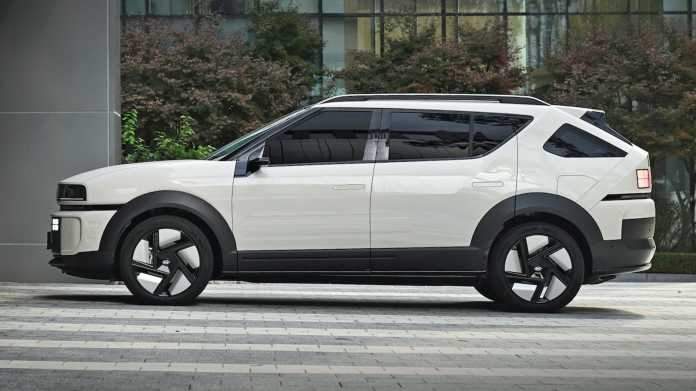
At the driver's seat, there is a curved screen like from the Hyundai Ioniq 6 (Test), a standard head-up display, and the two screens for the side exterior cameras, which Hyundai has mounted instead of exterior mirrors. Wherever you can touch something, the feel and look are not cheap, which also applies to the exterior design: especially at the front, the new “Art of Steel” styling concept with the pixel-like LED headlights looks cool, at least unusual at the rear. Car fans might discover influences from the Pontiac Aztek, which was not entirely undisputed in terms of taste.
Videos by heise
Less expensive than before
Given what is offered, the price is a surprise. It will be around 68,000 euros. For an SUV of this size, that is still a lot of money, even though the previous Nexo—smaller and less powerful—recently cost 77,000 euros. However, for around 70,000 euros, a Nexo has plenty of competition from the battery-electric segment, which scores with better performance, lower running costs, and a denser supply network—in addition to a less harmful environmental impact. After all, only a fraction of the hydrogen worldwide is produced using renewable energy and is currently produced worldwide using renewable energy.
Will the less expensive new Nexo bring about a trend reversal for fuel cell cars? Hard to imagine, because out of the once around 100 filling stations, there are currently only about 80 left in Germany, and further expansion of the network is pure wishful thinking. Germany is leading in network density in Europe. In Austria, all four existing hydrogen filling stations were taken offline this spring. Furthermore, a kilogram of hydrogen costs up to 19 euros in this country. A full tank can therefore sometimes cost more than 100 euros. Charging still takes a little longer than refueling, but this small advantage is likely to be almost always consumed by the long drives to one of the rare filling stations.
A showcase project
This means that the further developed Hyundai Nexo, despite the price reduction, will likely remain more of a car for dedicated fans of fuel cell technology than ever before. An improvement in the surrounding conditions is not foreseeable in the long term. And so, like all H2 production models in the past 20 years, the Nexo will remain a showcase project with which manufacturers can show that they are ready—should a hydrogen economy, against all expectations, ever be established.
(dahe)