


"Visited Places" Tracking in Apple Maps: Where it works – and how
Google Maps users have long been able to automatically save location data – sometimes even unintentionally. A new feature for iOS 26 doesn't work everywhere.
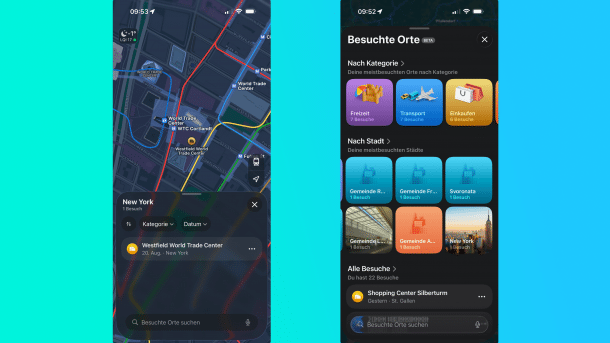
Examples of visited places: A single location on the left, the overview on the right.
(Image: heise medien)
On Android, many users were unaware for a long time that Google saved a location history, aka "Timeline", which could then be viewed via the web. The function has since become more privacy-friendly and is intended to only work as an opt-in function. Until now, Apple has largely lacked this feature, apart from the so-called important places, which can no longer be viewed. With iOS 26, the “visited places” were introduced, which allow a view of them in Apple Maps on request. However, the function is currently still in beta, not really reliable, and only usable in certain countries—the European Union is not among them. Here is an overview of what is already possible with "visited places"—the English term "visited places"—and what is not.
Activation on request in Apple Maps
“Visited Places” is not activated by Apple by default. Instead, in iOS 26, you receive a prompt when you first open Apple Maps. However, this is only possible in Switzerland, Great Britain, USA, Canada, Australia, and Malaysia. If the device is located in the EU, “Visited Places” is not offered to users at all, according to Apple, and visits are not recorded even during a holiday in other countries.
Videos by heise
How exactly Apple controls the activation remains unclear. A US App Store account is not enough to enable activation. It is conceivable that geo-blocking is taking place. Users in Switzerland, on the other hand, are offered the function and can also use it. If a user lives “permanently” outside the EU, “visited places” should be activatable according to Apple. However, what “permanently” means remains unclear. If “visited places” is active, places worldwide are recorded, except for China and Korea.
EU Issue and Data Quality
According to Apple, "Visited Places" are either stored locally or protected by end-to-end encryption when synchronized via iCloud. They “cannot be accessed by Apple,” according to the iPhone manufacturer. It is not possible to link the location data to the user's identity. The fact that “visited places” are not available in the EU, Apple attributes to the Digital Markets Act. The company fears that if activated, it would have to share user location data with other companies, as it assumes the function falls under the DMA regulation, which forces Apple to make such openings. According to its statements, Apple has not yet found a way to share this function with other developers without such a leakage occurring. This is precisely what the company wants to avoid.

Incidentally, “visited places” is not yet perfect. A user from Switzerland who provided us with data reports that not all places are recorded. For example, a visit to New York resulted in only one recorded location—but at a time when iOS 26 was still in beta. But even now, after the official release of iOS 26, the recording appears rather “spotty.” Only 22 “visits” in total have been recorded since the function was activated. It is unclear which categories Apple uses before a location is saved. Movement histories are not recorded anyway; the main purpose is to be able to find places you have been to later.
Empfohlener redaktioneller Inhalt
Mit Ihrer Zustimmung wird hier ein externer Preisvergleich (heise Preisvergleich) geladen.
Ich bin damit einverstanden, dass mir externe Inhalte angezeigt werden. Damit können personenbezogene Daten an Drittplattformen (heise Preisvergleich) übermittelt werden. Mehr dazu in unserer Datenschutzerklärung.


(bsc)

