


World's largest electric ship goes into operation for the first time
The Australian shipyard Incap has completed the world's largest electric ship. The test program is now starting.
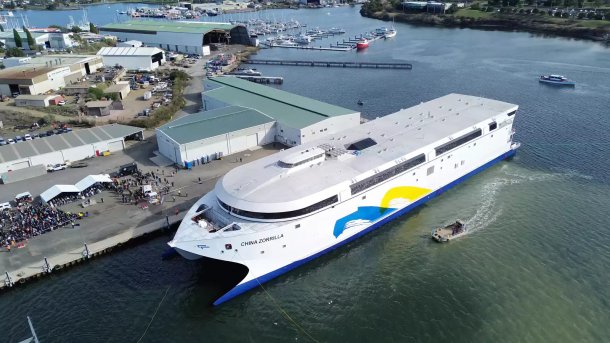
Incat electric ferry at launch
(Image: Incat)
All aboard the electric ferry: Australian shipyard Incat Tasmania has powered up the systems of the ferry Incat Hull 096 for the first time and tested the jet drive. According to the shipyard, the ship is currently the largest electric ship in the world.
The ship features a waterjet propulsion system with eight jets: water is expelled through nozzles at high pressure, creating a recoil that propels the ship. In front of invited guests, including Australian Minister for Trade and Tourism Don Farrell and Tasmanian Premier Jeremy Rockliff, Incat CEO Robert Clifford started the jets and demonstrated their performance, Incat announced. This marked the start of the test program before the ship is delivered.

The Incat Hull 096 is a ferry commissioned by the Uruguayan shipping company Buquebus. Buquebus operates ferries on the Río de la Plata, the border river between Uruguay and Argentina. The electric ferry is also intended to be used there.
The catamaran can accommodate over 200 vehicles
The ferry is a 130-meter-long and 32-meter-wide aluminum catamaran. The ship, which was launched in Hobart in May, will have space for 225 vehicles and 2100 passengers.

(Image: Incat)
Incat has not disclosed details such as the power of the drive. The energy storage has a capacity of 400 megawatt-hours and weighs around 250 tons. It comes from the Norwegian company Corvus Energy. The waterjet propulsion system was supplied by the Finnish company Wärtsilä.
"This is the first time worldwide that a ship of this size has been tested with a one hundred percent battery-electric drive," said Clifford. According to Incap, the ship is not only the largest electric ship in the world but also the largest electric vehicle ever built to date. The shipyard expects to deliver it in a few months after the tests.
Videos by heise
Approximately 90 percent of global trade is transported by sea. Shipping accounts for almost three percent of global carbon dioxide emissions, 13 percent of sulfur, and about 30 percent of nitrogen oxide emissions. In addition, there are soot particles and fine dust. The International Maritime Organization (IMO) of the United Nations set the goal in 2023 that ships must be climate-neutral by 2050.


(wpl)

