


Canva AI 2.0: Design becomes conversation
Graphics in Canva will be created through dialogue with artificial intelligence. Canva AI 2.0 learns to implement user styles from draft to campaign.
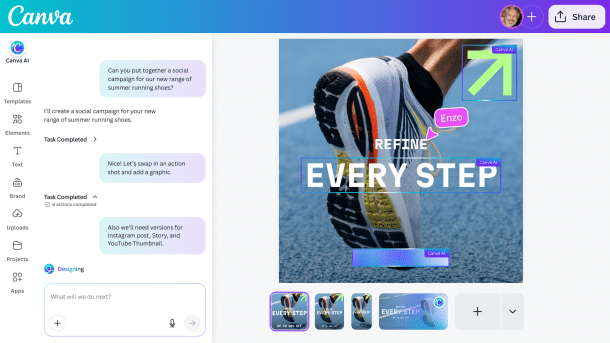
The design app Canva will soon be controllable via a language model, creating graphics, exchanging individual elements, and outputting the result for various channels.
(Image: Canva)
Australian software manufacturer Canva wants to further transform its graphic platform of the same name into an AI environment with “Canva AI 2.0” into an AI environment. Instead of clicking through tools and templates, users will simply describe their ideas in a dialogue with a language model – the AI will take care of the rest.
Canva did not disclose which language model will be used. The manufacturer speaks of its own “Foundation Models for Design” developed in its in-house AI lab. Canva apparently combines several models and systems optimized for design, layout, and content. In the past, Canva also relied on external AI services for text or image generation.
Videos by heise
Design via conversation instead of clickwork
In dialogue with the AI, users can formulate their ideas, whereupon Canva creates complete, editable designs. The process does not end after the first output: the AI remains in exchange, adjusts content upon request, and accompanies projects to the result.
A new control layer will coordinate the functions in the background, select, and combine suitable tools. This allows entire campaigns to be planned and implemented, for example, for marketing actions across different media.

(Image: Canva)
Changes without a new start
The Canva AI is said to be able to edit details precisely without recreating the entire design. Texts, images, or layouts can thus be adjusted individually while the rest remains unchanged. All content remains fully editable, which facilitates teamwork.
AI remembers style and brand
Also new is a kind of brand memory for the AI. Canva remembers workflows, design styles, and brand guidelines and automatically applies them to new projects. This ensures that content remains consistent without users having to manually define every detail.

(Image: Canva)
Integrate external services
In addition, Canva is expanding the platform with numerous functions for everyday work. External services such as email, calendar, or collaboration tools can be integrated to create content from existing data. Recurring tasks can also be automated, such as creating social media posts or meeting summaries. An integrated research function provides structured information from the web.

(Image: Canva)
Prices and availability
Canva AI 2.0 is launching immediately, initially as a “Research Preview”: The first one million users who register via the Canva website will gain access. In the following weeks, Canva plans to gradually expand access.
The software runs platform-independently as a web app. The free basic offer Canvas Free provides access to the design app and the desktop software Affinity. Canva Pro for 12 euros per month or 110 euros per year adds AI tools to both programs. The Business and Enterprise plans expand the offering for professional purposes and teamwork.


(akr)


