


Modular mini-computer: Flipper One becomes a universal Linux cyberdeck
The Flipper One is not just a successor to the successful gadget, but a versatile mobile companion. The community will be involved.
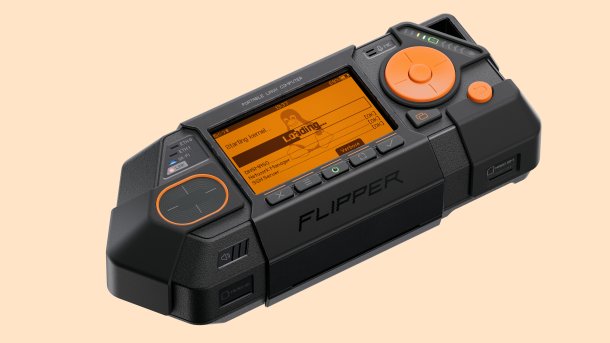
The Flipper One in top view: The amber-look LCD and the case shape still recall the first Flipper Zero.
(Image: Flipper Devices)
The Flipper Zero is a Tamagotchi and a hacker tool in one: the gadget masters various (short-range) radio protocols, can be expanded with additional modules via GPIO pins, and has since become a game console. This not only spawned imitators but also led to calls for a successor.
The Flipper One, now introduced, bears all the hallmarks of a sequel: name plus an increased version number, similar appearance, and operating concept. However, as the manufacturer has now announced, it will be an entirely different device. Above all, the “One” will be one thing: open – for extensions, collaboration, and further development. Flipper Devices CEO Pavel Zhovner is now asking the global developer community for help with his goals: Flipper One should become the most open and best-documented ARM computer in the world, all components should function without binary drivers, and an innovative operating concept should be implemented. These are ambitious goals, Zhovner admits, and states: “We are really scared.”
Prototyp des Flipper One (7 Bilder)

Flipper Devices
)Videos by heise
Multitool for Networking, Travel, and Hacking
The expandability and significantly stronger hardware compared to the Flipper Zero, but also to many Raspberry mini-computers, make the Flipper One, according to its creator, a universal tool for networkers. For example, as a travel router or for troubleshooting in corporate networks. However, the Flipper One is also intended to serve well as an emergency desktop computer or a travel media center.
And indeed, the published specifications for the Flipper One appear appealing to network tinkerers, Linux fans, and hackers. In addition to the 8-core RK3576 SoC with GPU and NPU, a dual-core RP2350 microcontroller also works on the device. Both share 8 GB of main memory. Two Ethernet ports, USB-C, a full-size HDMI port, and of course WLAN are planned. Via an M.2 expansion slot (Key-B), the Flipper can be expanded with plug-in cards of types 2242, 3042, and 3052 up to construction height D3.
Those who need more wireless range have access to four SMA sockets on the back of the housing and can, for example, connect the antenna connectors of an M.2 WLAN adapter to them. Satellite modems could also be connected this way; Flipper One also supports the NTN protocol, which is also satellite-based.
Linux – as open as possible
The operating system “Flipper OS” is also intended to herald a departure from the status quo in ARM-based mini-computers. The state of Linux under ARM is “depressing” and dominated by proprietary binary drivers, Zhovner complains. Together with the Collabora team, the Flipper developers have now brought support for the RK3576 SoC into the Linux kernel to reduce such dependencies. Goal: a completely open platform that supports any Linux. And Zhovner has also set himself ambitious goals in the other direction. The operating concepts and graphical interface he envisions for his Flipper One should also work on other mini-computers, ideally with just one “apt install” command.
A lot of work, and they are “not 100 percent sure what the architecture will look like,” says Zhovner. Therefore, the project is asking for active participation and has launched a developer portal for this purpose. Those who want to help can find information there on how to get involved in one of the six sub-projects: Hardware, Mechanics, Linux, UI, Firmware, Documentation, and Testing.
One is coming – when?
However, the announcement leaves some information missing: when the device will be released and what it will cost. One can only speculate about the release date; at least a functional prototype has existed since February of this year. The price, on the other hand, is likely to be aimed more at affluent gadget enthusiasts. Zhovner had already hinted months ago that the RAM crisis and general increase in hardware component prices threaten the project's economic viability and will drive up the price. The Flipper Zero's €219 will likely be significantly exceeded by the One, and the street price could even be four figures.


(cku)


