


New process simplifies lithium extraction from ore
A new process enables the extraction of lithium from ore in a simple, inexpensive, and environmentally friendly way. An MIT spin-off wants to market it.
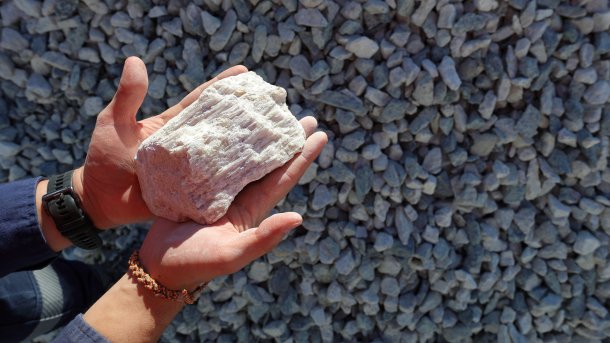
Lithium-containing mineral spodumene: lithium salts, lithium fluoride, silicon dioxide
(Image: BJP7images / Shutterstock.com)
Lithium is one of the sought-after raw materials of our time. A new process is intended to make its extraction simpler, cheaper, and less environmentally damaging. It was developed by researchers at the Massachusetts Institute of Technology (MIT).
Lithium can be extracted in two ways: It can be extracted from salt lakes in South America, such as Bolivia, with high water consumption. Or it can be mined as lithium-containing ore. However, extracting it from ore is complex. The process developed by MIT researchers simplifies it.
The team led by Camden Hunt takes the opposite approach to the currently used method: Instead of dissolving lithium from the lithium-containing mineral spodumene, they dissolve the spodumene into its components at room temperature. The team achieves this with ammonium hydrogen difluoride (NH4HF2) in an aqueous solution, which breaks the stable bond between silicon and oxygen and reacts with the metals in the spodumene.
This creates the fluoride salts lithium fluoride (LiF), ammonium cryolite (NH4)3AlF6), and ammonium hexafluorosilicate (NH4)2SiF6). These are then further processed: the lithium fluoride is converted into lithium hydroxide or lithium carbonate for battery production. Aluminum oxide can be obtained from ammonium cryolite in several steps, which can then be smelted into aluminum. Silicon dioxide, used for cement production, can be made from ammonium hexafluorosilicate. The ammonium hydrogen difluoride and water can largely be recycled, creating an almost closed material loop.
Inspiration from bathroom renovation
The idea came to MIT materials researcher Ming Chiang while renovating his bathroom: He wanted to treat transparent glass blocks so that they were no longer transparent but only translucent. In a hardware store, he found a paste that etched the surface of the glass, achieving the desired effect.
He remembered this paste, containing ammonium fluoride as the active ingredient, when he was looking for a way to split spodumene. Like glass, spodumene is mainly composed of silicon dioxide.

Lithium is an important component of batteries and thus one of the most sought-after raw materials. The methods currently used to extract lithium from spodumene work in reverse: they dissolve the desired raw materials, in this case lithium, from the silicate framework. However, this requires heating the mineral to about 1000 degrees Celsius and then treating it with acids.
This process is energy-intensive – emitting large amounts of carbon dioxide – and environmentally harmful due to toxic wastewater. Furthermore, this type of lithium extraction mainly takes place in China, which further increases dependence on this country for raw materials.
Videos by heise
High water consumption
In addition, this method is expensive – significantly pricier than extracting lithium through evaporation. However, the latter requires large amounts of groundwater, which has significant environmental impacts in the dry regions of South America.
“By 2040, we need to quadruple global lithium production, which requires hundreds of new lithium production facilities,” said Hunt, one of the authors of the study published in the journal Science. Lithium ores are abundant – including in Germany. But processing is mainly done in China.
“Our central thesis is,” said Hunt: “If you can find an easier way to break up the rock, extract the lithium, and make battery-grade lithium salts, you can change the lithium market. This aligns with current efforts to produce critical minerals in the USA.”
The team has already spun off the company Rock Zero from MIT to market the process. It is expected to compete with evaporation-based extraction in terms of cost.


(wpl)

