


RISC-V FPGA board is aimed at beginners
Microchip has released the RISC-V based FPGA development board PolarFire SoC Discovery Kit and offers comprehensive online training.
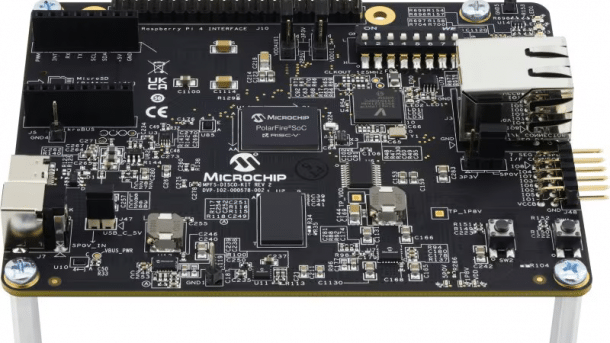
(Image: Microchip [Link auf https://www.microchip.com/en-us/development-tool/mpfs-disco-kit])
- Daniel Schwabe
Microchip has released a RISC-V FPGA board. It is based on Microchip's 5-core, 667 MHz MPFS095T-1FCSG325E FPGA with 95K logic elements and 4 64-bit RISC-V cores, a 1 gigabyte main memory and a micro SD card slot. Linux can be installed on the board via the SD card slot. The PolarFire SoC Discovery Kit also has Gigabit Ethernet.
The ports are supplemented by three UART connections via USB type C, a MIPI connection (Mobile Industry Processor Interface) and a MicroBUS connector, which can be used to connect boards from the MikroE-Click ecosystem. There is also a 7-segment display connection and a 40-pin connector, which is known as the "Raspberry Pi Connector". The extent to which the PolarFire SoC Discovery Kit is compatible with Raspberry Pi hardware is not specified.
Videos by heise
The board is intended for beginners in FPGA and RISC-V development. Therefore, a collection of webinars is available as support, which explain the handling and development of the single-board computer. These watch-on-demand webinars are held by various industry partners, always about the PolarFire SoC.
A FlashPro 5 is installed directly on the board for programming. To get started, the PolarFire SoC only needs to be connected with a USB to J4 cable. It can then be loaded with FlashPro Express.
The board measures 10.4 cm x 8.3 cm and is available from the Microchip store for 123 euros.
On this page there are also links to design files and the official GitHub page. The reference design kit is already available there.
If FPGAs are still too powerful for you, our MicroPython board overview will certainly help you get started with a project.


(das)


