


Pentesting: Kali Linux 2024.2 uses new time counting and updates desktop
The makers of the pentesting distribution Kali Linux have released version 2024.2. This updates packages and the desktop.
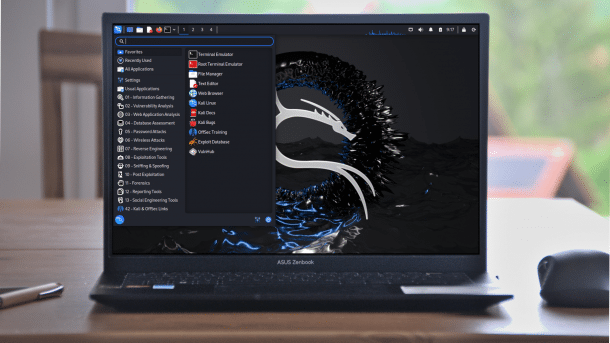
(Image: heise online / dmk)
The pentesting Linux distribution Kali Linux is now available in version 2024.2. The latest version brings a new time count, an updated desktop environment and new community packages.
A new time count refers to the size of the time_t variable type. This stores the Unix timestamp in seconds since the "Unix epoch". The actual size depends on the system architecture. On architectures with 32-bit time_t, there will be a round trip into the negative number range in 2038. To prevent this, it is necessary to switch to a 64-bit time_t data type. Since Kali Linux is based on Debian Testing as a rolling distribution, the quality assurance automation came into massive trouble - it ensures that packages are not rolled out if they cause problems in Kali Linux. And this was the case when Debian adapted the data type in Testing.
Problem case t64 transition
Changing such a fundamental and frequently used data type is a big deal, the Kali maintainers write in the version announcement. Many packages have to be completely rebuilt for this, as the Application Binary Interface (ABI) changes. The Kali distributions for ARM processors (e.g. for the Raspberry Pi) are particularly affected by this; for the i386 architecture, however, time_t remains a 32-bit data type. For users of ARM64 and AMD64 architectures, only many package updates with the suffix "t64" will be visible. Users on armel or armhf boards should make sure to update the distribution with apt full-upgrade instead of apt upgrade.
Videos by heise
In addition to this fundamental change, the maintainers have updated the desktop environment to Gnome 46. As expected, this provides a more polished user experience. The Xfce desktop, which is also available, now supports Kali Undercover (a collection of scripts that gives the Kali interface a Windows 10-like look) and high-resolution HiDPI modes.
In addition, new pentesting tools for security analyses have been added, several of which were contributed by the community, which the Kali maintainers are pleased about. A list can be found in the version announcement. Kernel 6.8 did not make it into the release, but is expected to follow shortly. Kali Nethunter, a version of the pentesting framework for Android smartphones, now supports Android 14 and has received various bug fixes. New Nethunter kernels run on the Huawai P9 with LinageOS 16, Nothing Phone 1 with Android 12, 13 and 14, as well as on the Poco F3 with Android 14.
Updated images for various platforms, processor architectures and virtualizers are available for download on the Kali project's download page.

Kali Linux 2023.4, which was released around six months ago, had major innovations to offer. For example, it ran for the first time on the Raspberry Pi 5, in cloud VMs such as Amazon's AWS and Microsoft's Azure and came with new tools.


(dmk)

