


Event Horizon Telescope achieves sharpest radio image of the Earth to date
The Event Horizon Telescope increases the resolution by 50 percent and allows more detailed insights into black holes at a wavelength of 0.87 mm.
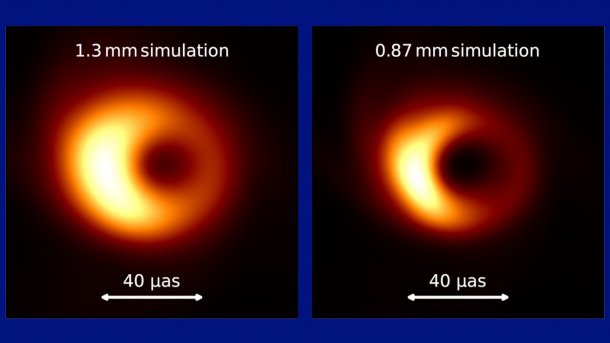
Computer simulations show the emission near the event horizon of a black hole at wavelengths of 1.3 mm (left) and 0.87 mm (right). They show how many details become visible when observing a black hole at shorter wavelengths.
(Image: Christian M. Fromm, Julius-Maximilian University, Würzburg)
The Event Horizon Telescope (EHT) has achieved a resolution record in radio astronomy: for the first time, observations have been made at a wavelength of just 0.87 millimetres (corresponding to a frequency of 345 GHz), which enables the highest angular resolution of ground-based telescopes to date. This should make it possible to produce even sharper images of black holes and their immediate surroundings in the future. The angular resolution increases with decreasing observation wavelength, so that observations at shorter wavelengths allow an even sharper view of the immediate surroundings of the black holes.
An international team of around 140 researchers led by Alexander Raymond and Sheperd Doeleman reports in the journal "The Astronomical Journal" on successful interferometric test observations that were carried out in October 2018 with a telescope group consisting of ALMA, APEX, GLT, IRAM-30m and NOEMA. They succeeded in detecting radio sources with radio telescopes up to 9500 kilometers apart, which corresponds to an angular resolution of around 19 microarcseconds. According to the Max Planck Institute for Radio Astronomy (MPIfR) in Bonn, this is comparable to the size of the cap of a fruit juice bottle on the moon, to illustrate the precision . The MPIfR operates the Atacama Pathfinder Experiment (APEX) telescope involved in the measurements.

(Image: ESO/M. Kornmesser)
The observations at a wavelength of 0.87 millimeters represent an improvement in resolution of around 50 percent compared to the previous EHT observations at 1.3 millimeters. This enables an even sharper view of the immediate surroundings of supermassive black holes such as Sagittarius A* in the center of our Milky Way or M87* in the Messier 87 galaxy.
According to the research team, considerable technical challenges had to be overcome in order to be able to use this extremely short wavelength. The atmosphere is significantly more opaque at 0.87 millimetres than at longer wavelengths, which makes observations more difficult. In addition, the telescopes must be synchronized with the highest precision to enable interferometric measurements over such large distances.
The EHT uses the technique of Very Long Baseline Interferometry (VLBI), in which globally distributed radio telescopes are interconnected like a single gigantic telescope. The new observations at 0.87 millimetres promise not only sharper images of black holes, but also new insights into the physics in their extreme environment. In the future, it could be possible to directly image the so-called photon sphere – the area in which light is trapped in a circular path around the black hole –.

(Image: Alexander W. Raymond et al.)
It will also open up new possibilities for studying the jets emitted by many active galactic nuclei. "At shorter wavelengths, we can zoom in closer to the origin of the jets and better understand how they are created and accelerated," explains Raymond.
The researchers are already planning further improvements to the EHT network in order to further increase sensitivity and equip more telescopes for observations at 0.87 millimetres. The aim is to be able to record not only static images, but even "movies" of the dynamic environment of black holes in the future. "The combination of the IRAM telescopes in Spain (IRAM-30m) and France (NOEMA) with ALMA and APEX will make it possible in future to image even smaller and fainter emissions than before at two wavelengths, 1.3 mm and 0.87 mm, simultaneously," says Thomas Krichbaum from MPiFR, one of the co-authors of the publication.
Empfohlener redaktioneller Inhalt
Mit Ihrer Zustimmung wird hier ein externes YouTube-Video (Google Ireland Limited) geladen.
Ich bin damit einverstanden, dass mir externe Inhalte angezeigt werden. Damit können personenbezogene Daten an Drittplattformen (Google Ireland Limited) übermittelt werden. Mehr dazu in unserer Datenschutzerklärung.
EHT: Developed for imaging black holes
The EHT was developed to take direct images of black holes for the first time. In April 2019, it published the first image of the black hole in the galaxy M87, followed by an image of Sagittarius A* in the center of the Milky Way in May 2022.
The network consists of several radio telescopes distributed around the world – from Greenland to the South Pole. The distances between each pair of radio telescopes are called baselines. A plane radio wave incident at a small angle to the perpendicular of the baseline reaches one of the telescopes a little earlier than the other. The difference in transit time indicates the angle of incidence to the vertical. The longer the baseline, the greater the transit time difference for a particular angle and the smaller the angular differences can be distinguished.
By combining the data from these telescopes, the EHT achieves an extremely high angular resolution. The observations require an enormous technical effort. The telescopes record huge amounts of data – during the first observation campaign in 2017, totaling 3.6 petabytes. This data is then elaborately processed using supercomputers to generate images.
The EHT usually works at a wavelength of 1.3 mm. It can therefore "see" 5000 times sharper than the Hubble Space Telescope. With the shorter wavelength of 0.87 mm, the resolution can be almost doubled, albeit at a higher processing cost.
The EHT is planning further improvements for the future. Even more telescopes are to be integrated, which should enable even sharper images and even video sequences of black holes. In the long term, space telescopes could also be connected to further increase the resolution.


(vza)


