


macOS 15: These features are missing on Intel Macs
Once again, Apple is only giving Apple Silicon machines all the new macOS features. For the foreseeable future, updates will be discontinued altogether.
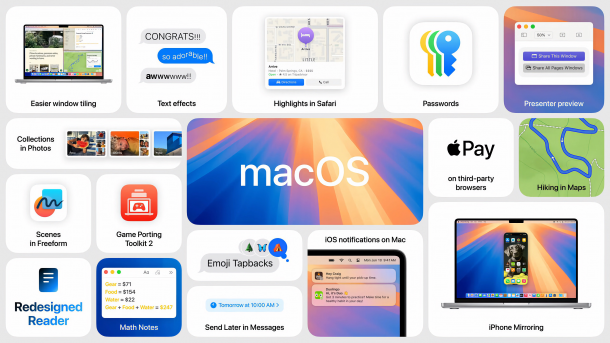
(Image: Apple)
The death knell is slowly ringing for Intel Macs: Apple is likely to discontinue support for x86 processors altogether in the coming years. However, macOS 15 alias Sequoia, which was released on Monday, can still run on these machines. However, as usual, this does not apply to all functions. Apple is only making key new features available for Macs with Apple Silicon, i.e. computers with M1, M2 or M3.
Functions that you will have to do without
For several versions of macOS, Apple has only provided all features to computers with its own chips. This is no different in macOS 15. Apple Intelligence, which unlike the iPhone and iPad can also be used on the Mac in Europe, is completely missing. There are no writing tools in macOS 15.1, which will be released in October, and there will also be no image generators. Apple will also not be implementing the transcription of audio in English in the Voice Memos and Notes app. The same applies to summaries of documents.
At least things are looking better in other areas. The new Passwords app, the new window management, the new integration of reminders and calendar and even iPhone mirroring (unfortunately not in the EU) are coming to Intel Macs. Apple could have been "nastier" here.
Intel is still going – but probably not for long
macOS 15 can normally be used on all Intel Macs that have a T2 co-processor, which provides security functions, among other things. However, there are a few exceptions. Basically, the operating system runs on the iMac from 2019, the iMac Pro from 2017, the MacBook Air from 2020, the Mac mini from 2018, the MacBook Pro from 2018 and the Mac Pro from 2019 (plus Mac Studio from 2022, which never existed as an Intel version). A complete list for cross-checking your own configuration can be found on Apple.com.
Videos by heise
It is currently unclear how long Apple will continue to release macOS for Intel machines. On average, Intel Macs have received updates for six to seven years, which would mean that at least macOS 16 or even macOS 17 are still compatible. Alternatively, Apple could only offer macOS 16 for a few Intel machines and end support completely with macOS 17 in 2026. The most radical option would be to cut off the Intel braids with macOS 16 in the fall of 2025. In principle, the switch to Apple Silicon machines has long been worthwhile. The computers that have been on the market since 2020 are more powerful, run cooler and rarely require the fan to be activated. Software problems are practically non-existent – There is just no Boot Camp for Intel Windows anymore and, of course, only ARM Windows runs in virtual machines.
Empfohlener redaktioneller Inhalt
Mit Ihrer Zustimmung wird hier ein externer Preisvergleich (heise Preisvergleich) geladen.
Ich bin damit einverstanden, dass mir externe Inhalte angezeigt werden. Damit können personenbezogene Daten an Drittplattformen (heise Preisvergleich) übermittelt werden. Mehr dazu in unserer Datenschutzerklärung.


(bsc)


