


Samsung Galaxy Tab S10 Ultra and S10+: Turn three into two
With the new tablet series, Samsung is reducing the number of models, with the small Galaxy Tab S10 falling behind.

Samsung Galaxy Tab S10 Ultra
(Image: heise online/sht)
The Samsung Galaxy Tab S10 is not coming, but the Tab S10 series is. Samsung has canceled the smallest model without replacement and left it with two new Android tablets: Galaxy Tab S10 Ultra and Galaxy Tab S10+. Both have a lot to offer.
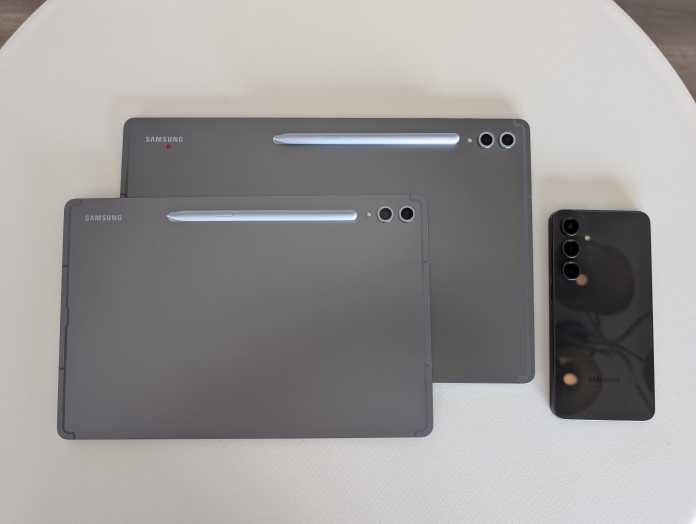
The new Galaxy tablets are outrageously flat. Without the camera, Samsung specifies a "thickness" of 5.6 millimetres for the Tab S10+ and 5.4 millimetres for the Tab S10 Ultra. The edges around the 12.4-inch and 14.6-inch displays are only a few millimetres thin, with only a small bump around the 12-megapixel front camera. The aluminum housings are IP68-protected, so the tablets can get dirty or wet. Gorilla Glass 5 protects the front against scratches. The Tab S10 Ultra weighs around 720 grams, while the S10+ weighs a good 570 grams.
The displays in both tablets are OLED panels with a flexible refresh rate of 60 to 120 hertz. The resolution of the large Galaxy Tab S10 Ultra is 2960 x 1848 pixels, while the slightly smaller S10+ has 2800 x 1752 pixels. You can not only swipe around on the touchscreen with your finger, but also use the S Pen. The pen is included with both tablets. It attaches magnetically to the back and is charged inductively.
Mediatek instead of Qualcomm or Exynos
Unlike their predecessors, the new tablets are not powered by Qualcomm processors, but by Mediatek chips. The Dimensity 9300+, which is also found in the Xiaomi 14T, delivers comparable performance to the Snapdragon 8 Gen 3 in benchmarks. Samsung promises 17 percent more computing power and 30 percent more graphics power compared to the Tab S9 Ultra, and 12 percent more performance for AI tasks. A new, larger vapor chamber is intended to keep waste heat in check. The detailed test will show whether this is successful. In the short hands-on, both tablets made their usual fast impression; we did not notice any lag, charging pauses or stutters. The battery of the Galaxy Tab S10 Ultra has a capacity of 11200 mAh, while the S10+ has barely less at 10090 mAh. Both charge exclusively via cable with a maximum of 45 watts.
The Galaxy Tab S10 Ultra is available in three storage variants: 12/256 GB, 12/512 GB and 12 GB/1 TB. Samsung does not offer the large variant with the Galaxy Tab S10+. Both tablets have a slot for a microSD card and optional 5G support. The Tab S10 Ultra uses the standard Wifi 7 at close range, while Wifi 6E is sufficient for the S10+. The main camera has a 13-megapixel sensor, while the ultra-wide-angle camera takes photos with a maximum of 8 megapixels.
Samsung Galaxy Tab S10 Ultra und S10+ (9 Bilder)
Samsung Galaxy Tab S10 Ultra und S10+
heise online/sht
)Samsung's tablet software can almost turn Android into a desktop operating system if desired. In DeX mode, which can be started with a keyboard and/or mouse even without an external display, it is also quite comfortable to work on the go. The system is based on Android 14 and Samsung promises seven years of updates. The Galaxy AI, whose functions can be switched on and off individually, is also included. Exciting for pen artists: the AI creates almost works of art from doodles with just a few strokes, and in different styles.
Videos by heise
The range of accessories includes various covers and sleeves for the tablets. Pre-order customers receive the Smart Book Cover Slim with keyboard at no extra charge, for which Samsung regularly charges just under 100 euros.
The Wi-Fi version of the Samsung Galaxy Tab S10+ costs 1119 or 1239 euros, depending on the memory. With 5G it is 150 euros more in each case. The Galaxy Tab S10 Ultra starts at 1339 euros with Wi-Fi and small memory, while the top model with 5G and 1 TByte tears a 1909 euro hole in your wallet.
Empfohlener redaktioneller Inhalt
Mit Ihrer Zustimmung wird hier ein externer Preisvergleich (heise Preisvergleich) geladen.
Ich bin damit einverstanden, dass mir externe Inhalte angezeigt werden. Damit können personenbezogene Daten an Drittplattformen (heise Preisvergleich) übermittelt werden. Mehr dazu in unserer Datenschutzerklärung.


(sht)


