


2024 Nobel Prize in Physics for machine learning
This year's Nobel Prize in Physics goes to two researchers who have made machine learning with artificial neural networks possible.
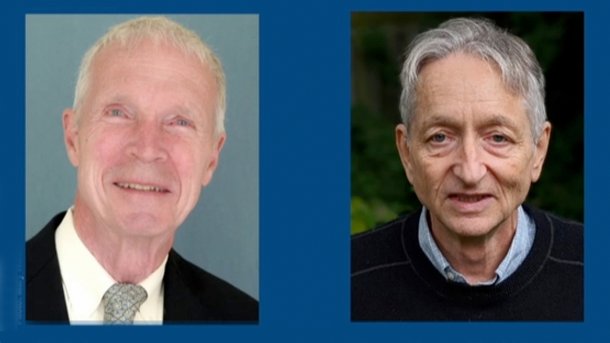
John J. Hopfield (l.), Geoffrey E. Hinton
(Image: Mary Waltham / University of Toronto)
This year's Nobel Prize in Physics goes to John Hopfield from Princeton University and Geoffrey Hinton from the University of Toronto. This was announced by the Royal Swedish Academy of Sciences today, Tuesday, in Stockholm.
The researchers won the prize for groundbreaking discoveries and inventions that enable machine learning with artificial neural networks. John Hopfield and Geoffrey Hinton used tools from physics to develop methods that helped lay the foundation for today's powerful machine learning. Machine learning based on artificial neural networks is currently revolutionizing science, technology and everyday life.
Nobel Prize for neural networks
With their research, the Nobel Prize winners laid the foundation for machine learning and artificial intelligence. While AI has only been attracting attention in everyday life for a few years, machine learning has been an important part of research for 15 to 20 years. The development of artificial neural networks was fundamental to this.
Using concepts and methods from physics, Hopfield and Hinton were able to develop technologies to evaluate information using neural networks. Machine learning is fundamentally different from the way conventional software works. While this information is processed according to a predefined recipe, in machine learning a computer learns with the help of examples.

(Image: Johan Jarnestad/The Royal Swedish Academy of Sciences)
Although computers cannot think for themselves, they can imitate human abilities such as thinking and learning. The inspiration for neural networks came from brain research. In the 1940s, researchers were puzzling over the mathematics that underpinned the network of neurons and synapses in the brain. Added to this were theories by neuroscientist Donald Hebb about how the brain learns thanks to the connection between neurons.
Hopfield network
After researchers had long thought that neural networks would not provide any real benefit, the research of this year's Nobel Prize winners in the 1980s sparked renewed interest in them. Physicist John Hopfield was researching theoretical problems in molecular biology when he first came across brain research at a meeting on neuroscience. This fueled his interest in neural networks.
When neurons work together, they produce phenomena and properties that are not recognizable when you look at each neuron individually. Hopfield was familiar with similar phenomena from physics. In magnetism, for example, the spin of individual atoms gives a material consisting of countless atoms its magnetic properties.
He used this prior knowledge to model the so-called Hopfield network. Just as the spin of an atom can assume the values 0 and 1, the nodes of his network could assume two different values. The network of neurons he modeled was able to store patterns and restore them. When the network received incomplete or distorted information, it was able to identify the stored pattern that most closely resembled it.

(Image: Johan Jarnestad/The Royal Swedish Academy of Sciences)
Hopfield himself compared the memory of his network to a hilly landscape. The new information corresponds to a ball that is placed in this landscape. The ball automatically rolls to the lowest point of the landscape – which corresponds to the stored pattern that most closely resembles the information.
Recognizing categories
Geoffrey Hinton, on the other hand, was concerned not only with storing information, but also with interpreting it. People learn to recognize patterns by perceiving the world around them. After a child has seen a few dogs, cats or birds, it can reliably recognize and assign them. Hinton asked himself whether machines could recognize patterns in the same way as humans without having to be given categories to sort and interpret them.

Together with his colleague Terrence Sejnowski, Hinton used the Hopfield network and methods from statistical physics to solve this problem. Statistical physics deals with large systems composed of many similar particles, such as gases. While it is difficult to describe so many particles individually, it is possible to consider them together and thus describe the properties of a gas, such as its temperature or pressure.
The probability of different configurations in which the individual particles can exist is described by the so-called Boltzmann equation. Some states are more probable than others, depending on their energy. Hinton used this equation to describe a neural network. This machine learns with the help of training data, can generate new patterns that are similar to the training data and identify categories. This so-called Boltzmann machine was one of the first forms of a generative model.
Foundation for modern AI
With their research, Hopfield and Hinton laid the foundations for machine learning, which caused a revolution in the 2010s. Today's neural networks consist of many layers and can process huge amounts of data. These are deep neural networks and the basis for deep learning.
While physical methods have helped in the development of neural networks, today neural networks are used in physical research. These have made it possible, for example, to analyze the gigantic amounts of data that led to the discovery of the Higgs particle.
The Royal Swedish Academy of Sciences contacted Hinton by telephone shortly after the announcement. The AI researcher believes that artificial intelligence will have a huge impact on humanity. "It will be comparable to the Industrial Revolution, but instead of surpassing humans in physical strength, it will surpass humans in intellectual ability."
At the same time, Hinton is critical of the use of AI. Last year, he quit his job at Google Brain, the company's AI research team, in order to be able to speak freely about the risks of AI. He did this together with other scientists last May in the journal Science. "We have no experience of what it's like when things are smarter than us," he said during the announcement. This could lead to a more efficient healthcare system and increased productivity. "But we also have to worry about a number of potential negative consequences. Especially about the risk of these things getting out of control."
Molecular short films in 2023
Last year, the Nobel Prize in Physics went to Anne L'Huillier, a Frenchwoman researching in Sweden, Pierre Agostini, a Frenchman researching in the USA, and Ferenc Krausz, a Hungarian-Austrian physicist researching in Germany. The prizewinners succeeded in generating ultrashort laser pulses with a length of just a few attoseconds. An attosecond lasts only a billionth of a billionth of a second. This method enables researchers to resolve the movement of electrons in atoms and molecules, display it on film and thus investigate it.
The Nobel Prizes go back to the dynamite inventor and prize donor Alfred Nobel (1833-1896). According to his will, the prizes are intended to honor those who have made the greatest contribution to humanity in the respective prize categories in the past year. The physics category is the first that Nobel mentioned in his will.
Since the first prize was awarded in 1901, 224 different Nobel Prize winners in physics have been awarded, including only five women. Only the US physicist John Bardeen has received the award twice in the physics category.
Nobel Prize in Medicine for US researcher
The Nobel Prize winners for Physiology and Medicine were announced on Monday. This year, the award goes to the US-Americans Victor Ambros and Gary Ruvkun for their discovery of microRNA and its role in gene regulation.
Videos by heise
All Nobel Prizes this year are endowed with eleven million Swedish kronor (approx. 970,000 euros) per category. If more than one laureate is awarded, the prize money is divided among them. Traditionally, the prizes are presented at a ceremony on the anniversary of Nobel's death on December 10.
This message was updated at 16:51.


(spa)

