


Microsoft and OpenAI show the first Nvidia Blackwell systems
Nvidia delivers the first Blackwell GPUs. Microsoft and OpenAI show their systems – one of them with a huge heat sink.
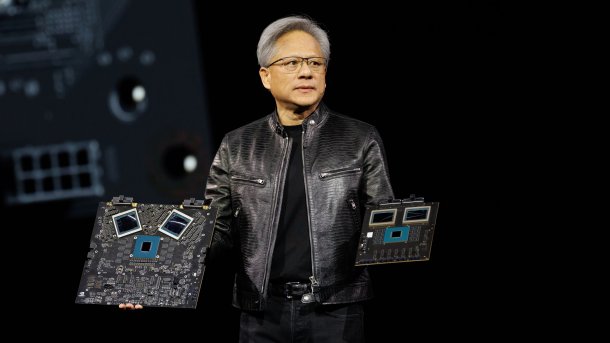
Nvidia's boss Jensen Huang with various GB200 models.
(Image: Nvidias)
It has become a tradition for OpenAI to be the first company to receive new AI accelerators from Nvidia. This year it is the turn of a DGX B200 system. It uses eight B200 accelerators from the Blackwell generation, driven by two Intel Xeon Platinum 8570 processors (56 CPU cores each, Emerald Rapids).
Nvidia sells the whole thing as a complete system with an AI computing power of 72 petaflops in the data formats FP8, FP6 and INT8. With the previously rare FP4, 144 petaflops are also possible. Each GPU in the B200 version consumes up to 1000 watts – an entire DGX-B200 system comes to 14.3 kilowatts.
Microsoft's own creation
Microsoft has also received Blackwell boards, but in the form of GB200 models. A GB200 consists of two B200 GPUs and an ARM Grace CPU from Nvidia. The actual hardware is located in the rack on the left, including eight GB200 slots and nine NVLink switch slots from Nvidia. At least the left-hand section is very similar to Nvidia's GB200-NVL72 rack.
In contrast, the right-hand section for cooling the GPUs, CPUs and switches looks downright massive: it is twice as wide as the attached hardware cabinet and contains a large heat exchanger at the rear. The chips themselves are water-cooled.
A cooling system like this is normally sufficient for several hardware racks. The Serve The Home website, which specializes in servers, lists cooling solutions from CoolIT that can dissipate up to 240 kilowatts in a similar size. That would be four complete GB200 NVL72s with a total of 144 GB200 boards or 288 B200 GPUs.
Videos by heise
Microsoft will presumably be showing a test system to which additional hardware will be connected later.
Nvidia has so far only produced the Blackwell GPUs in small batches. Together with the chip contract manufacturer TSMC, Nvidia has adapted the design at short notice in order to increase the chip yield. Series production is therefore not scheduled to start until between November 2024 and the end of January 2025. Huge announced Blackwell supercomputers are therefore not expected until later in 2025.
Empfohlener redaktioneller Inhalt
Mit Ihrer Zustimmung wird hier ein externer Preisvergleich (heise Preisvergleich) geladen.
Ich bin damit einverstanden, dass mir externe Inhalte angezeigt werden. Damit können personenbezogene Daten an Drittplattformen (heise Preisvergleich) übermittelt werden. Mehr dazu in unserer Datenschutzerklärung.


(mma)


