


Microsoft: Create your own AI agents with Copilot Studio from November
From next month, companies will be able to use Copilot Studio to create their own AI agents to automate tasks. The competition already does this.
(Image: Microsoft)
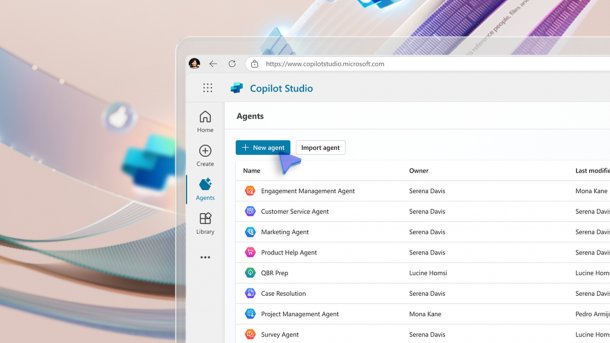
Microsoft has announced that customers will be able to use Copilot Studio to create their own AI agents tailored to specific tasks from November. The US company calls these agents the "new apps for an AI-driven world". In future, organizations will have a whole range of them, from simple applications that become active on request ("prompt") to "fully autonomous" ones. They would work for individuals, departments or company-wide, Microsoft predicts. Copilot Studio is the point of contact for interacting with the AI agents. The competition from OpenAI has long made it possible to build your own GPTs, which can be offered in a kind of app store.
Supporting employees, not replacing them
The agents have long been in use at Microsoft itself and are extremely successful. For example, one sales team has been able to significantly increase turnover and conclude many more contracts. Another team was able to conclude customer inquiries much more quickly. Even the companies that already use their own AI agents have already attested to major improvements. The use of AI agents can therefore drastically speed up time-consuming processes. The AI applications can access internal company data and help with a wide range of different and very diverse tasks. Microsoft is now also making ten of its own agents available.
Videos by heise
In the announcement, Microsoft emphasizes that the so-called agents help human employees with their work. This also implies that they are not intended to replace them. At the same time, the company points out that the US company Honeywell has identified productivity gains thanks to AI technology that would correspond to 187 new employees. However, with almost 100,000 employees, this seems marginal so far. The concern that AI technology will make a large number of jobs obsolete in the long term has not disappeared, but has recently receded into the background.



(mho)

