


Chinese researchers: Quantum annealer breaks through encryption techniques
Chinese researchers claim to have successfully attacked an encryption algorithm for the first time using a quantum computer.
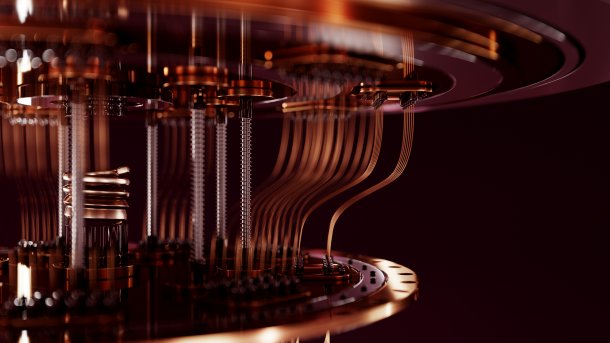
(Image: Bartlomiej K. Wroblewski/Shutterstock.com)
In the vast majority of cases, encryption algorithms are not used to conceal secret messages. More often, cryptography is used to secure business transactions, authenticate people on the Internet or ensure that updates are only imported from reliable sources.
This makes it all the more worrying to think that the security of conventional encryption methods is based solely on the fact that decrypting them takes a very, very long time. What would take thousands of years with conventional computers could – at least theoretically – be achieved much faster with quantum computers. So far, however, there are no quantum computers powerful enough to accomplish this.
Successful attack on encryption
A Chinese research team has now shown in principle how a modern encryption algorithm can be defeated using a quantum computer. This is reported by the industry portal The Quantum Insider. According to the report, the researchers have not cracked any specific passcodes. However, the Chinese newspaper South China Morning Post sees the attack as a "real and significant threat" to sectors such as banking and the military.
Moreover, the successful attack was not made possible by a universal quantum computer, but by a so-called "quantum annealer" from the Canadian manufacturer D-Wave. The company was the first in the world to offer commercially available quantum computers. However, only special optimization problems can actually be solved on the D-Wave quantum processors. The skill of the programmers is to first transform the specific problems to be solved into optimization problems so that they can be solved with a D-Wave processor. Wang Chao from the University of Shanghai and his team describe the technical details of the attack in an article for the Chinese Journal of Computers.
The authors emphasize that although the quantum computer has not yet uncovered the specific passwords of the algorithms tested, it was closer to the solution than ever before. As technology advances, further developments could lead to more robust quantum attacks, the researchers say.
Videos by heise
How does a quantum annealer work?
The D-Wave Advantage has a quantum chip with 5000 qubits. In principle, the qubits used by D-Wave are technically the same as those used by Google and IBM. But unlike there, the qubits in D-Wave cannot be addressed individually, only all at the same time.
The term annealing actually comes from materials science and refers to the heat treatment of metals and glass. In this process, defects from the manufacturing process, such as stresses or defects in the crystal structure, are "healed" at high temperatures. To maintain this healed state permanently, the material must then cool down slowly so that the atoms in it assume a state of minimal energy. D-Wave's quantum chip simulates this process, taking advantage of the fact that the qubits can "tunnel" between different energy states.
This article was first published on t3n.de


(mma)


