

For more range: Mercedes Benz researches "solar paint" for electric cars
With a "solar paint job", Mercedes-Benz wants to transform electric cars into small PV systems in the future in order to extend their range.
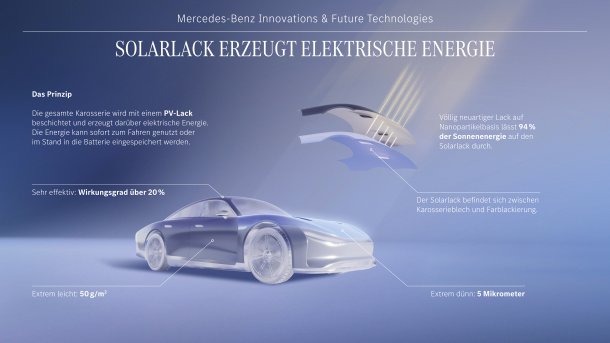
As soon as the sun shines, the electric car charges itself via PV modules. And not just via a solar roof, but across the entire surface. There have been many ideas along these lines in the past. Mercedes is now reviving the idea with a research project. According to the car manufacturer, it is developing a new type of solar module that can be seamlessly applied to all body parts in the form of a wafer-thin "paste". According to the car manufacturer, this could give an average-sized e-SUV 11 square meters of photovoltaic surface.
The photovoltaic layer, which is only five micrometers thick, is to be applied underneath the actual paint layer and will have an efficiency of 20 percent, which is roughly equivalent to what normal silicon solar cells achieve. The photovoltaic coating should also be free of rare earths and contain only non-toxic and readily available raw materials.
Doubts about economic viability
Equipping cars with solar modules is not a new idea in itself, but has proven to be less economical in practice. The Genesis brand, which belongs to the Hyundai Group, offers this for an extra charge. The yield proved to be quite clear in the test, but the surcharge was high.
Videos by heise
Detailed information on the costs or cost-effectiveness of the solar paint that Mercedes is now developing has not been made public, and it is currently only a research project. It is merely stated that the solar paint should be "considerably cheaper to produce than conventional solar modules". Referring to the example of the SUV with 11 square meters of PV surface, according to Mercedes-Benz, the car would produce enough electricity for around 12,000 km of driving per year "under ideal conditions" at the Stuttgart site.
Including charging losses, an e-SUV will consume an annual average of around 20 kWh/100 km. This means that around 2400 kWh would be required for 12,000 km. However, it is doubtful that Mercedes will be able to harvest this. Under favorable conditions, a conventional PV system with an area of 11 square meters would produce around 2500 kWh per year, which would be sufficient for 12,500 km of driving at an average consumption of 20 kWh/100 km including charging losses. However, the yield of a solar paint car is unlikely to be that high, if only because not all sides are exposed to sunlight at the same time.
(mch)