


Hyundai wants to build nuclear-powered container freighter
Ships should be climate-neutral by 2050. The South Korean company wants to achieve this with a nuclear propulsion system.
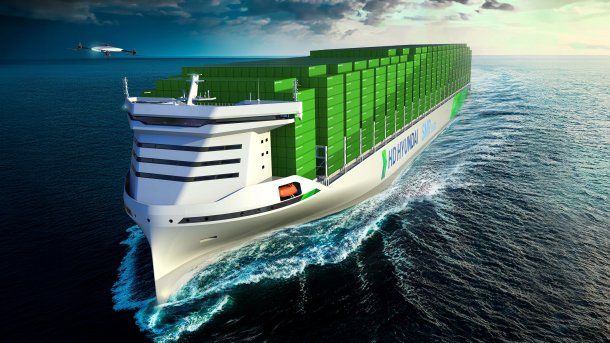
Concept of a nuclear-powered container freighter
(Image: HD KSOE)
Will the container freighter of the future be powered by a nuclear reactor? The South Korean shipyard HD Korea Shipbuilding & Offshore Engineering (KSOE) is planning to build a nuclear-powered container freighter.
HD KSOE presented the design for the ship at the New Nuclear for Maritime Houston Summit in Houston, Texas. According to the subsidiary of HD Hyundai Heavy Industries, it has already received approval in principle (AIP) for the project from the American Bureau of Shipping (ABS).
A molten salt reactor (MSR) is to supply the energy for the machines. Reactors of this type are operated with thorium and liquid salt is used as a coolant. Such an MSR is said to be safer than a pressurized or boiling water reactor.
Ship for 15,000 standard containers
The ship will have a capacity of 15,000 standard containers (Twenty-foot Equivalent Unit, TEU). This puts it in the class of Ultra-Large Container Ships (ULCS), currently the largest class of container freighters. The largest ships in this class, the MSC-Irina type of the Swiss shipping company Mediterranean Shipping Company (MSC), can transport more than 24,000 TEU.
HD KSOE presented the first concepts for a nuclear-powered ship last year. And the shipyard is not the only one working on this. The Chinese state-owned shipyard China State Shipbuilding Corporation (CSSC), for example, presented a concept for a nuclear-powered 24,000 TEU container freighter at the end of 2023.
Europe is not averse to the idea either: The Norwegian shipyard Ulstein presented its concept for a nuclear-powered ship in 2022. Last year, Rolf Habben Jansen, head of Hapag-Lloyd, told the news magazine Der Spiegel that the German shipping company was looking into the issue.
Proponents argue that nuclear ships do not emit carbon dioxide and other pollutants such as sulfur oxides, nitrogen oxides, soot particles and particulate matter. Shipping currently generates around 2.6 percent of man-made carbon dioxide emissions worldwide. Ships must be climate-neutral by 2050.
160 nuclear ships on the world's oceans
According to the lobby organization World Nuclear Association (WNA), there are currently around 160 nuclear ships, most of which belong to the navy, such as aircraft carriers and submarines. The only civilian ones are several nuclear icebreakers and an ice-going freighter, all under the Russian flag.
Videos by heise
The first nuclear ship ever was the submarine USS Nautilus, which was commissioned in 1954 and dived under the North Pole in 1958. The first civilian nuclear ships arrived in the 1960s. There were only five in total, including the Otto Hahn, which was launched in Kiel in June 1964.
They were not a success: construction and operating expenses were too high. In addition, the ships were not allowed to call at many ports. This could also happen today, as the industry magazine The Maritime Executive reported some time ago. According to this, passages through the Suez and Panama Canals, two of the world's most important shipping routes, could also become difficult.



(wpl)

