

BMW New class: Zone architecture and powerful computers
BMW has redesigned the electronics concept for the New Class platform from the ground up, with zones, high integration and plenty of computing power.
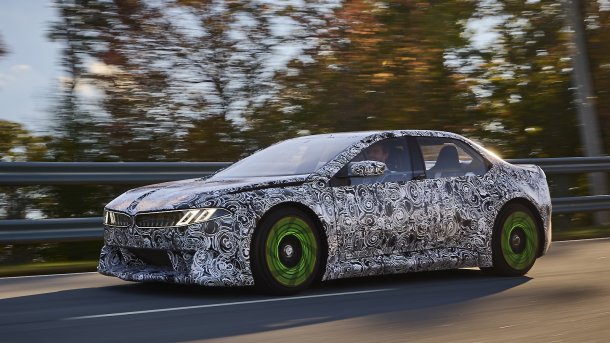
The official launch of the first models based on the New Class is scheduled for later this year.
(Image: BMW)
For the "New Class", BMW is completely overhauling fundamental aspects of the electronics architecture. The platform will be based on a modern zone architecture that drastically increases computing power. "This architecture allows us to decouple the development of the vehicle and software from each other," says Frank Weber, Board Member for Development at BMW AG. "The advantage: even more than today, all future BMW models will remain digitally up to date via over-the-air upgrades and will also receive updates from the next generation of vehicles and the generation after that." The engineers installed four computing devices in front of the passenger's feet in the car:
- "Core Brain" controls core functions such as vehicle access, air conditioning, comfort systems, lighting, data flow and processing and takes care of software updates.
- The "Brain of Panoramic iDrive" controls the same iDrive with the screens of the entire front console, 3D HUD, sound, navigation, entertainment in general and voice control.
- The "Brain of Automated Driving" takes care of driving automation. According to BMW, the computing power here has increased twenty-fold.
- Finally, "Heart of Joy" bundles the driving dynamics functions. As drive and chassis control now take place on one device, the latency of interactions is reduced to less than one millisecond. That is a tenth of the previous technology with separate controllers for the controls.

(Image: BMW)
Four zones
Advances in zonalization and electronic fuses allow BMW to save large quantities of expensive copper. Instead of a classic wiring harness with numerous direct connections between the control units, the New Class uses a zone architecture that divides the vehicle electrical system into four zones. For each zone, a zone controller bundles the energy and data flow for the sensors and actuators in the respective zone.
The zone controllers are connected to each other and to the computers via Ethernet. This massively reduces the amount of cable required, as power and switching signals only have to be switched the short distance from the zone controller to the respective consumers instead of, in extreme cases, through the entire car. The wiring can thus be significantly reduced. BMW claims to be able to manage with 600 meters less wiring per vehicle and 30 percent less wiring harness weight. Due to the price development of semiconductors and copper and a higher degree of automation in the production of the zonal wiring harness, the cost structure should also be right.
Programmable semiconductor switches
The classic fuse has also become obsolete for many applications in the New Class. Depending on the model, BMW is replacing up to 150 fuses with electronic fuses called "Smart eFuse". In principle, these are digitally programmable semiconductor switches that not only cut the current for line protection like a fuse, but can also be intelligently switched according to other aspects. BMW uses them to switch off consumers completely in a targeted manner. This means that the manufacturer is independent of how well suppliers implement quiescent current consumption on standby.
In the zone controllers, BMW works with state-controlled power modes in order to combine typical situations such as parking, charging, driving or software updates with the optimum switching in each case. The eFuses thus make a significant contribution to the energy efficiency of the New Class, which according to BMW should be up to 20 percent better than in the previous electronic architecture.

(Image: BMW)
Conclusion
BMW is using the new platform in many areas of production and vehicle technology to make a fresh start at the current state of the art. The new electronics architecture is a major step forward and allows a level of flexibility that was previously only possible at higher cost or not at all. The reduction in control units follows the current trend towards centralization of computing power. The different functional domains are integrated into the four computers. This increases both safety and flexibility enormously.
The significantly increased computing power in turn gives BMW the scope for future software improvements. From a technology enthusiast's point of view, it is great that BMW has used the opportunities offered by the new platform to introduce major advances behind the scenes. It brings to mind Mr. Jobs' famous quote from the carpenter: "Those who are passionate about their job always try to see it through to the last, unseen corner just as they do with the headlining features.

(nie)