

Autonomous driving in Germany: what is permitted is permitted
Germany has very progressive legislation for autonomous driving by global standards. A car here is allowed to do everything that its homologation permits.
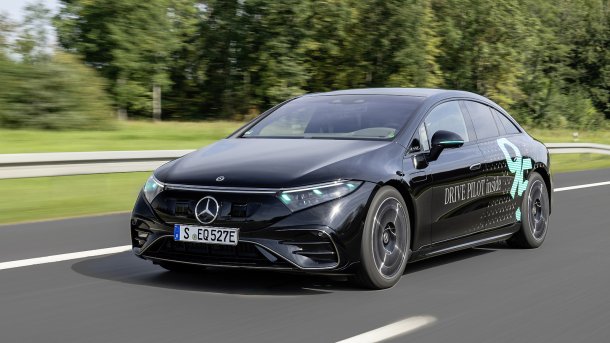
(Image: Mercedes)
- Christoph M. Schwarzer
"Verboten" is an internationally known German word alongside "Schadenfreude" or "Kindergarten". It is supposedly at the heart of our culture that stepping on the lawn and the washing machine rumbling at night are forbidden. However, there are things that are allowed in Germany and not elsewhere: autonomous driving, for example. Contrary to popular belief, Germany has particularly progressive legislation for autonomous driving compared to other countries in the world. What a car is allowed to do is determined by the homologation of the respective vehicle. This is the general authorization to allow a vehicle with certain characteristics to go into series production.
Specifically, the Federal Ministry of Transport (Bundesministerium für Digital und Verkehr, BMDV) points out that Germany has enacted the first ever legal framework for driverless vehicles according to Level 4. On normal public roads and outside of defined test scenarios, mind you. According to the BMDV, no application is excluded from the outset. The ordinance accompanying the law has been in force since July 1, 2022. The problem is the vehicles, i.e. cars and trucks. For the sake of simplicity, let's look at cars, although the logistics industry is extremely keen to do away with people behind the wheel.

(Image: Rimac)
UNECE defines the registration requirements
Cars must be registered – regardless of the drive type. The Federal Motor Transport Authority (Kraftfahrtbundesamt, KBA) is the authority that grants approval for all automation functions of a type. However, the legal framework is provided by the UNECE, i.e. the United Nations Economic Commission for Europe.
The nation states lobby the UNECE for what they think is right. For example, the approval of the Automated Lane Keeping System (ALKS) to Level 3 and up to 130 km/h is the result of a German initiative. Nevertheless, it is clear that much still needs to be done at the UNECE to clearly define what Level 4 autonomous driving means: a standardization, precise definition and unification of the requirements, which would make the national framework in Germany, for example, superfluous, is still pending. After all, everything that the UNECE regulates goes beyond what the car manufacturers actually deliver.
At Level 2, the driver is always responsible
What the manufacturers can deliver is usually level [2]. The Federal Highway Research Institute (BASt) calls this level "assisted driving". If a car takes over longitudinal control – i.e. acceleration and braking via adaptive cruise control – and lateral control (= lane center guidance) in Level 2, the driver must permanently monitor this. They are responsible in every situation, even if it doesn't feel like it. Marketing speak has even more to offer than Level 2: systems according to Level 2+ (sometimes called Level++ or Level 2.9 in China) are not protected in their designation. They give people the impression of automated or autonomous driving, although this is not actually the case.

(Image: Rimac)
Level 2 with hands-off only as special approval
One example of this is the "Driving Assistant Professional" in the BMW i5: unlike other Level 2 systems, the driver does not have to prove that he is paying attention by keeping his hand on the steering wheel (hands-off); the driver's attention is ensured by eye tracking. For those who haven't tried it yet: This works impressively well in many applications on the highway, and this system is only designed for this type of route.

BMW has special approval for this driving assistance system for Germany. The UNECE has actually banned hands-off with DCAS (Driver Control Assistance Systems) since 2025. However, it is planned to define precisely this function in an upcoming further development of DCAS and thus approve it. According to reports, Tesla is also only planning a Level 2 system with hands-off extension for the approval of FSD (Full Self-Driving) and not genuine autonomous driving. It remains to be seen exactly how this approval will be granted –, for example in the Netherlands –, and in which EU countries it will be valid.

(Image: Christoph M. Schwarzer)
At level 3, the driver may turn away for the first time
Level 3, or "automated driving" according to the BASt, allows the human driver to withdraw completely from the driving task within a limited framework for the first time. These are usually slow speeds on the highway. However, the driver must be able to take over again. The qualitative difference to Level 2 is therefore that at Level 3 a movie can be watched or eaten without the human having to take care of monitoring the driving function – in at least one precisely defined scenario. A provider can therefore precisely formulate the conditions under which it enables automated driving. An example of a conceivable list of requirements: "Temperatures of more than 4 degrees, dry road surface, several lanes in one direction that are spatially separated from the oncoming lane". Every manufacturer is also free to enable automated driving in more than one scenario.
Videos by heise
There are only a few passenger cars that are approved for Level 3. The Mercedes EQS, for example. It is capable of the Automated Lane Keeping described above on the highway and, more recently, up to a speed of 95 km/h. The Mercedes S-Class can also do this with immediate effect. The assistant required for this is linked to other extras, which raises the total surcharge to more than 11,000 euros. In view of the narrow framework within which automated driving currently operates, this is undoubtedly a hefty sum, even in this class.
Still many limitations
Hardly any automation system can and can do as much as the one in the Mercedes EQS, and yet it is limited: For example, it does not (yet) work at night or in the rain. Mercedes and BMW are striving to gradually expand the limits of the Level 3 functions. Similar to the Level 2 designation, Level 3 will also have a very wide range of capabilities. It is an important task for the automotive industry to make it clear to drivers when they are responsible and when they are allowed to withdraw. In technical jargon, this is called "mode awareness".

(Image: Mercedes)
Who can achieve Level 4 cheaply and in large-scale production?
After Level 3 comes Level 4. Level 4 is autonomous driving. According to everything that can be reasonably predicted today, Level 4 will become a reality in many cars and trucks in the 2030s. Perhaps as early as 2030, perhaps not until 2039. The extensive practical tests, ranging from Waymo in San Francisco to MOIA in Hamburg, prove the fundamental feasibility of autonomous driving. However, there is a big difference between an autonomous robotaxi on the road in California or Texas, where manufacturers are allowed to certify themselves, and a generally applicable rule across an entire continent. This rule is implemented in a mass-produced vehicle at an affordable price. In any case, the legal framework is not the limiting factor in Germany.
(wpl)