

Introducing BYD Dolphin Surf: small electric car with small LFP battery
The BYD Dolphin Surf competes with small electric cars such as the Citroën ë-C3 or the Hyundai Inster. It does not offer much range.

- Christoph M. Schwarzer
BYD has presented the electric Dolphin Surf: The small car can be ordered now and will be delivered from June. In other regions of the world, the Dolphin Surf is called the Dolphin Mini or simply Seagull. There are slight modifications for the German market. The small car is 3.99 m long, 1.72 m wide and 1.59 m high. That is 21 cm longer than the Dolphin Mini. A look at the side view suggests that it is not the wheelbase, which measures 2.5 m, and the amount of space that have increased. Rather, the front and rear bumpers are significantly wider and the design has also changed slightly.
Competitors Hyundai Inster, Citroën ë-C3
For comparison: a Hyundai Inster is 3.83 m long and 1.61 m wide, but has a multivariable interior with sliding rear seats and front seats that can be folded down on both sides. The BYD Dolphin Surf has none of this. It has a conventional interior layout like the Citroën ë-C3, which is 4.02 m long and 1.81 m wide. The Dolphin Surf is approved for four people. Its trunk capacity ranges from 308 to 1037 liters. For orientation: An Opel Corsa Electric is slightly longer and has around 40 liters less space in the luggage compartment at 267.

BYD offers three versions of the Dolphin Surf: Active, Boost and Comfort. Active and Boost have a 65 kW drive motor that accelerates the Surf to 100 km/h in 11.1 and 12.1 seconds respectively. The Comfort has 85 kW, which shortens the sprint to 9.1 seconds. The top speed is a standard 150 km/h. The drive is installed at the front and also transmits its power to the front wheels.
30 or 43.2 kWh energy content
The Dolphin Surf Active has a traction battery with an energy content of 30 kWh. The range in the WLTP is 220 km. In Boost and Comfort, the battery has 43.2 kWh, which should last for 322 km (Boost) and 310 km (Comfort) respectively. As always with BYD, only lithium iron phosphate cells (abbreviated to LFP) are used. The advantages of this cell chemistry are its robustness, high level of safety and low cost. The disadvantages are the low energy density and the pronounced sensitivity to cold.
BYD Dolphin Surf außen (5 Bilder)

BYD
)With the exception of Tesla, no manufacturer has yet succeeded in satisfactorily controlling LFP cells. The reason: this cell chemistry requires relatively high operating temperatures. Preconditioning for the charging stop – i.e. in most cases targeted heating – is absolutely essential in order to achieve good charging performance, especially in winter. The Citroën ë-C3 is a fail in this respect due to the lack of preconditioning, and the test cars from BYD have not been convincing either.
Preconditioning or not?
At least Toyota promises to install optional or manual preconditioning as standard in the Urban Cruiser. Volkswagen will also equip the LFP batteries, which are to be installed in several electric cars from 2026, with preconditioning as standard. BYD has left it open as to whether the Dolphin Surf has preconditioning. Against this background, the factory specification of 30 minutes for the charging stroke from ten to 80 percent should be viewed with a certain degree of reservation. The peak output for DC charging is between 65 and 85 kW, depending on the battery size.

(Image: BYD)
This vehicle class is mainly used for short and medium distances; very long distances are the exception rather than the rule. The average charging power between a charge level of 10 and 80 percent is based on this. In conjunction with the small battery, it is 42 kW, with the large battery it is 60.5 kW – under ideal conditions and plus charging losses. Extrapolated, around 21 or 30 kWh are recharged after half an hour. On the AC side, a three-phase charger with eleven kW is fitted as standard. This charger also always has the option of supplying external devices with 3.3 kW power.
Videos by heise
Extensive standard equipment
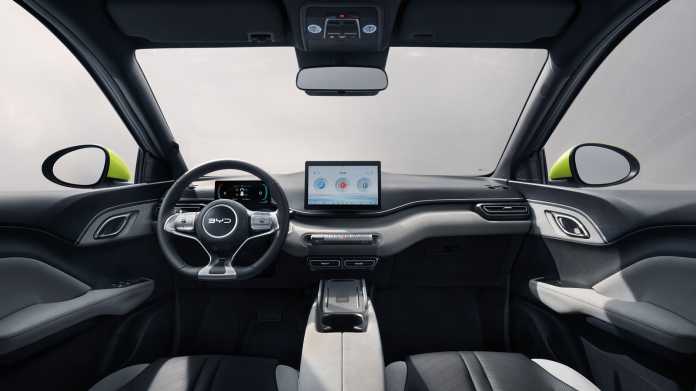
The standard equipment is extensive in all versions of the BYD Dolphin Surf. Automatic air conditioning is included in all of them, as are adaptive cruise control, electrically adjustable exterior mirrors, parking sensors and a reversing camera. The mid-range Boost trim level also includes a rain sensor and electrically adjustable seats. The top-of-the-range Comfort model adds heated front seats, LED headlights and a 360-degree camera.
BYD Dolphin Surf innen (3 Bilder)
BYD
)Small cars are often bought by private customers for whom the warranty conditions are important: It is six years or 150,000 km on the car itself and eight years or 200,000 km on the electric motor and traction battery. BYD has not given any prices in advance. One guide is the Citroën ë-C3, which is available from 19,990 euros (30 kWh) or from 23,300 euros (44 kWh). The self-confident Chinese have probably realized by now that they cannot charge more for their electric cars than the established competition.
(wpl)