

Presentation of the Toyota RAV4: PHEV with 100 km electric range and DC charger
Toyota gives a first preview of the sixth RAV4. It will have improved drive systems and is set to become a software-defined vehicle.

(Image: Toyota)
Toyota had the right instinct at the beginning of the 1990s and recognized the market: There is a market for cars that look like off-road vehicles but are optimized for use on the road. What they can do off-road is often not even of secondary importance to the target group, but simply irrelevant. Toyota has sold 15 million RAV4s since 1993, 2.5 million of them in Europe alone. Next year will see the launch of the sixth generation, which is set to be more economical and "digital" than the current version.

Four drive systems
Even in this generation, no RAV4 will be launched on the market without a combustion engine. A battery-electric drive is not planned, at least not for the time being. Initially, four versions are planned, with Toyota already revealing a few technical details:
| Version | Power in kW | Drive system |
| PHEV AWD | 224 | All-wheel drive |
| PHEV FWD | 197 | Front-wheel drive |
| Full hybrid AWD | 140 | All-wheel drive |
| Full hybrid AWD | 135 | Front-wheel drive |
The battery in the plug-in hybrids has an energy content of 23 kWh and can – also be filled with 50 kW at the DC charger, depending on the equipment –. All PHEVs have a three-phase AC charger with 11 kW. However, Toyota seems to be very concerned about the durability of the battery, as the promised charging time of around three hours indicates that either the charging power is also capped comparatively early on the AC charger or the charging losses would really be remarkably high. An electric range in the WLTP of 100 km is promised, which presumably only applies to the PHEV with front-wheel drive. It is praised in the first package insert for the press as having a particularly long range.
Toyota RAV4 2026 außen (6 Bilder)
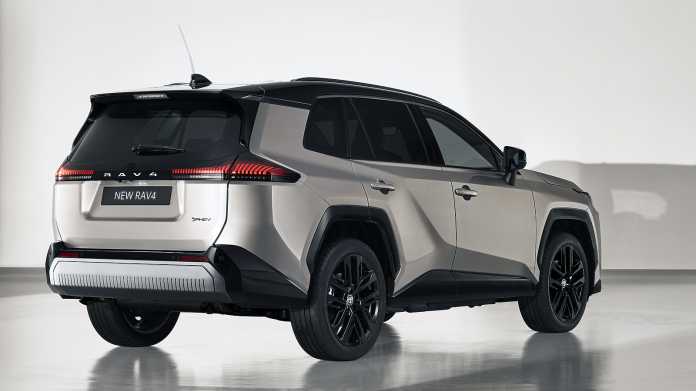
Toyota
)Still without battery electric drive
Toyota has not yet provided any information on fuel consumption. In the past, the hybrid drives, which have been continuously improved over many years, have proven to be economical in practice – compared to the direct competition. How far this will go in the future remains to be seen. Because in terms of environmental impact, responsiveness and noise comfort, a drive system involving a combustion engine has pretty much no chance against a battery-electric one.
Regular updates
With the Arene software platform, Toyota is also set to enter the age of software-defined vehicles. The brand has a lot of catching up to do in this respect, because whatever the previous models were liked for: Fancy infotainment systems or sophisticated assistants were almost certainly not. The Japanese promise to keep assistants and entertainment electronics up to date with regular updates. The first images suggest a rather conservative interface and operation, which is not necessarily a mistake.
Videos by heise
Among other things, new assistants warn of vehicles that could potentially get in the way of the RAV4 at junctions. On the highway, an assistant alerts the driver to cars approaching quickly from behind before changing lanes. However, there is no mention of highly assisted or even semi-autonomous driving in the RAV4.
Toyota RAV4 2026 innen (9 Bilder)
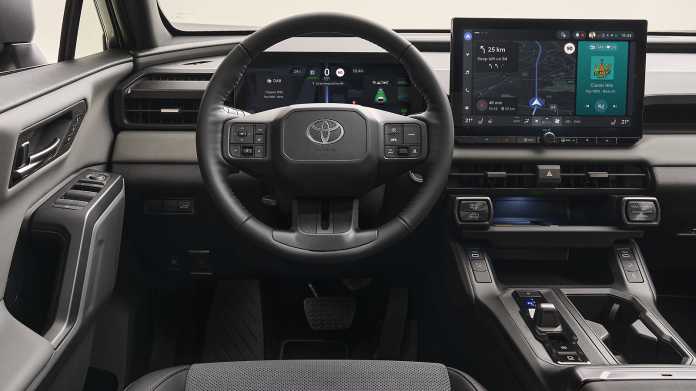
Toyota
)Prices
The financial direction is not yet clear nine months before the dealer premiere. However, customers will probably have to be prepared for slightly higher prices. Currently, the Toyota RAV4 is officially available from 40,990 and the plug-in hybrid from 52,790 euros. However, the latter has always had all-wheel drive, but in future it will also be available with front-wheel drive.
(mfz)