

Presentation of the Nissan Leaf 2025: Better than before, but is that enough?
The third generation of the Nissan Leaf electric car is back with significant changes. It is not aiming for technological leadership.

(Image: Nissan)
In the fast-moving news world, it has almost been somewhat forgotten: For many years, the Nissan Leaf was the best-selling electric car in the world. But as electric car registrations in general rose significantly, the Leaf was usually not the first choice, although prices in the major car markets have recently been quite accommodating. Nissan wanted to prioritize three things with the model change. Whether this will be enough to build on previous successes is questionable.
Previously, there were two batteries with 39 and 59 kWh net. They could be charged via a CHAdeMO plug with a maximum of 50 kW. Only single-phase charging with up to 6.6 kW was possible with alternating current, which can be used at public charging stations, for example. This was no longer a match for the more modern competition. The good news is: Nissan has made significant improvements here. The Leaf shares the CMF-EV platform with Renault, among others.
Finally, with CCS
The third Leaf gets the CCS plug, which is widely used in Europe, and apparently even in two versions. The first images show a charging flap in each of the front fenders. Two powertrains are planned. The base model with 130 kW and 345 Nm will have a battery with 52 kWh. This battery can be charged with a maximum of 105 kW. The larger storage unit with 75 kWh offers a little more. It can be charged with up to 150 kW. The drive then offers slightly more power at 160 kW. But even if Nissan emphasizes that it can recharge 250 km of range in 14 minutes: New best values cannot be read off here.
Nissan Leaf 2025 außen (5 Bilder)
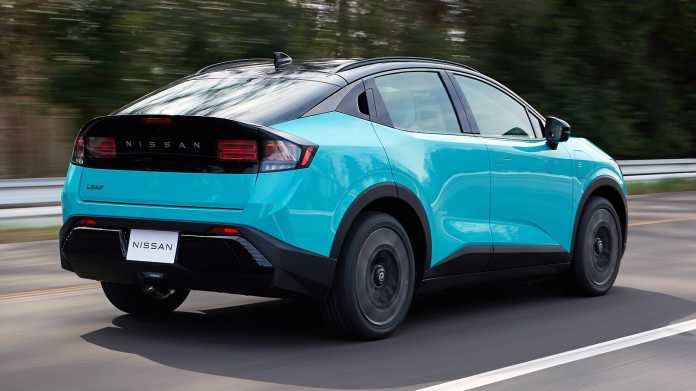
Nissan
)Especially as the average charging performance in both cases is not aiming for a top position. The 60 percent between a charge level of 20 and 80 percent should be recharged in around 30 minutes. This would be 31.2 kWh for the small battery and 45 kWh for the large battery. The average net charging capacity in this window is therefore around 62 or 90 kW. Three-phase alternating current can be charged at 11 kW. So no extraordinary capability here either, but a significant improvement on the outdated predecessor. Nissan specifies the range in the WLTP as 436 and 604 km.
It is not yet clear whether a heat pump will be fitted as standard. According to Nissan, a lot of development work has been put into the temperature control of the battery cells. Preconditioning of the cells can be integrated into the route planning. Among other things, the route is included in the calculation, writes Nissan.
Donor for external applications
The Leaf was once the first mass-produced electric car whose battery could also be integrated as storage for the home. This was probably only used by very few people, as the battery had a gross energy content of 24 kWh, which was quite small, and the technical substructure in the garage was extremely expensive at the time. The third generation can be used for vehicle-to-load and vehicle-to-home, but not in all markets. In Europe, the battery can be tapped for external consumers with up to 3.6 kW. Vehicle-to-grid is in preparation. This would give the Leaf the opportunity to participate in the electricity market.
At 4.35 m, the third Leaf is around 14 cm shorter than its predecessor. The switch to the SUV format brings with it a higher seating position, but above all a positioning in the segment with the highest global demand. On an initial short test drive, the chassis turned out to be comfortable rather than overly dynamic. Only transverse joints at short distances are handled somewhat woodenly. Four levels of recuperation are offered, ranging from one-pedal driving to coasting. The remarkably careful noise insulation was noticeable over the few kilometers.
Videos by heise
Android Automotive
Like the French, Nissan has also decided to no longer develop its own infotainment system. Instead, Android Automotive is used, equipped with its interface. This is played out via a head-up display and two screens with a diagonal of 14.3 inches. The glossy plastic surfaces on the steering wheel are not a good idea, as they quickly smudge. For an extra charge, Nissan offers a large glass roof that can be darkened at the touch of a button. It cannot be opened.
Nissan Leaf 2025 innen (5 Bilder)
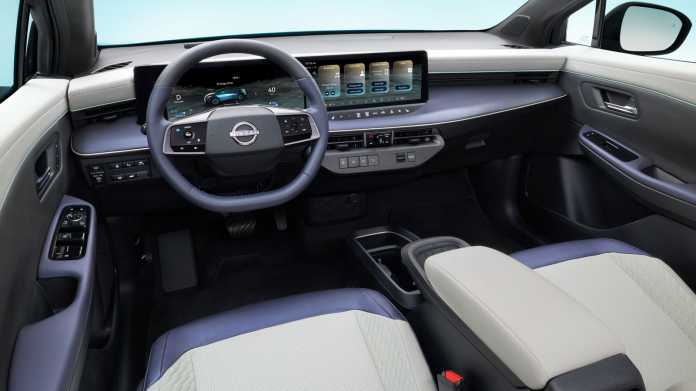
Nissan
)The price issue
The third Leaf finally offers the usual charging options, can charge faster and drive further than its predecessor. However, the environment has changed fundamentally since the premiere of the series in 2010. Competition is fierce, and Nissan's refusal to offer outstanding features will have to be reflected in the price if the e-SUV is not to remain a purely niche product. Nissan's ideas in this regard will probably become clear early next year when the first price list is available. Sales in Europe are scheduled to start in spring 2026.

(mfz)