

Presentation of Lexus RZ: Electric car gets steer-by-wire
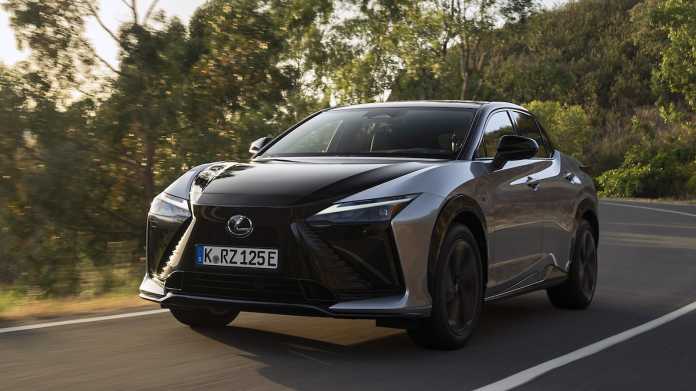
Lexus gives the RZ SUV a facelift with some cosmetics and a steering system that no longer has a mechanical connection. A first test drive.

(Image: Lexus)
- Joaquim Oliveira
In recent decades, many car manufacturers have tried to eliminate the mechanical connection between the steering wheel and steering system. So far, only Infiniti and Tesla have actually built this in series production. The Toyota Group has been announcing it for a long time, and now a so-called steer-by-wire is being offered in the revised Lexus RZ. We have already been able to take a short test drive.
Lexus had already planned the introduction of steer-by-wire two years ago, but it was necessary to “improve the operation and make the response less direct,” explains chief engineer Yasuyuki Terama. Originally, the driver needed a steering angle of just 150 degrees to turn the steering wheel fully from the center position or 300 degrees to move from side to side. This has been increased to 200 and 400 degrees. This perhaps becomes clearer if you imagine that only just over half a turn of the steering wheel is required for a full turn of the wheel. Steering is still fundamentally different from conventional systems.
No steering rod
There is no steering rod; steering commands are transmitted via a potentiometer on the steering wheel and a servomotor on the steering. There are no drive influences and vibrations, but there is also no feedback from the road. On the other hand, there is no cranking on the steering wheel, which takes some getting used to, especially in tight bends. It takes some getting used to to avoid oversteering and hitting a kerb or an object on the inside of a bend. But you get used to the all-electric system surprisingly quickly. There is no doubt that not every driver will be comfortable with the fact that even small steering commands can cause major lane changes. But it doesn't take much to imagine the next steps. These will presumably include giving the driver the option, within certain limits, of setting the angle at which they want to change direction on the steering wheel.
Lexus RZ 2026 (10 Bilder)
Lexus
)Slight increase in energy content
The model update also brings progress in other areas. Alternating current charging is now possible with up to 22 kW. The DC charging power remains the same at 150 kW, but the average net charging power increases slightly. This is because the time it takes to charge from 10 to 80 percent remains the same at 30 minutes, despite the slight increase in energy content. Instead of 71.4, the battery now has 77 kWh. Previously, the charging capacity in the aforementioned window was 100 kW; now it is just under 108 – as always under ideal conditions and plus charging losses. Just under 54 kWh recharged in these 30 minutes. On an annual average, this should be enough for an estimated 250 to 270 km on the highway, provided you don't let the E-SUV go crazy there.
Only in the RZ 350e base model does the customer have the option of choosing 18-inch rims with narrower tires instead of 20. This has a surprisingly large impact on the range, because in the WLTP Lexus promises 568 km with the smaller wheels and 508 km with the larger ones. For the models with all-wheel drive, the customer has no chance of deciding a more modest size than 20 inches. Lexus gives their range in the WLTP as around 450 km. Consumption in the cycle is 14.4 to 18.4 kWh/100 km.
All-wheel drive with up to 300 kW
Nevertheless, most customers will probably prefer one of the all-wheel drive models, as they are somewhat more pleasant to drive than a powerful front-wheel drive model. The basic model already has 167 kW and 269 Nm to offer. It is limited to 160 km/h and accelerates to 100 km/h in 7.5 seconds. In the two all-wheel drive models, a 167 kW engine is added to the rear axle. The system output is 280 kW in the RZ 500e and 300 kW in the RZ 550e. The E-SUV can thus accelerate up to 180 km/h. In the “F Sport” variant, an “Interactive Manual Drive” simulates an eight-speed automatic, which is presumably intended to convince those who lack the classic tractive power differences of a combustion engine and its transmission. I consider this to be just as important as the optional fade-in of synthetic drive sounds from the loudspeakers namely not at all.
Videos by heise
Premium standard
The RZ still has a high-quality interior, and the workmanship is solid. The amount of space is sufficient, which is to be expected for a 4.8 m long car with a 2.85 m wheelbase. The trunk capacity of just 522 liters, on the other hand, is disappointing—even a much shorter VW ID.5 offers a little more. The instrumentation is rather plain, with graphics that don't exactly look modern and symbols that are too small and difficult to read. Visible screw heads on the steering wheel and no lined door pockets do not match Lexus' premium claim. There is no glove compartment, and the only closed storage compartment between the front seats is occupied by the owner's manual, safety vest, and vehicle documents. The button control system on the steering wheel is anything but intuitive. It is also a shame that the large glass roof can be darkened at the touch of a button but cannot be opened.
No price yet
The revised RZ is due to go on sale at the beginning of next year. Lexus has not yet revealed any prices, but the base model is likely to remain at around 56,000 euros despite a little more power. The fully equipped top-of-the-range version previously cost 73,000 euros. For this sum at the latest, the Lexus RZ has plenty of competition, which may not offer a ten-year battery warranty but can charge faster and drive further. Lexus is therefore unlikely to have high hopes of massively increased sales figures.

(mki)