

50 years of the BMW 3 Series
No car has shaped BMW like the 3 Series. The success story began with the first deliveries in August 1975 and has continued over seven generations to this day.

The BMW three-series - a success story that is writing its seventh chapter with the current G20. Pictured: the six previous generations
(Image: BMW Group)
- Christian Lorenz
On the occasion of its fiftieth birthday, an enthusiast, and fan is allowed to climb into his own BMW 3 Series, E46 320i Automatic, model year 2002. He takes a very subjective journey into the history of what is probably the most important and most iconic BMW series. There are very few car types that embody their brands to a certain extent. First and foremost, of course, the 911 for Porsche, perhaps the E-Class for Mercedes, or the 3 Series for BMW.
Inline six-cylinder sound
In the purely subjective opinion of the author, the E46 embodies both the pinnacle of the 3 Series and a certain end of its heyday. So we start the six-cylinder M54 with a displacement of 2.2 liters, camshaft adjustment for the intake and exhaust sides (continuously variable double Vanos) and an aluminum crankcase and cylinder head. The garage is filled with a soothing carpet of sound with a pleasantly deep timbre. You are reminded of the commercial in which a young hipster drives a Z3 2.8i (at least, if I recall correctly) and listens to Janis Joplin on cassette. "Oh Lord, won't you buy me a Mercedes-Benz". The man shifts to stop in disgust. You can hear the beautiful six-cylinder sound. Then the driver switches the cassette radio back on. "My friends all drive Porsches." That's enough. The cassette flies out of the moving convertible in a high arc. An off-screen speaker announces the additional quintessence: "Nothing sounds like an inline six-cylinder BMW".
E21 initially only with four cylinders
Exactly 50 years ago, in August 1975, the first 3 Series, the E21, only came with four-cylinder engines, which it took over from its predecessor, the 02. The so-called M10 four-cylinder had decisively shaped the "New Class" and thus contributed to the fact that BMW, after looking deep into the abyss in 1959, was able to become one of the most successful car manufacturers just a few years later. From then on, sporty saloons were BMW's DNA. As a hot-blooded Alfa Romeo fan, the author cannot help but think of the headline of a very early test, probably a 1600-2, in Auto Motor und Sport: "The German Giulia".
E21 (5 Bilder)

(Bild:
BMW Group
)Paul Bracq's four-eyed face
The E21, designed by Frenchman Paul Bracq, adopted the established style of the first 5 Series E12 presented in 1972, with its compact, angular appearance, shark nose and the Hofmeister kink in the C-pillar, which actually characterizes BMW almost to this day. The "smaller" engine variants 316 and 318 had single large round headlights, which made them look similar to the 02. Only the models from the 320 onwards had the four-eyed face that was to become typical of BMW from then on.
Videos by heise
The first six-cylinder was an "air pump"
The first six-cylinder in the 3 Series did not follow until two years later. In 1977 came the 320/6 with Solex twin carburetors. With three hp less, top-heavy and lower torque than the 320i with four cylinders, some called it an "air pump". Nevertheless, it really did lift the 3 Series into a "new class". Drive comfort with a superior, vibration-free sound and proverbial revving pleasure – was now BMW DNA. However, the six-cylinder 3 Series became truly unrivaled a year later. The new top model 323i with 143 hp made the top dogs of the time with their six-cylinder Capris or Commodores look pretty old in one fell swoop. The factory promised 9.5 seconds in the standard sprint and a top speed of up to 190 km/h – at the time; 50 years later, any basic Golf can keep up. Standards have moved on considerably, but this does not detract from the driving pleasure of the 323i.
323i as a Granturismo
Especially when things got twisty, the 323i showed the six-cylinder competition of the time its characteristic twin-pipe exhaust system, with one pipe on the left and one on the right. But only briefly, then it was gone. Although the 2002 drivers noticed a slight softening at the time and a sharply driven 2002ti could outpace the 323i on serpentines. The 323i was a class above, more comfortable – the much better touring car. It represented a leap from the more shirt-sleeved 2002 family sports car to the Granturismo.
Inventor of the center console tilted towards the driver
In the interior, the first 3 Series was the first to feature a design element that was characteristic of BMW: the center console tilted towards the driver. In the following years, it became less and less angular, less abrupt for the front passenger. It is still there in the E46, albeit very finely rounded. This should be the last time we see it here. But now put the leather-covered selector lever in D and off you go. I know what you're thinking – and you're right. Anyone who chooses the E46 with an automatic and not a manual gearbox has not understood something fundamental.
Precise gearshift
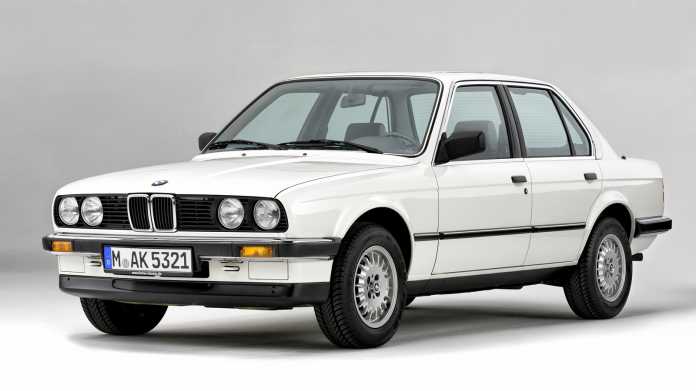
In my case, however, it wasn't a matter of choice. I inherited my E46 from my father. He only joined BMW when he was over 70. He had previously driven a Mercedes 230E W124 with automatic transmission and therefore never enjoyed the proverbially good manual transmission of the BMW 3 Series. His E36, like the two E46s that followed, had already been an automatic. However, I remember with a pleasant shudder the first time I experienced a manual gearbox in a 3 Series. It was a 316i from the late 1980s. I will never forget the feeling of moving the gear stick to the left into reverse gear. Never again have I felt such mechanical precision combined with such ease of movement. A feeling that was reinforced with every clutch and gear change. The second three-wheeler, known internally as the E30, was already great! For many purists, it is and remains the three-seater par excellence. Like its predecessor, it initially came in 1982 as a two-door saloon with a four-cylinder engine (316) and a new six-cylinder engine (320i). The 323i followed a year later with the option of four doors. In 1985 came a full convertible and in 1987 even an estate called Touring.
E30 (6 Bilder)
BMW Group
)Teething problem: timing belt
In the year the estate was launched, the model series was comprehensively revised. Slightly less chrome and lower front and rear aprons characterized this model update. At the same time, BMW introduced a new four-cylinder generation, which had a few teething troubles. The most serious concerned the timing belt, whose replacement interval was quickly reduced from the initial 80,000 to 40,000 km. The problem was simply that too few teeth were in mesh at the same time and the load on each individual tooth was therefore very high. My colleague Martin has clocked up more than 200,000 km with this machine and has also changed the timing belt several times. Practically no replacement was too early.
E30 not just a racer on the racetrack
BMW had to invent the term "lifestyle estate" for the Touring because, like the Touring based on the 02, it offered surprisingly little utility value for a station wagon. Unlike the first Touring, however, this did not stand in the way of its sales. The E30 became the best-selling BMW model to date, with over 2.3 million units produced. The design, carefully modernized by Claus Luthe, which continued the spirit of its Bracq predecessor, marked the most beautiful, the classic, the true 3 Series for many. The 325i, which replaced the 323i in 1985, became the dream of ambitious family fathers with 170 hp. However, the true Über-3 from 1986 had a four-cylinder engine on a supposedly antiquated M10 base. The M3 with initially 200 hp in the "civilian" model became the most successful racing touring car of all time – and a legend.
318is as a not-so-secret insider tip
The 318is, which was only built for a short time, became a not-so-secret insider tip among the E30 engines. It breathed the spirit of the original M3 in a way that was more digestible for the wallet and family members riding along. The 1.8-liter four-valve engine with 136 hp and little weight on the front axle is still a lot of fun today, which is why it is more expensive as a youngtimer than a 320i. The engine is also considered to be quite stable, because unlike the 316i and 318i of the time, it has a timing chain instead of a timing belt. The E30 was first available with diesel engines and as an all-wheel drive variant 325 iX – Neither became a bestseller. It was built for over ten years. The last E30 Touring only left the production line in spring 1994. By then, its successor, the E36, had been on the market for almost four years – and was now fully accepted.
E36 with teething troubles
Initially, BMW fans had a little trouble with it. The comparatively bloated body was one thing. The front end in particular, where the twin headlights were located under shared lenses, was initially rejected by many. In addition, there were serious quality problems that BMW only got to grips with after a certain amount of time. At the end of its service life, the E36 was one of the best-prepared vehicles in its class. It was probably the most active sports sedan of its time right from the start. The E36 managed the balancing act of being crisper to drive and at the same time offering more suspension comfort than the E30. The four-valve six-cylinder engines of the M50 series offered more punch with less fuel consumption.
E36 (6 Bilder)

BMW Group
)Coupé and M3 as the icing on the cake of the E36
In the E30, the two-door was still the cheaper entry-level model. The E36 Coupé, on the other hand, was positioned higher and was more expensive than the four-door model. What made the E36 M3 so unique was its engine. The four-valve six-cylinder S50B30 with variable camshaft timing (VANOS) and individual throttle valves with an initial 286 hp finally made the M3 an alternative for 911 enthusiasts.
E46 - the best-selling BMW of all time
With over 2.7 million units built, including the Golf competitor 3 Series Compact with two doors and hatchback, the E36 even outperformed its predecessor, which had been spoiled by success. But the best-selling BMW of all time was to be its successor, known internally as the E46. It also started with weak points. I can still remember the first time I drove the 320i before the facelift, and at 180 km/h on the highway, it started to flounder like a Ford Scorpio. At the time, BMW came up with the idea of only making the suspension of the top model 328i taut ex works and only offering the other models a sports suspension for an extra charge. Within a short time, this was corrected, and the suspension tuning of the 328i was rolled out to all model variants.
Initially nasty suspension problems with the E46
Another problem also concerned the suspension. A few overambitious controllers had saved welding points. In the worst-case scenario, the first E46s lost their rear axles. In the fall of 2000, improvements were made and the issue was no longer a problem. Meanwhile, almost all E46s built before then have probably undergone a revision in this respect. Nevertheless, anyone interested in an early model from this series should definitely have this point clarified.
E46 (8 Bilder)

BMW Group
)E46 – a three-wheeler grows beyond itself
Apart from such initial mistakes, however, the E46 developed magnificently. Velvety twin Vanos six-cylinder engines, a comparatively princely amount of space in the interior and trunk, outstanding driving comfort with sporty driving pleasure – the three-cylinder reached a level of high quality and class. This caused many a five-cylinder driver to step down without perceiving it as a relegation. The last three-seater interior without a navigation hood and with complete round instruments seems to me, at least, to be an unrivaled zenith. It is a pity that the standard seats in this three-seater were not yet at luxury class level. I should have tried harder to persuade my father to buy the sports seats at extra cost. Although – the standard seats look better with my conservative 320i.
E46 - new standards in passive safety
The 3-series E46, which was launched in 1998, was also right up there in terms of safety. For the first time, a 3 Series was awarded five stars in the Euro NCAP crash test with front, side and head airbags as standard. Xenon headlights for the dipped beam and a parking aid with sensors in the rear bumper were available for an extra charge. For many, beyond the M3, which achieved 360 hp and a Nürburgring record in the legendary CSL, a diesel was the measure of all things for the first time. The in-line six-cylinder engine in the 330d made diesel driving a true BMW experience with 184 hp and plenty of torque, direct injection and smooth running. With over 3,360,000 units, the E46 is still the most-built BMW today. It was replaced by the E90 in 2005.
E90 – How the three-piece enters the Bangle years
The look of the E90 made three-series customers swallow a little, although Chris Bangle, the most controversial BMW design boss, was still comparatively restrained in his design, unlike the previously presented seven-series and the five-series at the time. He also knew that the brand's core model could not afford to be overly gimmicky. Especially as customers were also faced with some technical challenges. The 320i no longer had a six-cylinder engine, a large navigation hood with i-Drive was not standard, but its absence immediately stamped an E90 as a semi-precious cash frame. Especially as, for the first time in the three, there was no longer any driver orientation in the center console. In addition, the instruments were reduced to a comparatively sparse two round dials.
E90 (5 Bilder)

BMW Group
)Four cylinders and clunky manual gearboxes
The manual gearboxes were also suddenly far removed from the standard offered by the predecessor. Customers were to choose the six-speed automatic transmission, which set new standards and was clearly superior to the five-speed automatic in the predecessor E46. The automatic gearboxes were built by ZF and GM. Environmental standards played a prominent role for the first time. The E90 was optimized in this respect under the "EfficientDynamics" label, making it the most economical three-seater to date. Despite initial criticism, the E90 developed into a bestseller and serial winner in comparative tests. For the first time in the history of the three, the Touring was the best-selling variant. With over three million units produced, the E90 was a bestseller, even if it could not match the figures of the E46.
F30 with ZF eight-speed automatic transmission
In October 2011, the F30 was launched, a three-seater that was basically equipped with turbocharged engines and modern multimedia equipment. Although it was still available with a manual gearbox, this made it difficult to sell as a used car at the latest. The ZF eight-speed automatic transmission set a new standard for automatic transmissions. It is still considered one of the best automatic transmissions today. The so-called driving experience switch on the center console, which could be used to influence the characteristics of the steering, chassis and throttle response, was introduced for the first time. Premium-class features such as a head-up display and heated rear seats were also available for the first time in the three-seater.
F30 (4 Bilder)

BMW Group
)Adaptive suspension for the first time
The handling of the saloon, which was mature in every respect and could compete with the E39 series five-seaters in terms of space, was even better than its already excellent predecessor. With the optional adaptive suspension, the three-seater was superior to its competitors in terms of sporty firmness while at the same time eliminating bumps in the road. By far the best-selling version was the 320d Touring. The sixth three-seater sold magnificently and was often the winner in comparative tests. The Coupé and Convertible were separated from the model series as the 4 Series.
What remained of the three
The current G20 is still the benchmark for sports saloons. It still combines the joy of driving with the joy of traveling. Since its launch in 2019, however, the world has turned more than ever before in the drive sector. The diesel, which once dominated sales figures, has fallen out of favor with customers. Plug-in hybrids were late to improve their charging performance and range. And if you want a six-cylinder, you have to go pretty high up in the hierarchy.
Four-cylinder and hybrids
Considering the now dominant four-cylinder roar that prevails in most three-cylinder cars these days, the free-sucking in-line six-cylinder in the E46 is an acoustic relief. Although, to be honest, it has to be said that you generally hear very little in a three-cylinder G20. But the three is today what it always was: one of the most agile sports saloons on the market. Only the Giulia from Alfa Romeo can compete with it in this respect, but only because it was developed with precisely this aim in mind.
Looking to the future
It remains to be seen how the 3 Series will develop in the battery-electric future. The i4 gives cause for hope in this respect. BMW is also very aware of its responsibility and is even proclaiming a "new class" again with the upcoming optional battery-electric 3 Series generation, which BMW intends to lead into a new era with breathtaking success. This could work, because despite everything that customers demand today in addition to a good driving experience, the 3 Series has not yet lost its agile focus. The brand can be trusted to maintain this.
(chlo)