

Porsche Cayenne Electric: The interim hopeful
The fact that Porsche wants to return to the combustion engine in the face of appalling business figures takes time. The improved Cayenne should be the solution.

(Image: Porsche)
- Wolfgang Gomoll
Porsche has hit the skids after a series of strategically wrong decisions in a highly challenging business environment. The rapid decline in value caused Porsche shares to fall out of the DAX. The fact that the Porsche Macan was only available as an electric car in Germany and the USA did not help. Porsche therefore wants to offer the successful model with a combustion engine again in 2028. Until then, the hope is that the Porsche Cayenne Electric will do the trick. It will be the interim beacon of hope.
The Cayenne Electric must set new standards if it is to sell well in China and especially in the USA. Range and charging power are just as crucial as the agility expected of the brand. In the age of electromobility, performance is no longer an important differentiator. What matters is how dynamically the car takes to the road. Porsche still has a global lead in this respect. However, the Cayenne Electric still weighs around 2.6 tons despite its weight-saving deep battery integration.
Porsche Cayenne Electric (7 Bilder)

Porsche
)Even bigger battery
Based on the PPE platform, which Porsche developed together with Audi, the Cayenne utilizes 108 of 113 kWh gross capacity. By comparison, the Porsche Macan has 100 kWh gross. The Cayenne pouch cells have graphite-silicon anodes and NMCA cathodes with a nickel content of 86 percent. This results in an energy density that is around seven percent higher than that of the Porsche Taycan. Both the volumetric energy density and the crash structure benefit from the fact that the battery is part of the vehicle structure. The design makes it possible to replace individual modules of the battery. The battery can be lowered for this purpose.

Porsche uses two cooling plates in the Cayenne Electric to maximize performance during charging and discharging without compromising service life. In the Macan Electric, there is only one. With two fans, the cooling efficiency increases by 15 percent. This is also necessary for the Cayenne to achieve the peak charging power of 400 kW. This means it should only take a good 15 minutes to fill the batteries from 15 to 80 percent—under ideal conditions, of course. Of course, the charging infrastructure must first be able to deliver this charging power. In most cases in Germany, the peak is currently 300 kW.
A brief recalculation shows what Porsche promises. The window between 15 and 80 percent corresponds to 70.2 kWh net. If this is to be topped up in 15 minutes, the average charging capacity would have to be 281 kW – plus the charging losses. For orientation: BMW achieves a net charging capacity of 217 kW in the brand new iX3 with a similarly sized battery between 10 and 80 percent. The Cayenne would therefore be considerably faster.
Maximum charging power over 350 kW
According to the data sheet, Porsche achieves a maximum charging power of over 350 kW up to an SoC (State of Charge) of around 55 percent. The manufacturer promises that the Cayenne Electric can charge up to 300 km in the WLTP in ten minutes. A predictive battery temperature control system heats or cools the battery in advance depending on the weather, route, or driving style, thus optimizing the charging performance and the service life of the cells. The fact that the AC charging power of the Cayenne Electric is only 11 kW will change in the course of the model cycle. With inductive charging, the output is always over ten kW.
Porsche Cayenne Electric Details (5 Bilder)
Porsche
)The provisional top model, the Cayenne Electric Turbo, delivers more than 800 kW with Launch Control for short periods (continuous output 600 kW) and achieves up to 1500 Nm of torque. This enables a sprint time of less than three seconds and a top speed of around 270 km/h. A further 100 kW can be briefly added via the "overtaking button." The Cayenne Turbo S planned for later is expected to deliver even higher performance with the same technology.
All-wheel drive as standard
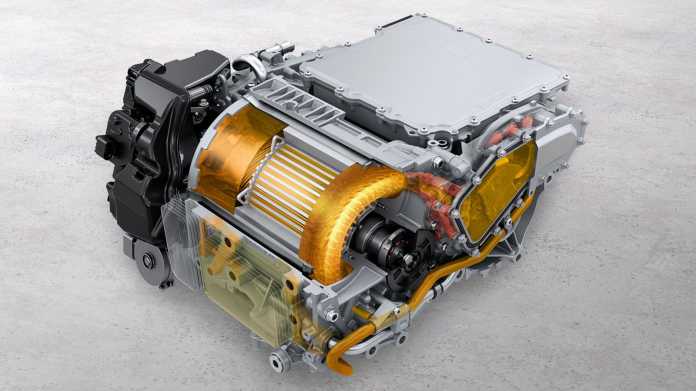
The oil-cooled permanently excited synchronous machine (PSM) on the rear axle feeds the oil directly past the current-carrying components. Because the heat is dissipated where it is generated, the engine remains stable even under high loads and retains most of its efficiency of up to 98 percent. Porsche developed this technology for e-racing with the GT4 e-Performance. The pulse inverter with silicon carbide semiconductors and recuperation with up to 600 kW also reach racing level. Around 97 percent of the braking processes are performed by the electric motors, writes Porsche.
A battery frame is just as unnecessary as reinforcements. This makes the structure stiffer and lowers the center of gravity, which benefits the driving dynamics: the body height is around three centimeters lower than in the current model. Space economy is also improved, as the first seat test confirms: The front and rear seats are significantly lower than before.
Videos by heise
Active chassis
The Cayenne Electric is the first Porsche SUV with active suspension thanks to air suspension and networked switchable dampers. Body movements are automatically reduced to a minimum during driving maneuvers. The “electronic Porsche Traction Management” (ePTM) regulates within five milliseconds—five times faster than conventional systems, Porsche promises. Torque vectoring and an optional ceramic brake round off the package.
The rear-axle steering turns the wheels by up to five degrees and increases the feeling of agility. It also reduces the turning circle by one meter to 11.1 meters. The utility value implied by the “U” in “SUV” is also a given: With the optional so-called “off-road package,” it can tow up to 3.5 tons, or three tons as standard.
Porsche Cayenne Electric Interieur (4 Bilder)

Porsche
)In front of the driver is the advanced curved display from the Taycan, supplemented by a head-up display with augmented reality. A large touchscreen is enthroned in the center. Overall, the driver and passengers should benefit from 50 percent more screen area than in the current model. Below this is an inwardly curved control surface. With the help of a handrest, which Porsche calls the “Ferry Pad,” it should be possible to operate its virtual buttons with pinpoint accuracy. This almost seems like an admission that physical controls would actually be better.
(dahe)