

Dacia Hipster study: Small, cheap, suitable for the masses?
The Dacia Hipster shows what a maximally cost-optimized entry into the world of e-cars could look like. A production model is to cost around 10,000 euros.

(Image: Dacia)
- Joaquim Oliveira
Dacia has firmly established itself on the European car market. Hardly any other manufacturer is as successful in business with private customers. Although commercial registrations make up the majority, good money can also be earned from customers who finance their car outside an employer. As is so often the case, Dacia's primary approach is to always offer the cheapest deal, although customers rarely go for the bare-bones model. Presumably, this would hardly be any different for a production model of the Hipster study. An initial preview shows an original design in detail, but also an attempt to see how prospective customers react to a very small traction battery.
Energy content: 10 kWh
The Hipster study is intended to enable affordable mobility and promises to halve the carbon footprint compared to electric vehicles currently available on the market. Romain Gauvin, Head of Advanced Design and Exterior Design at Dacia: “It's about inventing something that doesn't exist today.” The approximately 3 m long, 1.52 m high, and 1.55 m wide Hipster is designed to offer space for four adults. The tiny boot has a capacity of just 70 litres. However, if the rear seat is folded down, up to 500 litres are available. At 800 kg, the kerb weight is again well below that of the spring. However, a battery of around 10 kWh would only allow a range of 100 km in the cycle even at around 20 degrees, i.e., without any significant need for air conditioning. In practice, a range of between 60 and 80 km is more likely.
Strap instead of door handle
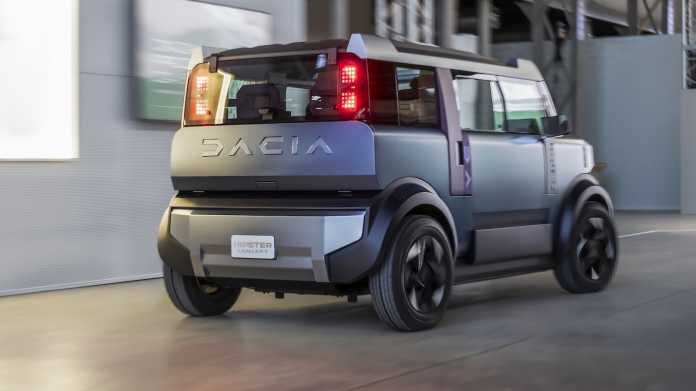
The exterior design can be summarized as a cube on wheels without overhangs with slim headlights in the very horizontal front. It has a single body color and only three painted parts: the front of the vehicle and the side door entry elements. The door handle has been replaced by a strap, which is light and inexpensive. At the rear, the two-part tailgate covers the entire width of the body of the Hipster Concept. The design of the rear lights is the result of a typical Dacia solution: as they are positioned behind the tailgate, they do not require their cover.
Dacia Hipster (10 Bilder)
Dacia
)In the interior, vertical windows and the windscreen allow optimum use of space. Access to the rear seats is facilitated by the wide door opening and the forward-folding front passenger seat. The front seats merge to form a bench seat. The dashboard and interior paneling are kept emphatically simple and can be extended with individual modules such as cup holders, armrests, or lighting elements from the accessories range. Additional fastening points in the interior accommodate smartphones or cup holders.
Videos by heise
How big is the segment?
Increasing electrification and customers' desire for more and more comfort have had a major impact on the small car segment in recent years. A lot of technology and ever-new specifications make the vehicles expensive, making it difficult to earn money in the entry-level segment. Dacia wants to change this with its electric Hipster. The gap that is opening up in the sub-10,000 Euro class has so far been insufficiently filled by a number of micromobiles, which are more like roofed scooters and, at a maximum speed of 45 km/h, are at best suitable for crowded city centres.

In Japan, the tiny kei-cars—highly tax-privileged—have been a big seller for urban mobility since the 1950s. Since 1998, the law has stipulated a maximum vehicle length of 3.4 metres and an engine capacity of less than 660 cc. For a long time, the market share of this segment fluctuated between 30 and 40 percent of new registrations in the country. In the years in which the government reduced tax incentives, the dominance of kei cars declined somewhat, but by 2024 their market share had returned to 38 percent and they dominated the top 10 sales figures. Suzuki was the market leader in this segment last year with 590,000 registrations out of a total of 1.5 million. Now voices are also growing louder in Europe that something similar to the Kei category could boost sales of electric vehicles in Europe and breathe new life into the former A-segment with models such as the Citroën C1 or VW Up.
(afl)