

Moto Guzzi V85 on test: Dynamic and economical thanks to variable valve timing
The revised V85 offers more torque and riding pleasure – and despite all the modernization, it still retains the special riding feel of an authentic Moto Guzzi.
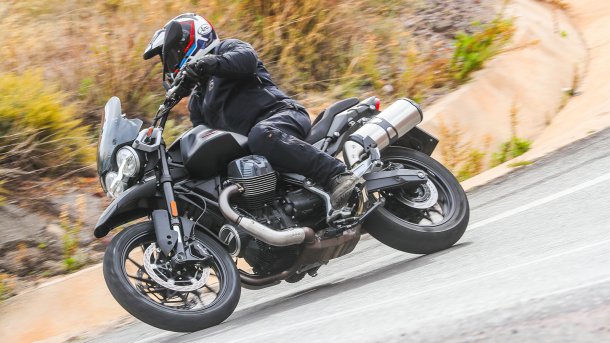
(Image: Moto Guzzi)
- Ingo Gach
For a long time, almost only hardcore Moto Guzzi fans were interested in the motorcycles from Mandello del Lario. That changed abruptly in 2018 when the brand with the eagle in its logo launched the V85 TT. A lovingly designed adventure enduro, inspired by the style of the 1980s. Suddenly, riders of other brands were looking curiously at the stylish Moto Guzzi. Especially since the V85 TT, with its air-cooled 853 cc V2 engine with two valves per cylinder, also produced 80 hp, which was a full 25 hp more than the Moto Guzzi V9, from which the engine originally came. To achieve this, the engineers increased the throttle body diameter from 32 to 52 mm, reduced the crankshaft weight by 30 percent, and installed titanium intake valves. In addition, there was a semi-dry sump lubrication and a valve train with roller rockers.
Variable valve timing
The 90-degree V2, traditionally mounted longitudinally at Moto Guzzi with cardan drive to the rear wheel, was housed in a steel tube frame without crossmembers. The beautiful V85[ ]TT (Test) enjoyed great popularity from the start but lost four hp of peak power in 2022 due to the Euro 5 standard. However, even before that, some riders had voiced the mild criticism that the V85 lacked some pulling power. Moto Guzzi has now remedied this with variable valve timing on the intake side; the V85 now offers the full 80 hp at 7750 rpm, plus more evenly distributed torque of a strong 83 Nm at 5100 rpm—and all this, of course, at the emissions level required by Euro 5+.
Torque more important than power
Our test ride confirms that the engine has not only returned to its former form but has become noticeably more powerful. This is made possible by significantly fuller torque in the lower rev range. Already at 3000 rpm, the current engine produces five hp more than before, and from 3500 rpm up to the rated speed, 90 percent of the maximum torque is available, which is much more crucial for the dynamics of adventure bikes or tourers than high peak power.
For 2024, Moto Guzzi offers the V85 in three versions: the Strada is the base model, the TT is the off-road version, and the Travel is the touring version. However, the engine, cardan drive, frame, fork, brakes, tank, seat, handlebars, headlight, and cockpit are identical on all three. The discerning eye will notice the visually redesigned cylinder head as an optical feature of the new model.
Minor design retouches
The still 23-liter tank is now a bit more angular but still has distinct indentations for the knees. Furthermore, the front shape of the tank is intended to generate less wind turbulence that could disturb the rider. The side covers under the seat have been redesigned as have the fork protectors. The headlight bracket is completely new—the steel tubes are replaced by aluminum—and the steel rear frame has also been replaced by one made of aluminum profiles, saving a total of around 1.9 kg in weight. The newly shaped windshield can now be adjusted vertically by 70 mm in five steps without tools. The cockpit features a now higher-positioned TFT display with new graphics and more functions. The menu control buttons offer improved haptics.
Strada with cast wheels
The Strada is the first V85 to roll on cast wheels, while the TT and Travel continue to use wire-spoke wheels. This gives the Strada a slight advantage in weight and handling, even though the tire dimensions of 110/80-19 at the front and 150/70-17 at the rear remain the same. While the Strada is equipped with the Michelin Anakee Road, the TT and Travel receive the Michelin Anakee Adventure, which is more suited for off-road use.
Comfortable riding position
I start on the V85 Strada. With the typical Moto Guzzi “klong,” the gearbox indicates that the first gear is engaged. The mechanically operated dry clutch can be pulled without much effort, and gear changes are smooth, even though Moto Guzzi omits a quickshifter.
The Strada places its rider at a seat height of 840 mm, which is just enough for riders around 1.75 m tall to reach the ground with both feet flush. The riding position has remained exceptionally comfortable; you can spend hours in the well-shaped saddle of the V85. Despite the 23-liter tank, your knees are not spread too wide, thanks to the sensible indentations. The upper body is upright, and the handlebars are pleasantly swept back, with a relaxed knee angle.
The Strada, weighing a claimed 226 kg by Moto Guzzi, is easy to maneuver and willingly follows every steering command. It accelerates smoothly and has no problem cruising through the city in fifth gear at 50 km/h; sixth gear, however, is a bit too long for that. Very important for many Guzzisti: the wonderfully sonorous engine sound has been preserved. The deep rumble is always pleasantly present but never loud, and certainly not intrusive.

The cockpit features a five-inch TFT display that prominently shows speed and gear indication, although the tachometer is rather small and requires close attention. The other displays are not exactly huge either, but they are still reasonably readable. The Moto Guzzi app allows you to connect your smartphone to the TFT display via Bluetooth. The menu operation with the four buttons on the left handlebar end proves to be foolproof, and the cruise control above it is also well placed.