

From Moped to Identity Anchor: The Simson Becomes a Political Issue
The Simson motorcycle brand is a cult today. CDU and SPD are now competing with the AfD to grant the brand special status as an “East German identity anchor.”
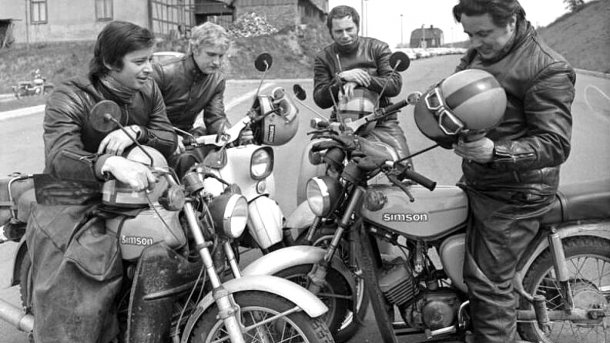
Test drivers on Simson mopeds in Suhl
(Image: Bundesarchiv, Bild 183-T1215-009 / Schaar, Helmut / CC-BY-SA 3.0)
- Verena Schmitt-Roschmann
On a moped in November, that's not always a joy. But the two SPD members of parliament, Nadine Graßmel and Wolfgang Roick, were less concerned with the riding pleasure when they arrived at the Potsdam State Parliament on their Simsons this week. They want protection and recognition for the mopeds, which were built in millions during GDR times. And that has become a politically rather hot topic.
Thuringia already had it on the table in September, when Minister-President Mario Voigt (CDU) said, “Simson is Thuringia; Simson is freedom on two wheels; Simson is a way of life.” The state parliament in Saxony dealt with the cult object in October, and the cabinet in Mecklenburg-Western Pomerania at the beginning of November. In Saxony-Anhalt, the CDU submitted a “groundbreaking motion” on this a few days ago.
60 km/h instead of 45 km/h also for re-imports
Specifically, it's about roughly the same thing everywhere: Due to a special clause in the Unification Treaty of 1990, Simsons are officially allowed to travel at 60 km/h, provided they were on German roads before the end of February 1992. For mopeds of other brands in the same class, the speed limit is 45 km/h. The East German states now want the special regulation to also apply to Simsons that were exported to—mostly socialist—foreign countries during GDR times and are now being brought back to Germany, i.e., re-imported. Sounds specific? Not for many East Germans.
“The Simson is more than a moped,” says the Federal Government's Commissioner for East Germany, Elisabeth Kaiser (SPD). “It is a promise of mobility and freedom in rural areas, especially for young people. That is just as important today as it was then.” Schwalbe, Star, or S51—the machines are robust and easy to repair, and they have been rolling since the 1960s to the present day. “No wonder the 'Simme' is a cult object,” says the SPD politician.

Historian Calls Simson an “Identity Anchor”
For many East Germans, the Simson is an “identity anchor,” says Sören Marotz, exhibition director of the DDR Museum in Berlin. “The fact that we need identity anchors is human nature.” Marotz himself bought a Simson S51 as a teenager in East Berlin in 1988. In the GDR, one had to wait ten years or more for cars; the mopeds were quickly available new or used from about 1000 GDR Marks, the historian recalls. Over the decades, about six million units of all Simson models were built. Simsons were part of everyday life. Teenagers zipped across the country on them in pairs, police officers rode them, pastors, and community nurse Agnes traveled on a Schwalbe. “It was a practical utility moped,” says Marotz.
“All the cult that is being made now, the political debates, are retrospective inventions, so to speak,” adds his historian colleague Stefan Wolle. It is a phenomenon that much of what was scorned and ridiculed in the GDR now enjoys high esteem in retrospect. Many said: “We will not let ourselves be looked down upon by Westerners, who of course always had the fancier cars and the fancier motorcycles and everything fancier and more money, but we identify with what we have.” It was similar with the Trabbi as with the Simson. “It's a sub-phenomenon of East German cult,” says Wolle.
This, in turn, seems to fit the times 35 years after reunification—a time of uncertainty, misunderstandings, and demarcation between East and West. And it seems to be a fitting topic for the AfD. Thuringia's state party leader Björn Höcke, born in Westphalia, already spoke enthusiastically about Simson excursions with young supporters during the 2024 election campaign. The 53-year-old likes to promote his “Simson tours” with photos in which he is not wearing a helmet on the moped.
AfD Proposes “Intangible Cultural Heritage”
Behind many of the state parliament debates in the East were initially motions by the AfD, which also advocates for the Simson to be protected as “Intangible Cultural Heritage.” The Simson stands “for freedom, independence, and individuality,” according to a motion by the AfD in Brandenburg. The other parties felt compelled to reclaim the topic from the far-right party. It annoys them “when the Simson is co-opted by West German populists and extremists who then conspicuously use it but are otherwise not at all interested in the special experiences of East Germans,” says Commissioner for East Germany Kaiser. “For me, the Simson does not stand for Ostalgie, but for the fact that East German engineering skill still enriches the entire country, now even as an e-Schwalbe with an electric motor.”
Videos by heise
Stefan Drönner from Simson-Freunde Kassel, a group of currently seven passionate mechanics, also distances himself from the AfD or any political goals. “We are concerned with the mopeds,” says the 57-year-old West German. He bought his first Simson shortly after the fall of the Berlin Wall because the spare parts for his Vespa became too expensive. It was a time when many in the East wanted to get rid of their Simsons. From 1989 to the 2000s, “they were given away for a crate of beer at first and then maybe for 150 euros,” says Drönner. He is convinced: “If we West Germans hadn't been there, there wouldn't be so many Simsons on the road anymore. We actually saved it. I tell every East German that too. I'm proud of that.”
(mho)