

Ford stops electric vehicles, costing billions
The purely electric pickup Ford F150 Lightning is retired, the electric van isn't coming at all. Instead, series hybrids are coming.
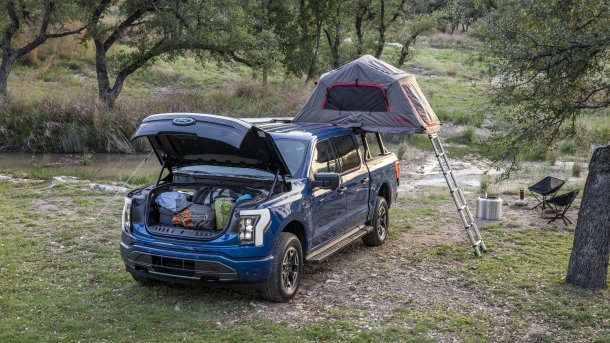
The frunk as storage space is retired. A power generator will be installed there.
(Image: Ford)
Ford is adapting its strategy to the political environment and market demand. The automotive group is withdrawing from the business of large, purely electric vehicles. Ford could not sustain the losses in the long run. The management expects profit from a pickup truck with a series hybrid drive and from a completely new division: large energy storage systems for power grids and data centers.
The last purely electric pickup, the F150 Lightning, has already rolled off the production line. It was not profitable, even though it was the best-selling electric pickup in North America. An electric SUV with three rows of seats, originally planned for 2025, was already announced last year. Instead, two electric vans were supposed to appear, one for North America one for Europe. Both projects are now canceled. There was likely no prospect of profits. In October, General Motors also withdrew its electric van from the market.
The withdrawal comes at a high cost for Ford: 5.5 billion US dollars will be incurred in the next two years. In addition, investments already made in facilities are worthless, resulting in write-downs of 19.5 billion dollars, the majority of which will be in the current quarter.
2030: 50 percent pure internal combustion engines
The new strategy stipulates that by 2030, half of all new Ford vehicles sold will still be pure internal combustion engines. The other half will be made up of internal combustion engines with hybrid add-ons, purely electric cars, or vehicles with series hybrid drives. In these, the wheels are driven electrically, while a – generates electricity more efficiently than a conventional internal combustion engine –. This can be built like Nissan, with a tiny battery that is not worth charging, or with a substantial battery that covers most of the usual journeys, so that the internal combustion engine generator only needs to kick in for longer trips or significant loads.
Ford calls this EREV (Extended Range Electric Vehicle). For this purpose, the group intends to continue using the F150 Lightning name. The new pickup truck, whose details and release date are still open, will drive purely electrically but will have a generator in the frunk that can supply additional electricity on the go. This generator should also be able to supply power to other loads, such as a house or equipment on a construction site.
Videos by heise
As a result, the series hybrid F150 Lightning is expected to be significantly more efficient than the internal combustion engine F150 and, at the same time, be able to tow substantial trailers, even over long distances. The range (without a trailer) is expected to exceed 1,100 kilometers.
This year, 83 percent of all new Fords are still pure internal combustion engines. Ford now plans to develop new pickup trucks and new vans. Customers should have more choice in powertrains, in addition to pure internal combustion engines, parallel hybrids, and EREVs (series hybrids). Ford hopes to return to profitability with this.
No wave of layoffs
Nevertheless, a platform for electric cars is still part of Ford's plans. Its simple name is Universal EV Platform. Based on this, a whole “family of smaller, highly efficient, and affordable electric vehicles” is to be created. The start will be made, of course, by a “fully connected” mid-size pickup truck in 2027. Pickup trucks simply sell well in North America, and through “full connectivity,” Ford also wants to secure ongoing revenue after the vehicle is sold.

The canceled electric van for North America is to be replaced by a new van, optionally hybrid or a classic pure internal combustion engine. However, there is no mention of a replacement for the electric van announced for Europe. In addition, three more new vehicle models are to be introduced by the end of the decade, which are to be “affordable.” Otherwise, Ford provides no further details, except that only one new model will be manufactured outside the USA.
The group is not announcing a wave of layoffs. Employees who have so far been involved in the production of the purely electric F150 Lightning will be seconded to the production of the classic F150. There, they will form a third shift. Following a fire at a metal supplier, Ford has to catch up on production.
In addition, Ford plans to sell large batteries for power grids and data centers. This will be a completely new business segment for the group.
(ds)